Interventions before consultations to help patients address their information needs by encouraging question asking: systematic review
- PMID: 18632672
- PMCID: PMC2500196
- DOI: 10.1136/bmj.a485
Interventions before consultations to help patients address their information needs by encouraging question asking: systematic review
Abstract
Objective: To assess the effects on patients, clinicians, and the healthcare system of interventions before consultations to help patients or their representatives gather information in consultations by question asking.
Design: Systematic review with meta-analysis.
Data sources: Electronic literature searches of seven databases and hand searching of one journal and bibliographies of relevant articles. Review methods Inclusion criteria included randomised controlled trials.
Main outcome measures: Primary outcomes were question asking; patients' anxiety, knowledge, and satisfaction; and length of consultation.
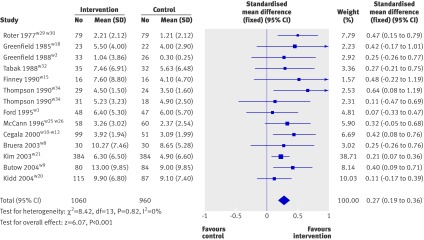
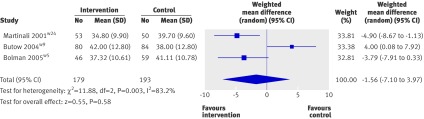
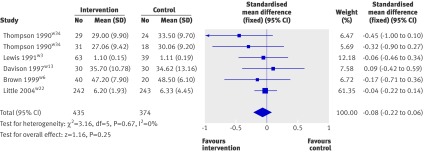
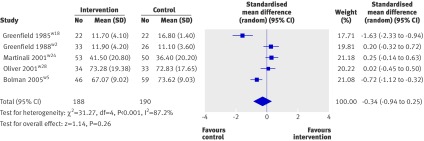
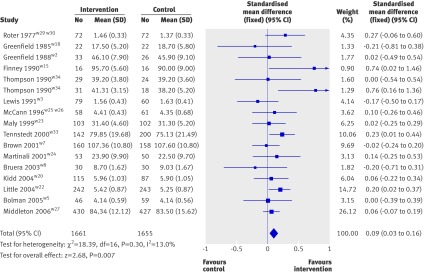
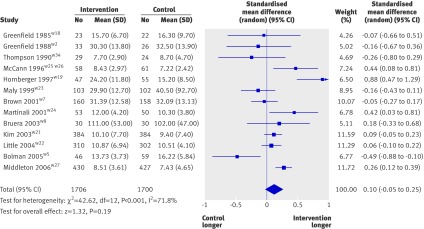
Results: 33 randomised trials of variable quality involving 8244 patients were identified. A few studies showed positive effects. Meta-analyses showed small and statistically significantly increases in question asking (standardised mean difference 0.27, 95% confidence interval 0.19 to 0.36) and patients' satisfaction (0.09, 0.03 to 0.16). Non-statistically significant changes occurred in patients' anxiety before consultations (weighted mean difference -1.56, -7.10 to 3.97), patients' anxiety after consultations (standardised mean difference -0.08, -0.22 to 0.06), patients' knowledge (-0.34, -0.94 to 0.25), and length of consultation (0.10, -0.05 to 0.25). Interventions comprising written materials had similar effects on question asking, consultation length, and patients' satisfaction as those comprising the coaching of patients. Interventions with additional training of clinicians had little further effect than those targeted at patients alone for patients' satisfaction and consultation length.
Conclusions: Interventions for patients before consultations produce small benefits for patients. This may be because patients and clinicians have established behaviours in consultations that are difficult to change. Alternatively small increases in question asking may not be sufficient to make notable changes to other outcomes.
Conflict of interest statement
Competing interests: PK directs a university unit that generates income by delivering training in communication skills to clinicians.
Figures
Comment in
-
Providing information for patients.BMJ. 2008 Jul 16;337:a280. doi: 10.1136/bmj.a280. BMJ. 2008. PMID: 18632671 No abstract available.
References
-
- Boreham P, Gibson D. The informative process in private medical consultations: a preliminary investigation. Soc Sci Med 1978;12(5A):409-16. - PubMed
-
- Boberg EW, Gustafson DH, Hawkins RP, Offord KP, Koch C, Wen KY, et al. Assessing the unmet information, support and care delivery needs of men with prostate cancer. Patient Educ Couns 2003;49:233-42. - PubMed
-
- Svarstad BL. The doctor-patient encounter: an observational study of communication and outcome. Doctoral dissertation. University of Wisconsin, 1974.
-
- Waitzkin H. Doctor-patient communication: clinical implications of social scientific research. JAMA 1984;252:2441-6. - PubMed
Publication types
MeSH terms
LinkOut - more resources
Full Text Sources
Medical