. 2008 Sep 15;586(18):4425-39.
doi: 10.1113/jphysiol.2008.158634. Epub 2008 Jul 17.

Activation of recombinant NR1/NR2C NMDA receptors

Affiliations

Activation of recombinant NR1/NR2C NMDA receptors

Shashank M Dravid et al. J Physiol. .

Abstract

The N-methyl-d-aspartate (NMDA) subtype of ionotropic glutamate receptors comprises both NR1 and NR2 subunits, and plays numerous roles in both physiological and pathophysiological processes in the central nervous system (CNS). NR2C-containing NMDA receptors are most abundant in cerebellum, thalamus and olfactory bulb, and are also expressed in oligodendrocytes and hippocampal interneurons. We have used patch clamp recording to explore the activation properties of recombinant NR1/NR2C receptors expressed in HEK293 cells. NR1/NR2C receptors activated by a maximally effective concentration of glutamate and glycine had two main conductance levels of 45 pS and 28 pS when the extracellular Ca(2+) concentration was 0.5 mm and the holding potential was -80 mV. The occurrence of the lower subconductance state was reduced in the absence of extracellular Ca(2+). The distribution of closed durations recorded from patches with a high probability of containing only one active channel were best fitted by five exponential functions; the apparent open duration histogram could be fitted by two exponential functions (n = 10 patches). The apparent mean open time of NR1/NR2C receptors was brief (0.52 +/- 0.04 ms), suggesting that the stability of the open state of the NR1/NR2C receptors is lower than other NR2-containing receptors. NR1/NR2C open probability was exceptionally low, being 0.011 +/- 0.002 in patches containing a single active receptor (n = 8). Fast agonist concentration jumps were performed on outside out patches with multiple NR1/NR2C channels, which activated with a 10-90% rise time of 3.9 +/- 0.4 ms, faster than other NR2-containing receptors. The deactivation time constant after a brief (5-8 ms) application of a maximally effective concentration of agonists was 319 +/- 34 ms. The majority of the patches also showed a modest level of desensitization that could be described by either a single or a double exponential time course with the fastest time constant between 15 and 47 ms. Conceptual models of activation were fitted using the maximum interval likelihood (MIL) method to the sequence of open and closed durations recorded from outside-out patches that contained one active NR1/NR2C channel. NR1/NR2C receptor properties including modest desensitization and low open probability could be described by gating schemes similar to those previously proposed for other NMDA receptor subunit combinations.


Figures

Figure 1
Figure 1. NR1/2C receptors have at least two conductance levels in the presence of 0.5 mm extracellular Ca2+
A, representative steady state recordings of unitary currents from outside-out patch containing one active channel in the presence of 0.5 mm extracellular Ca2+ in response to maximally effective concentration of glutamate and glycine (1 mm glutamate, 0.5 mm glycine, Vm−80 mV, digitized at 20 kHz, filtered at 5 kHz). Amplitude histogram (right panel) for each opening determined using time course fitting could be fitted by the sum of two Gaussian components. NR1/NR2C receptors exhibit two conductance levels with the chord conductance of 48 pS (72%) and 35 pS (28%). B, representative unitary currents from the same outside-out patch in A recorded in the absence of nominal extracellular Ca2+ with 10 μm EDTA added to the external solution. The conductance of NR1/NR2C receptors is increased under these conditions, and the occurrence of lower subconductance state is reduced. Chord conductance values were 59 pS (95%) and 51 pS (5%).
Figure 2
Figure 2. Determination of the number of active NR1/NR2C channels in a patch
A, the sequence of NR1/NR2C receptor open and closed durations recorded from one patch in which we recorded 20 424 openings with no simultaneous double openings was fitted (MIL). Monte Carlo simulations (50 s duration, 100 kHz) were performed to determine the total number of single openings between two simultaneous double openings in a patch that contained two active channels using this model. The total number of single openings between two double openings was determined for 10 simulations. This was repeated 10 times for each of four different models with open probability altered by changes to the forward C4–O rate. The mean number of consecutive single openings (±s.e.m.) was plotted against two times the open probability (Po2, □). The continuous line shows the relationship between number of consecutive openings and open probability generated using the approximation described by Colquhoun & Hawkes (1990; eqn (1) above) and our measured Po2 value. The three dashed lines indicate upper confidence limits corresponding for P = 0.039, 0.013 and 0.004 calculated as 3.2Er, 4.3Er and 5.4Er, respectively. Experimental data from two patches that showed a limited number of double openings and thus contained at least two active channels are represented by ▪. B, outside-out patch containing two active NR1/2C receptors (Vm=−80 mV, digitized at 20 kHz, filtered at 5 kHz). Arrows indicate two simultaneous openings that occurred in this patch on average after every 276 ± 46 single openings (n = 5).
Figure 3
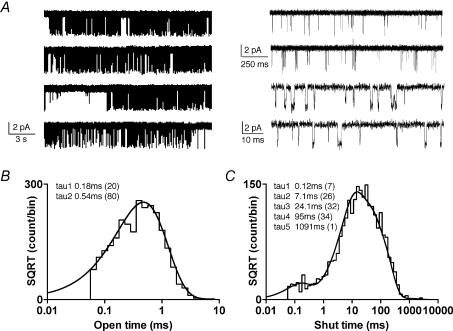
Figure 3. Steady-state NR1/NR2C unitary currents in outside out patches
A, steady-state recordings of NR1/NR2C unitary currents from an outside-out patch that contained one active channel in the presence of maximally effective concentration of glutamate and glycine (1 mm glutamate, 0.5 mm glycine, Vm−80 mV, digitized at 20 kHz, filtered at 2–5 kHz) under three different time scales showing the range of shut time durations. B and C, open (B) and shut (C) duration histogram from a representative patch containing 2647 open and 2646 closed durations fitted with multiple exponential components; single channel currents were analysed using time course fitting (SCAN) and histograms fitted using the maximum likelihood method (EKDIST). The fitted time constants for multicomponent exponential functions are given in the inset with the percentage area for each component in parentheses. The fitted time constants for the pooled data from 10 patches are described in the text.
Figure 4
Figure 4. Lack of correlation between open and closed durations of NR1/NR2C channels in outside-out patches from HEK293 cells
A, the closed duration histogram from a patch with single active channel recorded in the presence of maximally effective concentration of agonist was used to determine critical closed times to separate five fitted shut time components as described in Methods (Jackson et al. 1983). The critical times were 0.44, 12.6, 97, 705 ms. Conditional distributions were constructed from pooled data from four patches for intraburst apparent open durations adjacent to a brief closed durations in the range of 0.05–0.44 ms (continuous black line) or adjacent to longer duration closed times in the range of 97–705 ms (continuous grey line). The distributions and respective fitted exponential components for openings adjacent to brief closures were scaled to contain the same number of open periods as distributions for apparent open times adjacent to long closed times. The time constants for exponential fits to open periods were 0.18 ms (27%) and 0.52 ms (73%) for opening adjacent to brief closed durations and 0.15 ms (22%) and 0.45 ms (78%) for openings adjacent to long closed durations. B, the mean of the conditional apparent intraburst open durations either preceding (▪) or following (□) the specified shut time range are pooled from 10 patches and plotted against the fitted time constants describing the closed time distribution (Fig. 3). The closed duration ranges were (in ms) 0.05–0.44, 0.44–12.6, 12.6–97, 97–705 and 705–10 000. The dashed line in grey indicates the average of the mean open times from 10 patches (0.52 ms).
Figure 5
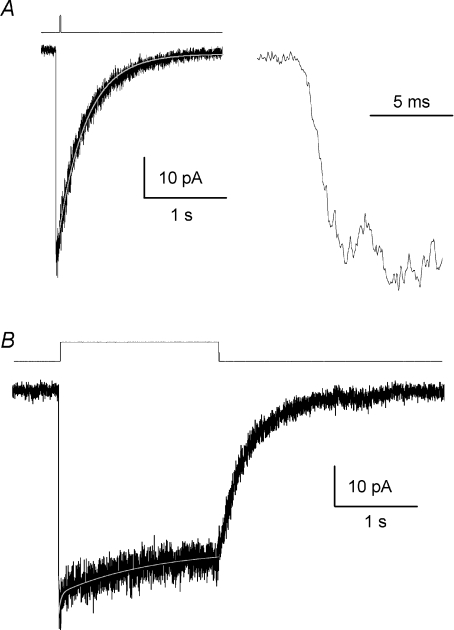
Figure 5. Macroscopic NR1/NR2C currents from outside-out patches
A, the average response time course is shown for NR1/NR2C channels in outside-out patches exposed to fast agonist concentration jumps of 5 ms duration (1 mm glutamate, 0.5 mm glycine present in all solutions); the trace is the average of three independent patches. The decay time constant for the macroscopic current response waveform was 306 ms. As depicted in the inset, NR1/NR2C receptors exhibit fast activation with a 10–90% rise time constant of 4.6 ms. B, the average current waveform in response to rapid agonist application of 2 s duration is shown. The desensitization is fitted to the sum of two exponentials with time constants of 26 ms and 1113 ms
Figure 6
Figure 6. Conceptual models of NR1/2C receptor activation
Three previously described gating schemes for NMDA receptors were fitted to single channel data to evaluate gating properties of NR1/NR2C receptors. Scheme 1 has been previously described by Popescu et al. (2004) for activation of NR1/NR2A receptors. Scheme 1a is the extension of Scheme 1 to include the agonist binding steps. Scheme 2 is similar to the gating mechanisms previously described for NR1/NR2A and NR1/NR2B receptors (Erreger et al. 2005a, b). Scheme 3 is a modification of Scheme 2 to include an extra closed state and has been used to describe NR1/NR2A receptor function (Auerbach & Zhou, 2005; Schorge et al. 2005). The rate constants obtained from MIL fitting and least squares fitting of models to single channel data and macroscopic waveforms are provided in Table 1 and Table 2.
Figure 7
Figure 7. Scheme 3a can describe both single channel and macroscopic data
A, MIL fit of single channel data with Scheme 3 is shown. The representative recording from one patch contained a total of 4765 closed and shut durations, an open probability of 0.008, and a apparent mean open time of 0.41 ms (imposed resolution of 50 μs). B, the results of macroscopic fitting of Scheme 3a to the data are shown. Three agonist application protocols were used to generate NR1/NR2C response waveforms in each patch: 1 mm glutamate for 2 s (HL), 1 mm glutamate for 5 ms (HS) and 5 μm glutamate for 2 s (LL), with 0.5 mm glycine always present in the bath. Averaged traces (n = 3) for each protocol were simultaneously fitted by Scheme 3a. The peak for 1 mm glutamate protocols was scaled to an open probability of 0.011. The EC50 of glutamate in outside-out patches was 4.2 ± 1.2 μm (n = 5). The agonist binding rates and the rates for the two desensitized states were allowed to vary during fitting, while all other rates in the gating scheme were fixed to the rate constants derived from the maximum interval likelihood fit of the single channel data by Scheme 3. Least squares fitting was used to fit the macroscopic currents (see Methods).
Figure 8
Figure 8. Conceptual model to describe the fast rise time of NR1/NR2C receptors
A, the ability of a gating scheme similar to that described for NR1/NR2A receptors (Auerbach & Zhou, 2005) to account for fast rise time of the NR1/NR2C receptors was examined. Scheme 4 and Scheme 4a adequately described the single channel and macroscopic data, respectively. The rate constants are described in Table 1 and Table 2. B, least square fitting of Scheme 2a, Scheme 3a and Scheme 4a to the rising phase of NR1/NR2C current responses evoked by 1 mm glutamate for 5 ms in outside-out patches is shown. Similar to macroscopic fitting in Fig. 7, only the desensitization and agonist binding rates were free parameters. Scheme 4a describes a relatively faster rise time compared to Scheme 3a.

References

    1. Auerbach A, Zhou Y. Gating reaction mechanisms for NMDA receptor channels. J Neurosci. 2005;25:7914–7923. - PMC - PubMed
    1. Banke TG, Traynelis SF. Activation of NR1/NR2B NMDA receptors. Nat Neurosci. 2003;6:144–152. - PubMed
    1. Beato M, Groot-Kormelink PJ, Colquhoun D, Sivilotti LG. Openings of the rat recombinant a1 homomeric glycine receptor as a function of the number of agonist molecules bound. J Gen Physiol. 2002;119:443–466. - PMC - PubMed
    1. Beato M, Groot-Kormelink PJ, Colquhoun D, Sivilotti LG. The activation mechanism of a1 homomeric glycine receptors. J Neurosci. 2004;24:895–906. - PMC - PubMed
    1. Binshtok AM, Fleidervish IA, Sprengel R, Gutnick MJ. NMDA receptors in layer 4 spiny stellate cells of the mouse barrel cortex contain the NR2C subunit. J Neurosci. 2006;26:708–715. - PMC - PubMed

Publication types

LinkOut - more resources