


Genome-wide expression patterns and the genetic architecture of a fundamental social trait
- PMID: 18636101
- PMCID: PMC2442221
- DOI: 10.1371/journal.pgen.1000127
Genome-wide expression patterns and the genetic architecture of a fundamental social trait
Abstract
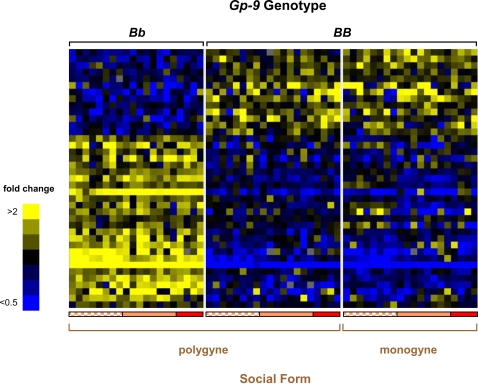
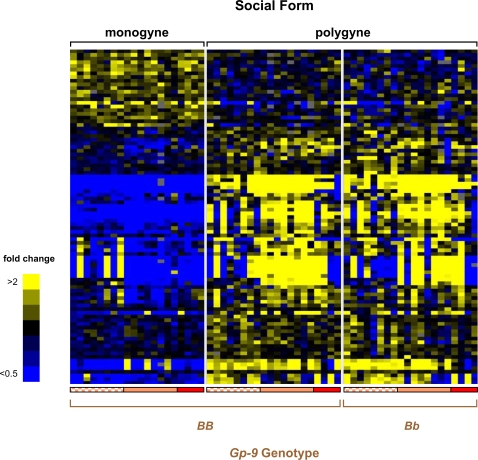
Explaining how interactions between genes and the environment influence social behavior is a fundamental research goal, yet there is limited relevant information for species exhibiting natural variation in social organization. The fire ant Solenopsis invicta is characterized by a remarkable form of social polymorphism, with the presence of one or several queens per colony and the expression of other phenotypic and behavioral differences being completely associated with allelic variation at a single Mendelian factor marked by the gene Gp-9. Microarray analyses of adult workers revealed that differences in the Gp-9 genotype are associated with the differential expression of an unexpectedly small number of genes, many of which have predicted functions, implying a role in chemical communication relevant to the regulation of colony queen number. Even more surprisingly, worker gene expression profiles are more strongly influenced by indirect effects associated with the Gp-9 genotypic composition within their colony than by the direct effect of their own Gp-9 genotype. This constitutes an unusual example of an "extended phenotype" and suggests a complex genetic architecture with a single Mendelian factor, directly and indirectly influencing the individual behaviors that, in aggregate, produce an emergent colony-level phenotype.
Conflict of interest statement
The authors have declared that no competing interests exist.
Figures
References
-
- Hansen TF. The evolution of genetic architecture. Annu Rev Ecol Evol Syst. 2006;37:123–157.
-
- Greenspan RJ. E pluribus unum, ex uno plura: quantitative and single-gene perspectives on the study of behavior. Annu Rev Neurosci. 2004;27:79–105. - PubMed
-
- Orr HA. The genetic theory of adaptation: a brief history. Nat Rev Genet. 2005;6:119–127. - PubMed
-
- Orr HA, Coyne JA. The genetics of adaptation - a reassessment. Am Nat. 1992;140:725–742. - PubMed
-
- Sokolowski MB. Drosophila: genetics meets behaviour. Nat Rev Genet. 2001;2:879–890. - PubMed
Publication types
MeSH terms
Substances
LinkOut - more resources
Full Text Sources
Other Literature Sources
Molecular Biology Databases
