


Common genetic influences underlie comorbidity of migraine and endometriosis
- PMID: 18636479
- PMCID: PMC2730957
- DOI: 10.1002/gepi.20361
Common genetic influences underlie comorbidity of migraine and endometriosis
Abstract
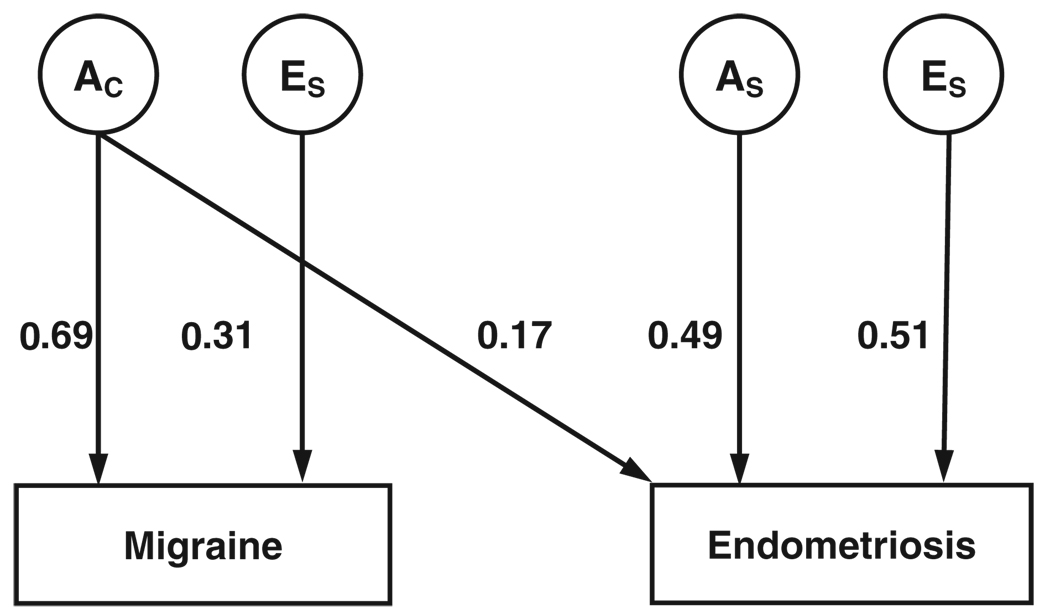
We examined the co-occurrence of migraine and endometriosis within the largest known collection of families containing multiple women with surgically confirmed endometriosis and in an independent sample of 815 monozygotic and 457 dizygotic female twin pairs. Within the endometriosis families, a significantly increased risk of migrainous headache was observed in women with endometriosis compared to women without endometriosis (odds ratio [OR] 1.57, 95% confidence interval [CI]: 1.12-2.21, P=0.009). Bivariate heritability analyses indicated no evidence for common environmental factors influencing either migraine or endometriosis but significant genetic components for both traits, with heritability estimates of 69 and 49%, respectively. Importantly, a significant additive genetic correlation (r(G) = 0.27, 95% CI: 0.06-0.47) and bivariate heritability (h(2)=0.17, 95% CI: 0.08-0.27) was observed between migraine and endometriosis. Controlling for the personality trait neuroticism made little impact on this association. These results confirm the previously reported comorbidity between migraine and endometriosis and indicate common genetic influences completely explain their co-occurrence within individuals. Given pharmacological treatments for endometriosis typically target hormonal pathways and a number of findings provide support for a relationship between hormonal variations and migraine, hormone-related genes and pathways are highly plausible candidates for both migraine and endometriosis. Therefore, taking into account the status of both migraine and endometriosis may provide a novel opportunity to identify the genes underlying them. Finally, we propose that the analysis of such genetically correlated comorbid traits can increase power to detect genetic risk loci through the use of more specific, homogenous and heritable phenotypes.
Figures
References
-
- Berkley KJ, Rapkin AJ, Papka RE. The pains of endometriosis. Science. 2005;308:1587–1589. - PubMed
-
- Birley AJ, Gillespie NA, Heath AC, Sullivan PF, Boomsma DI, Martin NG. Heritability and nineteen-year stability of long and short EPQ-R Neuroticism scales. Pers Individ Dif. 2006;40:737–748.
-
- Callaghan N. The migraine syndrome in pregnancy. Neurology. 1968;18:197–199. - PubMed
-
- Colson NJ, Lea RA, Quinlan S, MacMillan J, Griffiths LR. The estrogen receptor 1 G594A polymorphism is associated with migraine susceptibility in two independent case/control groups. Neurogenetics. 2004;5:129–133. - PubMed
Publication types
MeSH terms
Grants and funding
LinkOut - more resources
Full Text Sources
Medical
