


Clinical evidence continuous medical education: a randomised educational trial of an open access e-learning program for transferring evidence-based information - ICEKUBE (Italian Clinical Evidence Knowledge Utilization Behaviour Evaluation) - study protocol
- PMID: 18637189
- PMCID: PMC2494552
- DOI: 10.1186/1748-5908-3-37
Clinical evidence continuous medical education: a randomised educational trial of an open access e-learning program for transferring evidence-based information - ICEKUBE (Italian Clinical Evidence Knowledge Utilization Behaviour Evaluation) - study protocol
Abstract
Background: In an effort to ensure that all physicians have access to valid and reliable evidence on drug effectiveness, the Italian Drug Agency sponsored a free-access e-learning system, based on Clinical Evidence, called ECCE. Doctors have access to an electronic version and related clinical vignettes. Correct answers to the interactive vignettes provide Continuing Medical Education credits. The aims of this trial are to establish whether the e-learning program (ECCE) increases physicians' basic knowledge about common clinical scenarios, and whether ECCE is superior to the passive diffusion of information through the printed version of Clinical Evidence.
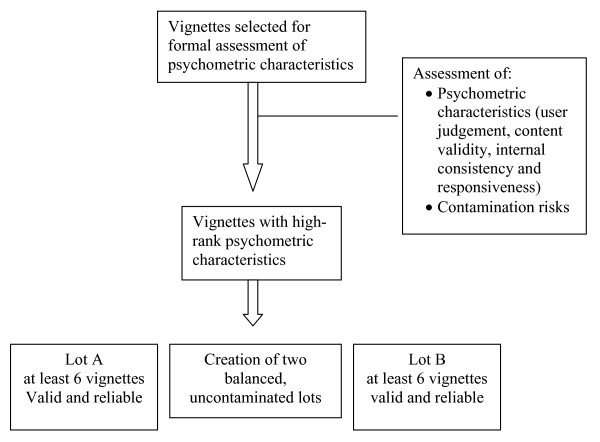
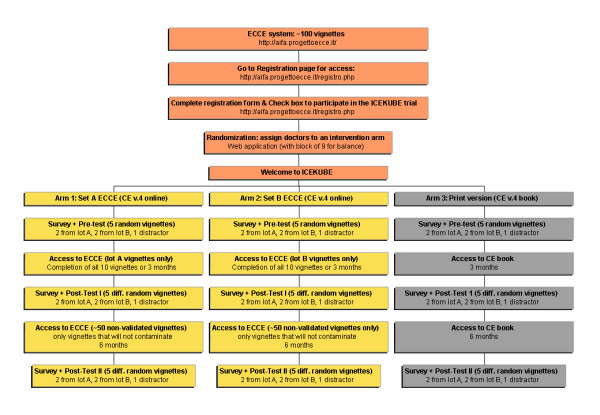
Design: All Italian doctors naïve to ECCE will be randomised to three groups. Group one will have access to ECCE for Clinical Evidence chapters and vignettes lot A and will provide control data for Clinical Evidence chapters and vignettes lot B; group two vice versa; group three will receive the concise printed version of Clinical Evidence. There are in fact two designs: a before and after pragmatic trial utilising a two by two incomplete block design (group one versus group two) and a classical design (group one and two versus group three). The primary outcome will be the retention of Clinical Evidence contents assessed from the scores for clinical vignettes selected from ECCE at least six months after the intervention. To avoid test-retest effects, we will randomly select vignettes out of lot A and lot B, avoiding repetitions. In order to preserve the comparability of lots, we will select vignettes with similar, optimal psychometric characteristics.
Figures
References
-
- Ministero della Salute. Il programma nazionale di Educazione Continua in Medicina. Roma. 2007. http://ecm.sanita.it/presentazione/programma.htm (Accessed 5 March 2007).
-
- Linetti M. Il programma ECM: risultati raggiunti e risultati attesi. Monitor. 2005. p. 14.
