. 2008 Sep;159(4):780-91.
doi: 10.1111/j.1365-2133.2008.08748.x. Epub 2008 Jul 14.

Analyses of volatile organic compounds from human skin

Affiliations

Analyses of volatile organic compounds from human skin

M Gallagher et al. Br J Dermatol. 2008 Sep.

Abstract

Background: Human skin emits a variety of volatile metabolites, many of them odorous. Much previous work has focused upon chemical structure and biogenesis of metabolites produced in the axillae (underarms), which are a primary source of human body odour. Nonaxillary skin also harbours volatile metabolites, possibly with different biological origins than axillary odorants.

Objectives: To take inventory of the volatile organic compounds (VOCs) from the upper back and forearm skin, and assess their relative quantitative variation across 25 healthy subjects.

Methods: Two complementary sampling techniques were used to obtain comprehensive VOC profiles, viz., solid-phase microextraction and solvent extraction. Analyses were performed using both gas chromatography/mass spectrometry and gas chromatography with flame photometric detection.

Results: Nearly 100 compounds were identified, some of which varied with age. The VOC profiles of the upper back and forearm within a subject were, for the most part, similar, although there were notable differences.

Conclusions: The natural variation in nonaxillary skin odorants described in this study provides a baseline of compounds we have identified from both endogenous and exogenous sources. Although complex, the profiles of volatile constituents suggest that the two body locations share a considerable number of compounds, but both quantitative and qualitative differences are present. In addition, quantitative changes due to ageing are also present. These data may provide future investigators of skin VOCs with a baseline against which any abnormalities can be viewed in searching for biomarkers of skin diseases.


Figures
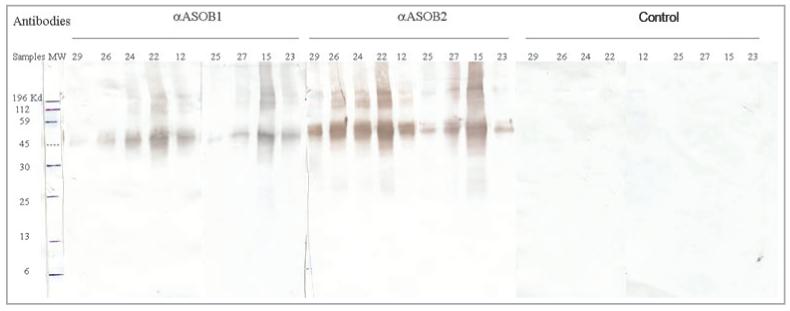
Fig 1
Fig 1
Immunoreactivity to apocrine secretion odour-binding protein (ASOB) 1 and ASOB2 from human sweat secretion containing 4 μg each of protein collected from the back of each subject. Pooled samples belonging to nine different ethnic/age group categories were separated by 12% sodium dodecyl sulphate-polyacrylamide gel electrophoresis and Western blotted. Proteins were developed using either immunopurified antibodies to ASOB1, ASOB2 or control (normal guinea pig antibody). Samples were coded as 29 (old Caucasian males), 26 (young Caucasian males), 24 (old Caucasian females), 22 (young Caucasian females), 12 (young Asian males), 25 (young Asian female), 27 (old African American males), 15 (young African American male) and 23 (young Hispanic female). The definition of ‘young’ or ‘old’ was as follows: young, 19-40 years; old, 41-79 years. Not all age and ethnic categories were available for testing.
Fig 2
Fig 2
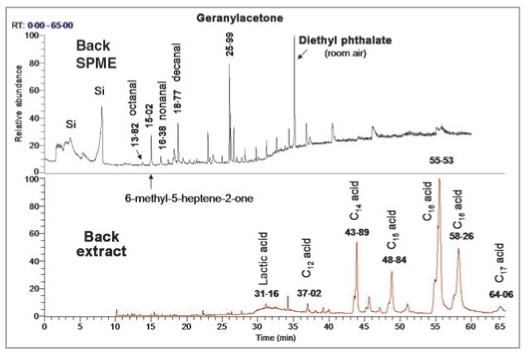
Total ion chromatograms (TICs) from back solid-phase microextraction (SPME) (top) and solvent extract analysis (bottom) for a 19-year-old Caucasian male. Compounds in bold represent exogenous volatiles. Compounds labelled Si represent silicon containments (from SPME fibres or septa). The SPME-collected volatiles elute earlier in the chromatogram, whereas the compounds collected via solvent extraction are less volatile and elute later. Overlapping compounds are seen in the area between 15 and 37 min, but are not readily visible in the normalized TIC.
Fig 3
Fig 3
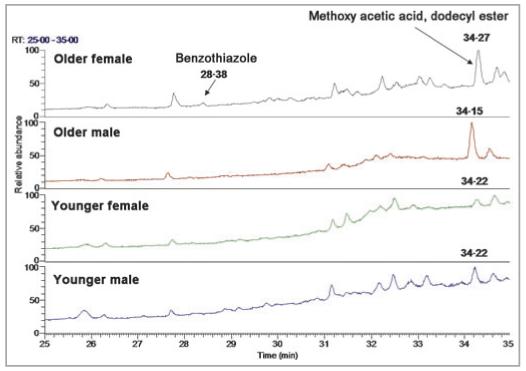
Comparison of total ion chromatograms from pooled back extracts. The portion of the chromatograms that is shown (25-35 min) highlights the area where the major differences were observed in the pooled samples.
Fig 4
Fig 4
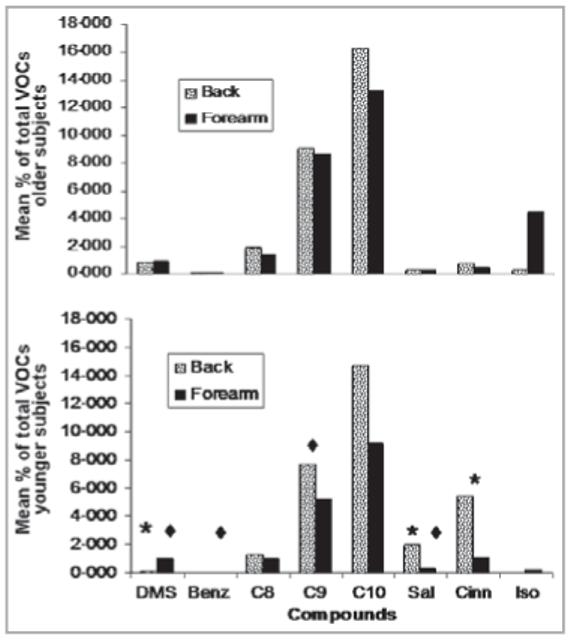
Mean percentages of selected compounds present in the back and forearm samples of younger (bottom graph) and older (top graph) subjects collected by solid-phase microextraction. The compounds in the top graph are the same as those listed along the x-axis of the bottom graph: DMS, dimethylsulphone; Benz, benzothiazole; C8, octanal; C9, nonanal; C10, decanal; Sal, hexyl salicylate; Cinn, α-hexyl cinnamaldehyde; Iso, isopropyl palmitate. *, compound in which locus was significant; ◆, compound for which age was significant.
Fig 5
Fig 5
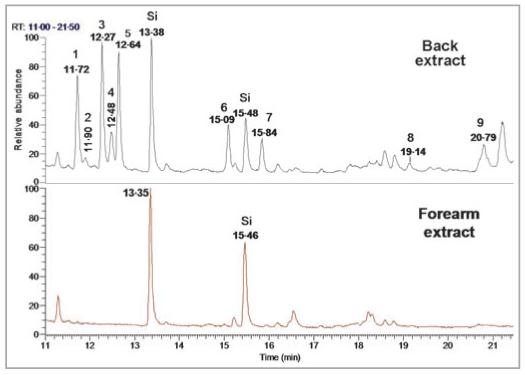
Comparison of total ion chromatograms from back (top) and forearm (bottom) solvent extracts from a 40-year-old Asian woman. The portion of the chromatograms that is shown (11-21 min) highlights the area where the major differences were observed in the samples. The compounds are coded as follows: 1, 3-hexanol; 2, 2-methyl-cyclopentanone; 3, 2-hexanol; 4, 3-methyl-cyclopentanone; 5, 1-methyl-cyclopentanol; 6, 3-methyl-cyclopentanol; 7, 1,6-heptadien-4-ol; 8, 2,5-hexanedione; 9, 6-hydroxy-hexan-2-one. Compounds labelled Si represent silicon containments (from solid-phase microextraction fibres or septa).

References

    1. Farabee MJ. The integumentary system. In: Farabee MJ, editor. The On-Line Biology Book. 9th edn. Estrella Mountain Community College; Avondale, AZ: 2007. pp. 1–3.
    1. Labows JN, McGinley KJ, Kligman AM. Perspectives on axillary odor. J Soc Cosmet Chem. 1982;34:193–202.
    1. Nicolaides N. Skin lipids: their biochemical uniqueness. Science. 1974;186:19–26. - PubMed
    1. Sato K, Kane N, Soos G, Sato F. The eccrine sweat gland; basic science and disorder of eccrine sweating. In: Moshell AN, editor. Progress in Dermatology. Dermatology Foundation; Evanston, IL: 1995. pp. 1–11.
    1. Wysocki CJ, Preti G. Facts, fallacies, fears, and frustrations with human pheromones. Anat Rec. 2004;281A:1201–11. - PubMed

Publication types