. 2008 Sep 1;76(5):589-96.
doi: 10.1016/j.bcp.2008.06.012. Epub 2008 Jul 2.

Honokiol is a potent scavenger of superoxide and peroxyl radicals

Affiliations

Honokiol is a potent scavenger of superoxide and peroxyl radicals

Sergey Dikalov et al. Biochem Pharmacol. .

Abstract

Honokiol, a compound extracted from Magnolia officinalis, has antitumor and antiangiogenic properties in several tumor models in vivo. Among the downstream pathways inhibited by honokiol is nuclear factor kappa beta (NFkappabeta). A prime physiologic stimulus of NFkappabeta is reactive oxygen species. The chemical structure of honokiol suggests that it may be an effective scavenger of reactive oxygen species. In this work, we have studied the reactions of honokiol with superoxide and peroxyl radicals in cell-free and cellular systems using electron spin resonance (ESR) and high-performance liquid chromatography (HPLC) techniques. Honokiol efficiently scavenged superoxide radicals in xanthine oxidase and cytochrome P-450 cell-free systems with the rate constant 3.2x10(5)M(-1)s(-1), which is similar to reactivity of ascorbic acid but 20-times higher than reactivity of vitamin E analog trolox. Honokiol potently scavenged intracellular superoxide within melanoma cells. In addition, honokiol scavenged peroxyl radicals generated by 2,2'-azo-bis(2-amidinopropane hydrochloride) (AAPH). The rate constant of the reaction of honokiol with peroxyl radicals (1.4x10(6)M(-1)s(-1)) was calculated from the competition with spin trap 5-(ethoxycarbonyl)-5-methyl-1-pyrroline N-oxide (EMPO), and was found close to reactivity of trolox (2.5x10(6)M(-1)s(-1)). Therefore, honokiol is an effective scavenger of both superoxide and peroxyl radicals, which may be important for physiological activity of honokiol.


Figures
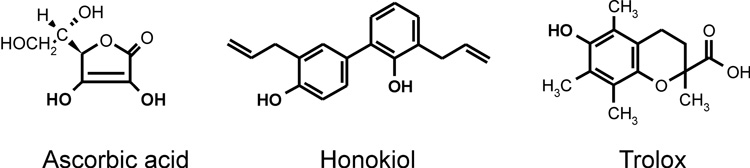
Figure 1
Figure 1
Chemical structures of ascorbic acid, honokiol and trolox (vitamin E analog).
Figure 2
Figure 2
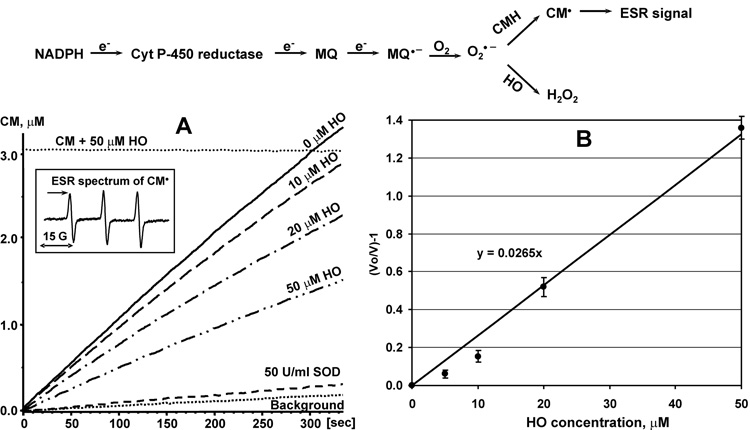
Measurement of the rate constant of superoxide reaction with honokiol by competition with spin probe CMH (1mM) in cytochrome P-450 reductase system (10 µM menadione, 0.1mM NADPH, 1µU cytochrome P-450 reductase). (A) Accumulation of CM-nitroxide in superoxide generating system in the presence of various concentrations of honokiol. CM accumulation was followed by an increase in intensity of low field component of ESR spectrum indicated by arrow (insert). (B) Inhibition of CM accumulation by honokiol. ESR settings were as described in Materials and Methods.
Figure 3
Figure 3
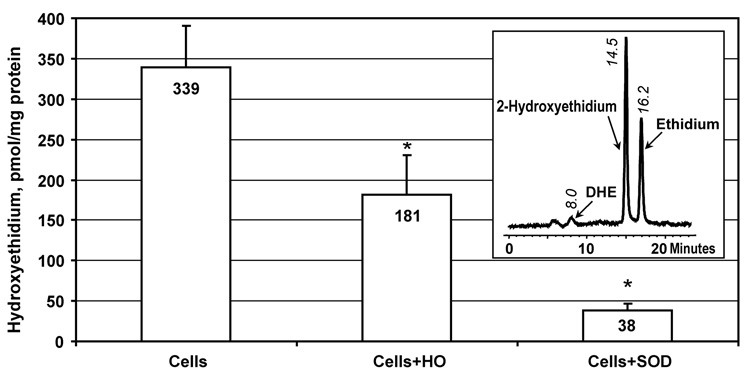
Detection of intracellular superoxide using dihydroethidium and HPLC in WM35pKB cells following 20-hour treatment with 10 µM honokiol or cell-permeable PEG-SOD (25 U/mL). Insert shows typical HPLC tracing of WM35pKB cells incubated with 10 µM DHE.
Figure 4
Figure 4
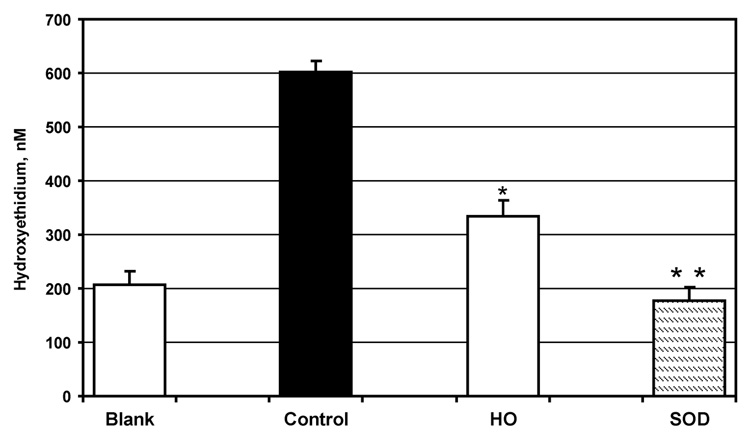
Scavenging of superoxide by honokiol (10 µM) measured by dihydroethidium and HPLC in xanthine (50 µM) plus xanthine oxidase (1 mU/ml) superoxide generating cell-free system.
Figure 5
Figure 5
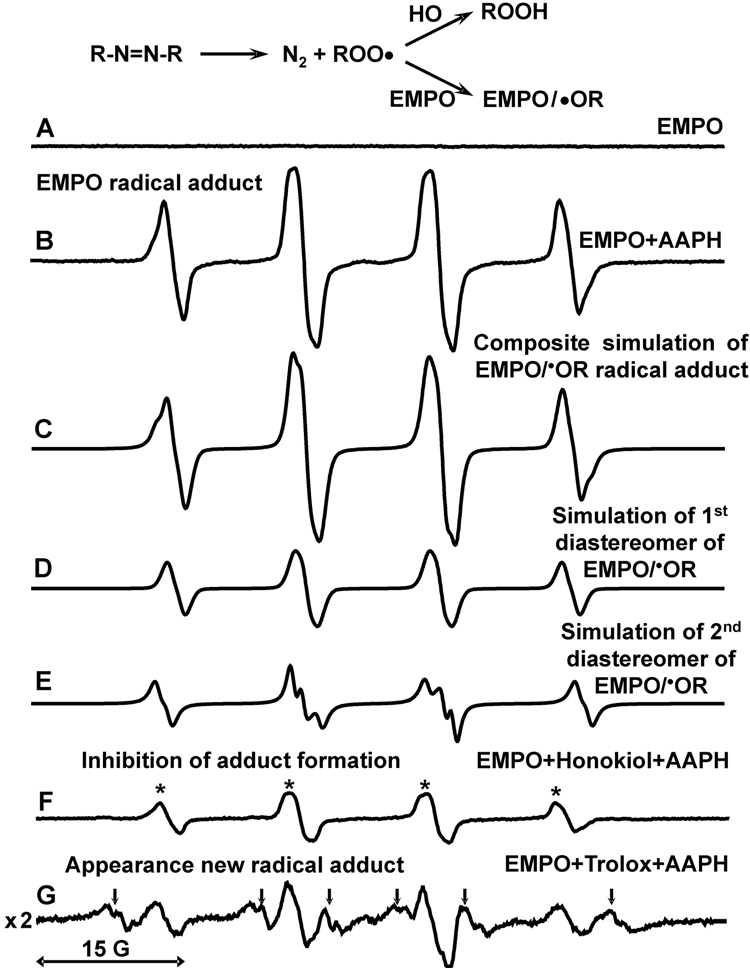
Scavenging of peroxyl radicals by honokiol. (A) ESR specrum of 60 mM EMPO; (B) specrum of EMPO plus 10 mM AAPH; (C) Composite computer simulation of (B); (D) First component of composite simulation with hyperfine coupling constants aN =13.6 G, aHβ=12.7 G, aHγ=0.9 G; (E) Second component of composite simulation with hyperfine coupling constants aN =13.6 G, aHβ=15.2 G, aHγ=0.9 G; (F) Addition of honokiol (0.2 mM) inhibited formation of the EMPO radical adduct due to scavenging of AAPH derived peroxyl radical by honokiol. (G) Addition of trolox (0.2mM) led to 6-fold decrease of EMPO/OR amplitude and appearance of new two trolox derived carbon-centered radical adducts indicated by arrows (hyperfine coupling constants aN =14.6 G, aHβ=23.1 G and aN =14.5 G, aHβ=20.6 G). ESR settings were as described in Materials and Methods.
Figure 6
Figure 6
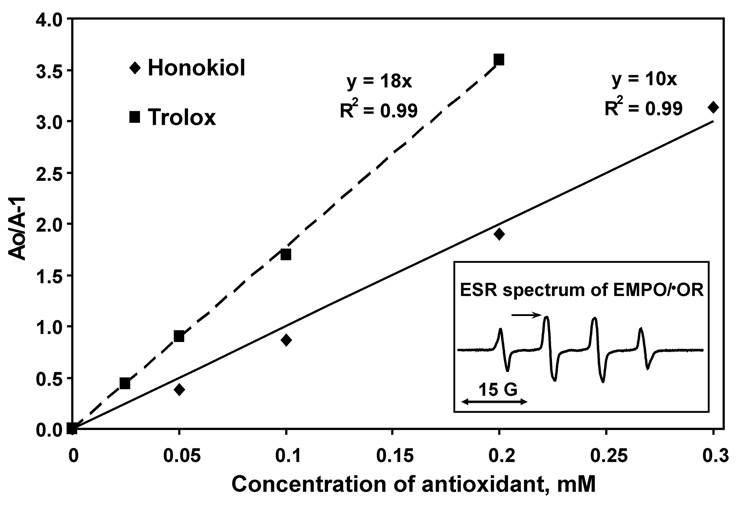
Calculation of the rate constant of peroxyl radical reaction with honokiol determined by competition with spin trap EMPO and comparison with vitamin E analog trolox. Insert shows typical ESR spectrum of EMPO/OR in the presence of 60 mM EMPO and 10 mM AAPH. Accumulation of EMPO/OR was followed by an increase in intensity of low field component of ESR spectrum indicated by arrow (insert). Ao is ESR amplitude of EMPO/OR radical adduct in the absence of antioxidants, A is ESR amplitude of EMPO/OR radical adduct in the presence of antioxidants. The slope of linear regression is equal to the ratio of the rate constants of scavenging reactions of antioxidants to the one of spin trap EMPO. The rate constant of trolox was previously determined as 2.5×10⁶ M−1s−1. Thus, honokiol rate constant with peroxyl radicals is 1.4×10⁶ M−1s−1.

References

    1. Bai X, Cerimele F, Ushio-Fukai M, Waqas M, Campbell PM, Govindarajan B, Der CJ, Battle T, Frank DA, Ye K, Murad E, Dubiel W, Soff G, Arbiser JL. Honokiol, a small molecular weight natural product, inhibits angiogenesis in vitro and tumor growth in vivo. J Biol Chem. 2003;278:35501–35507. - PubMed
    1. Ishitsuka K, Hideshima T, Hamasaki M, Raje N, Kumar S, Hideshima H, Shiraishi N, Yasui H, Roccaro AM, Richardson P, Podar K, Le Gouill S, Chauhan D, Tamura K, Arbiser J, Anderson KC. Honokiol overcomes conventional drug resistance in human multiple myeloma by induction of caspase-dependent and -independent apoptosis. Blood. 2005;106:1794–1800. - PMC - PubMed
    1. Battle TE, Arbiser J, Frank DA. The natural product honokiol induces caspase-dependent apoptosis in B-cell chronic lymphocytic leukemia (B-CLL) cells. Blood. 2005;106:690–697. - PubMed
    1. Chawla-Sarkar M, Bauer JA, Lupica JA, Morrison BH, Tang Z, Oates RK, Almasan A, DiDonato JA, Borden EC, Lindner DJ. Suppression of NF-kappa B survival signaling by nitrosylcobalamin sensitizes neoplasms to the anti-tumor effects of Apo2L/TRAIL. J Biol Chem. 2003;278:39461–39469. - PMC - PubMed
    1. Oberley LW, Buettner GR. Role of superoxide dismutase in cancer: a review. Cancer Res. 1979;39:1141–1149. - PubMed

Publication types