. 2008 Nov;155(5):673-80.
doi: 10.1038/bjp.2008.296. Epub 2008 Jul 21.

Biosynthesis of H2S is impaired in non-obese diabetic (NOD) mice

Affiliations

Biosynthesis of H2S is impaired in non-obese diabetic (NOD) mice

V Brancaleone et al. Br J Pharmacol. 2008 Nov.

Abstract

Background and purpose: Hydrogen sulphide (H2S) has been involved in cardiovascular homoeostasis but data about its role in animal models of diabetic pathology are still lacking. Here, we have analysed H2S signalling in a genetic model of diabetes, the non-obese diabetic (NOD) mice.

Experimental approach: NOD mice exhibit a progressive endothelial dysfunction characterized by a reduced reactivity of blood vessels as diabetes develops. NOD mice were divided into three groups according to different glycosuria values: NOD I, NOD II and NOD III. Age-matched non-obese resistant (NOR) mice were used as controls. H(2)S levels in plasma and aortic tissue were measured. Functional studies in aorta were carried out in isolated organ baths using both an exogenous source of H2S (NaHS) and the metabolic precursor (L-cysteine). Real time PCR and western blot analysis were also carried out on aortic tissues.

Key results: NOD mice exhibited a progressive reduction of H2S plasma levels, which paralleled disease severity. L-cysteine-induced H2S production by aortic tissues was also progressively reduced. L-cysteine-induced vasorelaxation was significantly reduced in NOD mice while NaHS-induced relaxation was unaffected. ODQ (guanylate cyclase inhibitor), L-NAME (NO synthase inhibitor) or PAG, an inhibitor of cystathionine-gamma-lyase (CSE) inhibited H2S production induced by L-cysteine.

Conclusions and implications: In NOD mice, endogenous H2S production is significantly impaired. Also, the ability of isolated aorta to respond to exogenous H2S is enhanced and endothelium-derived NO appears to be involved in the enzymatic conversion of L-cysteine into H2S.


Figures
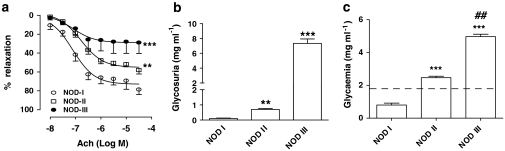
Figure 1
Figure 1
(a) ACh-induced vasorelaxation was progressively reduced in NOD mice (**P<0.01 vs NOD I; ***P<0.001 vs NOD I; two-way ANOVA). (b) Glycosuria was progressively increased in NOD mice. (c) Increase in blood glucose levels was related to glycosuria (glycosuria: NOD I: 0 mg mL−1; NOD II: ∼0.8 mg mL−1; NOD III: ∼8 mg mL−1; blood glucose: NOD I: ∼0.9 mg mL−1; NOD II: ∼2.5 mg mL−1; NOD III: ∼5 mg mL−1) (**P<0.01 vs NOD I; ***P<0.001 vs NOD I; ##P<0.01 vs NOD II; one-way ANOVA). Discontinuous line indicates physiological value of blood glucose. NOD, non-obese diabetic.
Figure 2
Figure 2
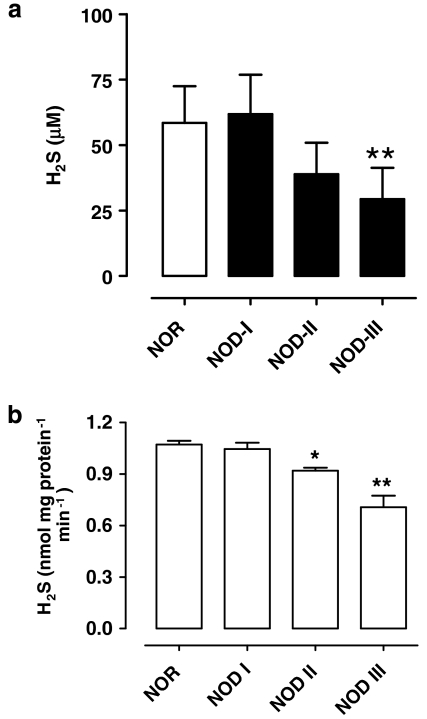
(a) Plasma levels of H2S gradually decrease in NOD mice (**P<0.01 vs NOR; one-way ANOVA). (b) L-cysteine-stimulated H2S production in aortic tissues was significantly reduced in NOD II or NOD III mice (*P<0.05 and **P<0.01 vs NOR; one-way ANOVA). Basal values were unchanged (data not shown). NOD, non-obese diabetic.
Figure 3
Figure 3
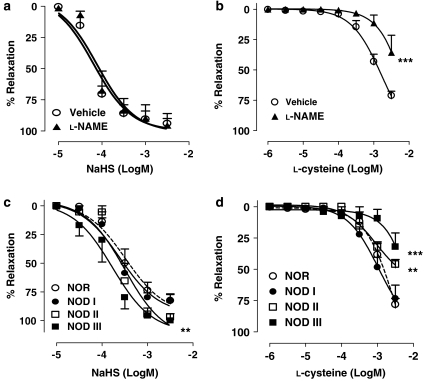
(a) NaHS vasorelaxant effect was not modified by L-NAME (100 μM) in NOR mice. (b) L-NAME (100 μM) pretreatment affected L-cysteine vasorelaxation in NOR mice (***P<0.001 vs vehicle; two-way ANOVA). (c) NaHS-induced vasorelaxation was not significantly affected in NOD I or NOD II mice, but enhanced in NOD III mice (dashed line: NOR mice) (P<0.01 vs NOR). (d) L-cysteine-induced vasodilatation was impaired in NOD mice and paralleled the disease development (dashed lines: NOR mice) (**P<0.01 vs NOR; ***P<0.001 vs NOR; two-way ANOVA). L-NAME, Nω-nitro-L-arginine methyl ester; NOD, non-obese diabetic.
Figure 4
Figure 4
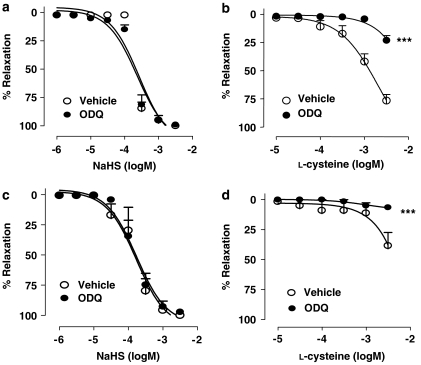
ODQ (5 μM) does not affect NaHS-induced vasorelaxation either in (a) NOR or in (c) NOD III mice (ns, n=5). Conversely, in (b), ODQ (5 μM) significantly inhibits L-cysteine-induced vasorelaxant response in NOR mice (***P<0.001 vs vehicle, n=5; two-way ANOVA). (d) ODQ (5 μM) abolished L-cysteine-induced vasorelaxant response, already reduced in NOD III mice (d) (***P<0.001 vs vehicle, n=5; two-way ANOVA). NOD, non-obese diabetic; ODQ, 1H-[1,2,4]oxadiazolo[4,3-a]quinoxalin-1-one.
Figure 5
Figure 5
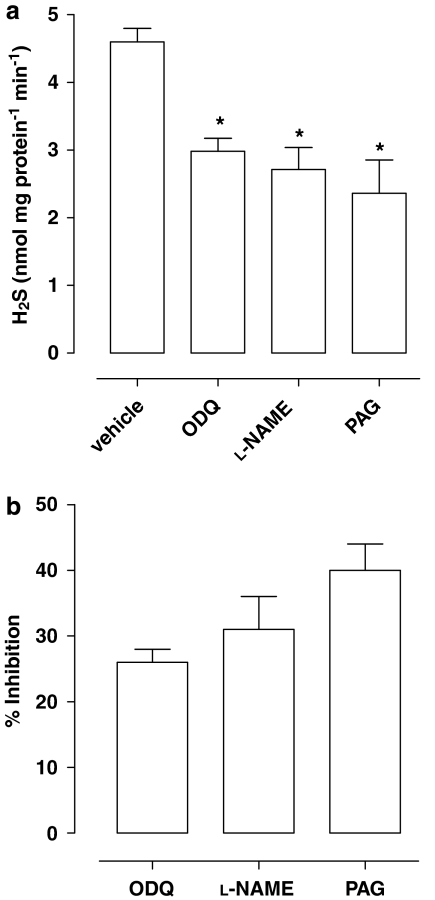
(a) Addition of exogenous L-cysteine (3 mM) to aortic tissues increased production of H2S by 40% (139±10 nmol per mg tissue), an effect that is lost when aortic tissues were pretreated with ODQ (5 μM) or L-NAME (100 μM). PAG (10 mM), an inhibitor of CSE, was used as positive control (*P<0.05 vs L-cysteine; one-way ANOVA, n=3). In (b), the data from (a) are expressed as % inhibition of L-cysteine-derived H2S production. The inhibitors used were without effect on basal H2S release (data not shown). CSE, cystathionine-γ-lyase; L-NAME, Nω-nitro-L-arginine methyl ester; ODQ, 1H-[1,2,4]oxadiazolo[4,3-a]quinoxalin-1-one; PAG, DL-propargylglycine.
Figure 6
Figure 6
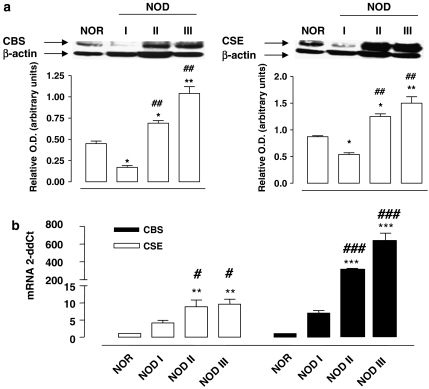
(a) Western blots show a significant increase in both CBS and CSE expression in NOD mice (*P<0.05 vs NOR; **P<0.01 vs NOR; ##P<0.01 vs NOD I; one-way ANOVA). Similarly, in (b), qRT-PCR confirmed the progressively increased expression of mRNA for CBS and CSE (**P<0.01 vs NOR; ***P<0.001 vs NOR; #P<0.05 vs NOD I; ###P<0.001 vs NOD I; one-way ANOVA). CBS, cystathionine-β-synthase; CSE, cystathionine-γ-lyase; NOD, non-obese diabetic; qRT-PCR, quantitative real-time PCR.

References

    1. Ali MY, Ping CY, Mok YY, Ling L, Whiteman M, Bhatia M, et al. Regulation of vascular nitric oxide in vitro and in vivo; a new role for endogenous hydrogen sulphide. Br J Pharmacol. 2006;149:625–634. - PMC - PubMed
    1. Bhatia M. Hydrogen sulfide as a vasodilator. IUBMB Life. 2005;57:603–606. - PubMed
    1. Braunstein AE, Azarkh RM. Participation of vitamin B6 in enzymic formation of hydrogen sulfide from L-cysteineteine. Dokl Akad Nauk SSSR. 1950;71:93–96.
    1. Bucci M, Roviezzo F, Brancaleone V, Lin MI, Di Lorenzo A, Cicala C, et al. Diabetic mouse angiopathy is linked to progressive sympathetic receptor deletion coupled to an enhanced caveolin-1 expression. Arterioscler Thromb Vasc Biol. 2004;24:721–726. - PubMed
    1. Chen X, Jhee KH, Kruger WD. Production of the neuromodulator H2S by cystathionine beta-synthase via the condensation of cysteine and homocysteine. J Biol Chem. 2004;279:52082–52086. - PubMed

MeSH terms