. 2008 Jul 21:8:48.
doi: 10.1186/1471-2288-8-48.

Advantages of the nested case-control design in diagnostic research

Affiliations

Advantages of the nested case-control design in diagnostic research

Cornelis J Biesheuvel et al. BMC Med Res Methodol. .

Abstract

Background: Despite its benefits, it is uncommon to apply the nested case-control design in diagnostic research. We aim to show advantages of this design for diagnostic accuracy studies.

Methods: We used data from a full cross-sectional diagnostic study comprising a cohort of 1295 consecutive patients who were selected on their suspicion of having deep vein thrombosis (DVT). We draw nested case-control samples from the full study population with case:control ratios of 1:1, 1:2, 1:3 and 1:4 (per ratio 100 samples were taken). We calculated diagnostic accuracy estimates for two tests that are used to detect DVT in clinical practice.

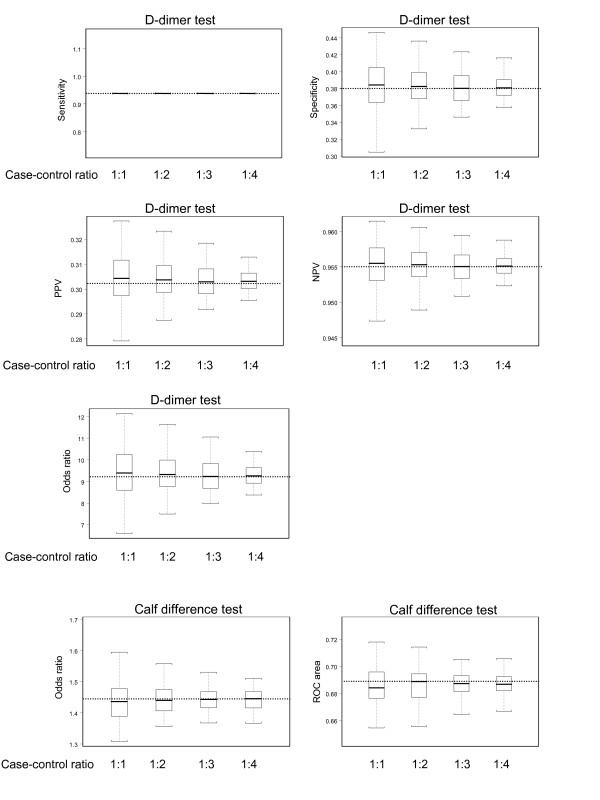
Results: Estimates of diagnostic accuracy in the nested case-control samples were very similar to those in the full study population. For example, for each case:control ratio, the positive predictive value of the D-dimer test was 0.30 in the full study population and 0.30 in the nested case-control samples (median of the 100 samples). As expected, variability of the estimates decreased with increasing sample size.

Conclusion: Our findings support the view that the nested case-control study is a valid and efficient design for diagnostic studies and should also be (re)appraised in current guidelines on diagnostic accuracy research.


Figures
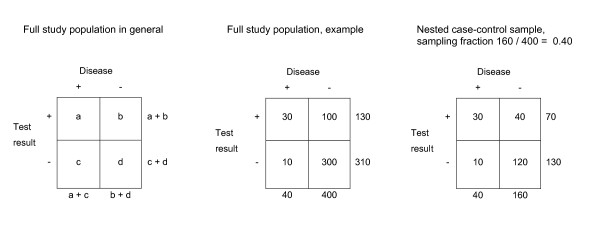
Figure 1
Figure 1
Theoretical example of a full study population and a nested case-control sample. The index test result and the outcome are obtained for all patients of the study population. The case-control ratio was 1:4 (sampling fraction (SF) = 160/400 = 0.40). Valid diagnostic accuracy measures can be obtained from the nested case-control sample, by multiplying the controls with 1/sampling fraction. For example, the positive predictive value (PPV) of a full study population can be calculated with a/(a + b), in this example 30/(30 + 100) = 0.23. In a nested case-control sample the PPV is calculated with a/(a + (1/SF)*b), in this example: 30/(30 + 2.5*40) = 0.23. In a case-control sample however, the controls are sampled from a source population with unknown size. Therefore, the sample fraction is unknown and valid estimate of the PPV cannot be calculated.
Figure 2
Figure 2
Estimates of diagnostic accuracy of the D-dimer test and calf difference test for the 100 nested case-control samples with case-control ratios ranging from 1:1 to 1:4. The boxes indicate mean values and corresponding interquartile ranges (25th and 75th percentile). Whiskers indicate 2.5th and 97.5th percentiles. The dotted lines represent the values estimated in the full study population.

References

    1. Knottnerus JA, van Weel C, Muris JW. Evaluation of diagnostic procedures. BMJ. 2002;324:477–480. doi: 10.1136/bmj.324.7335.477. - DOI - PMC - PubMed
    1. Knottnerus JA, Muris JW. Assessment of the accuracy of diagnostic tests: the cross-sectional study. J Clin Epidemiol. 2003;56:1118–1128. doi: 10.1016/S0895-4356(03)00206-3. - DOI - PubMed
    1. Lijmer JG, Mol BW, Heisterkamp S, Bonsel GJ, Prins MH, Meulen van der JHP, Bossuyt PMM. Empirical evidence of design-related bias in studies of diagnostic tests. JAMA. 1999;282:1061–1066. doi: 10.1001/jama.282.11.1061. - DOI - PubMed
    1. Rutjes AW, Reitsma JB, Di Nisio M, Smidt N, van Rijn JC, Bossuyt PM. Evidence of bias and variation in diagnostic accuracy studies. CMAJ. 2006;174:469–476. - PMC - PubMed
    1. Whiting P, Rutjes AW, Reitsma JB, Glas AS, Bossuyt PM, Kleijnen J. Sources of variation and bias in studies of diagnostic accuracy: a systematic review. Ann Intern Med. 2004;140:189–202. - PubMed

Publication types