. 2008 Sep;28(18):5777-84.
doi: 10.1128/MCB.00106-08. Epub 2008 Jul 21.

Diadenosine tetraphosphate hydrolase is part of the transcriptional regulation network in immunologically activated mast cells

Affiliations

Diadenosine tetraphosphate hydrolase is part of the transcriptional regulation network in immunologically activated mast cells

Irit Carmi-Levy et al. Mol Cell Biol. 2008 Sep.

Abstract

We previously discovered that microphthalmia transcription factor (MITF) and upstream stimulatory factor 2 (USF2) each forms a complex with its inhibitor histidine triad nucleotide-binding 1 (Hint-1) and with lysyl-tRNA synthetase (LysRS). Moreover, we showed that the dinucleotide diadenosine tetraphosphate (Ap(4)A), previously shown to be synthesized by LysRS, binds to Hint-1, and as a result the transcription factors are released from their suppression. Thus, transcriptional activity is regulated by Ap(4)A, suggesting that Ap(4)A is a second messenger in this context. For Ap(4)A to be unambiguously established as a second messenger, several criteria have to be fulfilled, including the presence of a metabolizing enzyme. Since several enzymes are able to hydrolyze Ap(4)A, we provided here evidence that the "Nudix" type 2 gene product, Ap(4)A hydrolase, is responsible for Ap(4)A degradation following the immunological activation of mast cells. The knockdown of Ap(4)A hydrolase modulated Ap(4)A accumulation, resulting in changes in the expression of MITF and USF2 target genes. Moreover, our observations demonstrated that the involvement of Ap(4)A hydrolase in gene regulation is not a phenomenon exclusive to mast cells but can also be found in cardiac cells activated with the beta-agonist isoproterenol. Thus, we have provided concrete evidence establishing Ap(4)A as a second messenger in the regulation of gene expression.


Figures
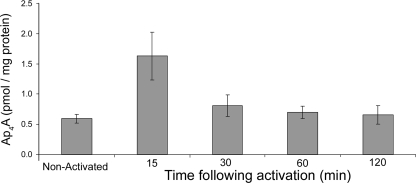
FIG. 1.
FIG. 1.
Kinetics of Ap4A accumulation following the IgE-Ag stimulation of mast cells. Upon stimulation of RBL cells with 100 ng/ml IgE anti-DNP and 100 ng/ml DNP, cells were harvested at specific times, Ap4A level was measured by a luminescence assay as described in Materials and Methods, and results were normalized by a Bradford protein assay. Error bars represent the mean of replicates ± the standard error of the mean. Results for one representative experiment out of four are shown.
FIG. 2.
FIG. 2.
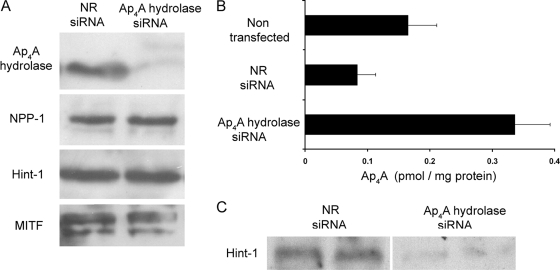
Ap4A hydrolase is degrading Ap4A in immunologically activated mast cells. (A) RBL cells were transfected with either NR siRNA or siRNA against the gene encoding Ap4A hydrolase. Twenty-four hours after transfection, Western blot analysis was carried out for cell lysates using antibodies specific for Ap4A hydrolase, NPP-1, Hint-1, and MITF. Results for one representative experiment out of three are shown. (B) RBL cells were transfected with either NR or Ap4A hydrolase siRNA for 24 h. Control and transfected cells were then stimulated by IgE-Ag for 6 h, and Ap4A levels were then determined. The mean and standard error of the mean for three experiments are shown. (C) Coimmunoprecipitation of MITF and Hint-1. MITF was immunoprecipitated from extracts of RBL cells transfected with siRNA against Ap4A hydrolase or NR siRNA. The level of coimmunoprecipitated Hint-1 was determined by Western blot analysis. Results for one representative experiment out of three are shown.
FIG. 3.
FIG. 3.
Ap4A hydrolase regulates the transcription of MITF and USF2 target genes in mast cells. (A) RBL cells were transfected with either NR siRNA or siRNA against Ap4A hydrolase. Twenty-four hours later, the cells were transfected with luciferase reporter under the control of the mMCP6 promoter. Cells were then stimulated with 100 ng/ml IgE anti-DNP and 100 ng/ml DNP. The luciferase activity of lysed cells was measured and normalized against the protein concentration. The mean and standard error of the mean for three experiments are shown. (B) RBL cells were transfected with either Ap4A hydrolase siRNA or NR siRNA. Cells were activated with 100 ng/ml IgE anti-DNP and challenged with 100 ng/ml DNP. Twenty-four hours later, cells were lysed and the mRNA quantitations of TPH, c-kit, and TERT were determined by Sybr green incorporation to real-time PCR in RBL cells. Expression levels were normalized to those of the β-actin housekeeping gene. Results are presented relative to NR siRNA-treated cells which were arbitrarily determined as 1. The mean and standard error of the mean for three experiments are shown.
FIG. 4.
FIG. 4.
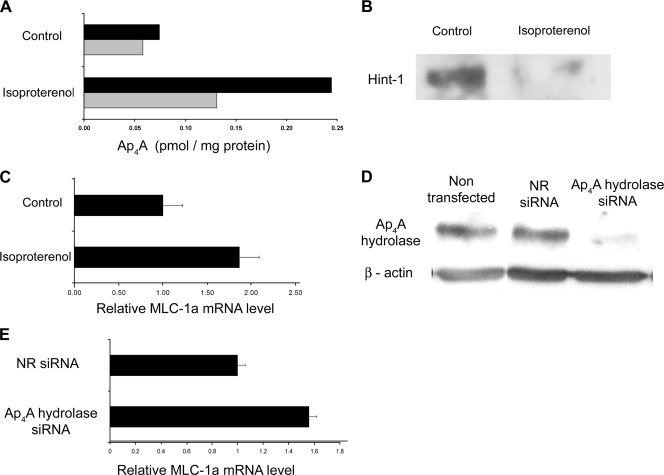
Role of Ap4A in the regulation of the MITF target gene, encoding MLC-1a, in activated rat cardiac cells (H9C2). (A) The Ap4A level was measured in H9C2 cells cultured with or without isoproterenol for 30 min. The results of two experiments are shown. (B) Coimmunoprecipitation of MITF and Hint-1. MITF was immunoprecipitated from extracts of H9C2 cells cultured with or without isoproterenol. The level of coimmunoprecipitated Hint-1 was determined by Western blot analysis. Results for one representative experiment out of three are shown. (C) H9C2 cells were cultured with or without isoproterenol. Four hours later, cells were lysed and the mRNA quantitation of MLC-1a was determined by Sybr green incorporation to real-time PCR. Expression levels were normalized to β-actin. The mean and standard error of the mean for three experiments are shown. (D) H9C2 cells were transfected with either NR siRNA or siRNA against Ap4A hydrolase. Forty-eight hours after transfection, Western blot analysis was carried out for cell lysates by using Ap4A hydrolase specific antibody. Results for one representative experiment out of five are shown. (E) H9C2 cells were transfected with either Ap4A hydrolase siRNA or NR siRNA. 24 h after cells were stimulated with isoproterenol they were lysed and the mRNA quantitation of MLC-1a was determined by Sybr green incorporation to real-time PCR in H9C2 cells. Expression levels were normalized to the β-actin housekeeping gene. The result is presented relative to NR siRNA-treated cells, which was arbitrarily determined as 1. The mean and standard error of the mean for three experiments are shown.
FIG. 5.
FIG. 5.
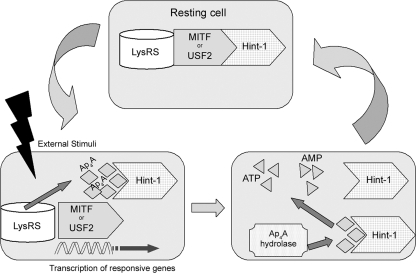
Proposed model for the involvement of Ap4A hydrolase in transcription regulation. Upon external stimuli, Ap4A levels are elevated. Ap4A binds to Hint-1, dissociating it from MITF or USF2. With the repression removed, the transcription factors are free to transcribe their responsive genes. Ap4A hydrolase hydrolyzes the accumulated Ap4A into AMP + ATP, returning its level to basal. When Ap4A levels decrease, Hint-1 reassociates with MITF or USF2.

References

    1. Bentley, N. J., T. Eisen, and C. R. Goding. 1994. Melanocyte-specific expression of the human tyrosinase promoter: activation by the microphthalmia gene product and role of the initiator. Mol. Cell. Biol. 147996-8006. - PMC - PubMed
    1. Bessman, M. J., D. N. Frick, and S. F. O'Handley. 1996. The MutT proteins or “Nudix” hydrolases, a family of versatile, widely distributed, “housecleaning” enzymes. J. Biol. Chem. 27125059-25062. - PubMed
    1. Chu, T. Y., and P. Besmer. 1995. Characterization of the promoter of the proto-oncogene c-kit. Proc. Natl. Sci. Counc. Repub. China B 198-18. - PubMed
    1. Fisher, D. I., and A. G. McLennan. 2008. Correlation of intracellular diadenosine triphosphate (Ap3A) with apoptosis in Fhit-positive HEK293 cells. Cancer Lett. 259186-191. - PubMed
    1. Ge, Y., T. Jippo, Y.-M. Lee, S. Adachi, and Y. Kitamura. 2001. Independent influence of strain difference and mi transcription factor on the expression of mouse mast cell chymases. Am. J. Pathol. 158281-292. - PMC - PubMed

Publication types

MeSH terms

Substances

LinkOut - more resources