


Acute inhibition of guanosine triphosphate cyclohydrolase 1 uncouples endothelial nitric oxide synthase and elevates blood pressure
- PMID: 18645049
- PMCID: PMC3523107
- DOI: 10.1161/HYPERTENSIONAHA.108.112094
Acute inhibition of guanosine triphosphate cyclohydrolase 1 uncouples endothelial nitric oxide synthase and elevates blood pressure
Erratum in
-
Correction to: Acute Inhibition of Guanosine Triphosphate Cyclohydrolase 1 Uncouples Endothelial Nitric Oxide Synthase and Elevates Blood Pressure.Hypertension. 2020 May;75(5):e14. doi: 10.1161/HYP.0000000000000101. Epub 2020 Apr 8. Hypertension. 2020. PMID: 32267810 No abstract available.
Abstract
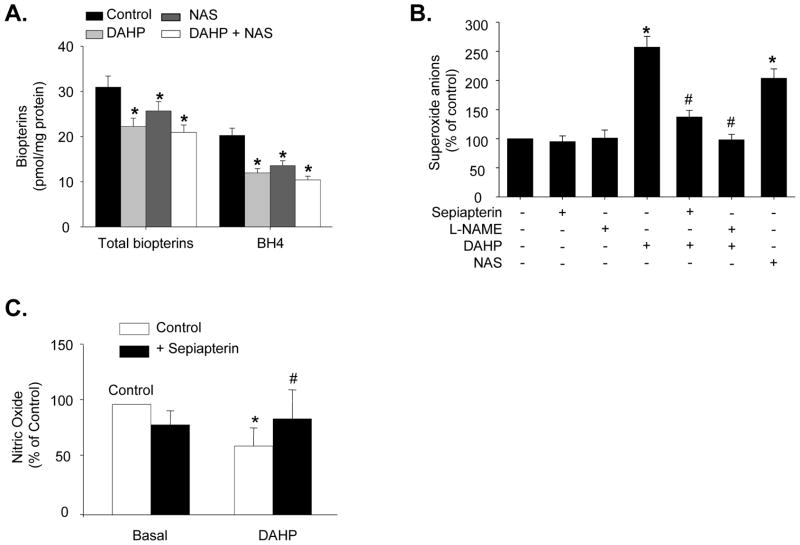
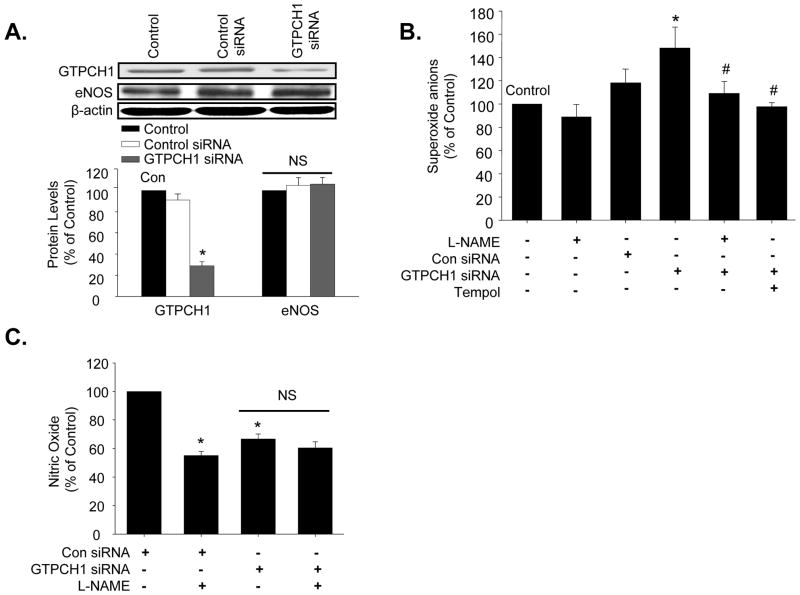
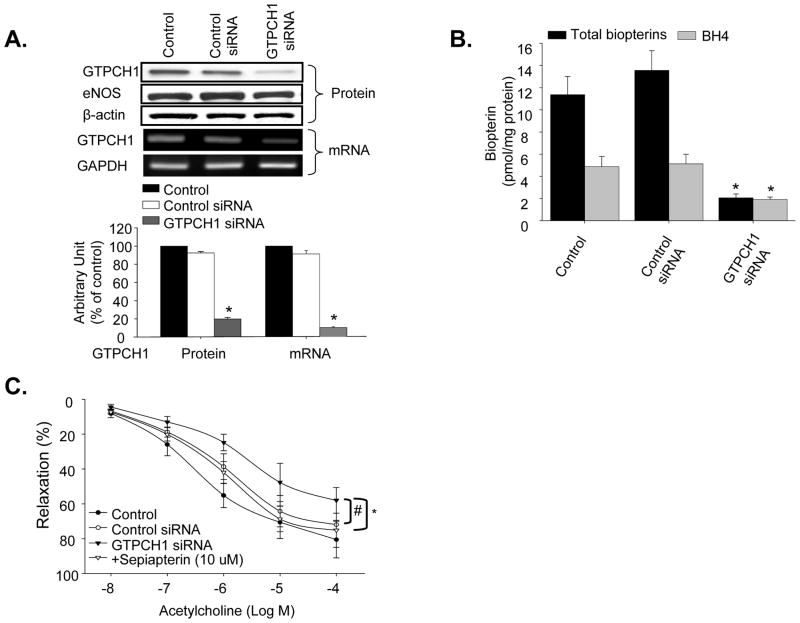
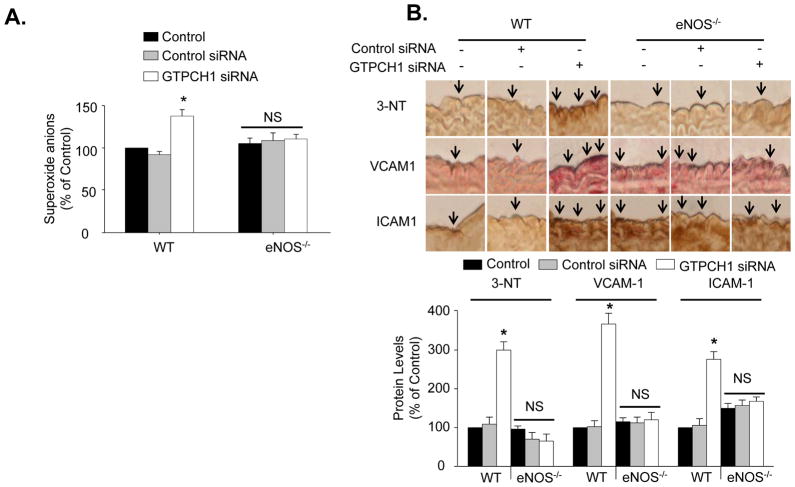
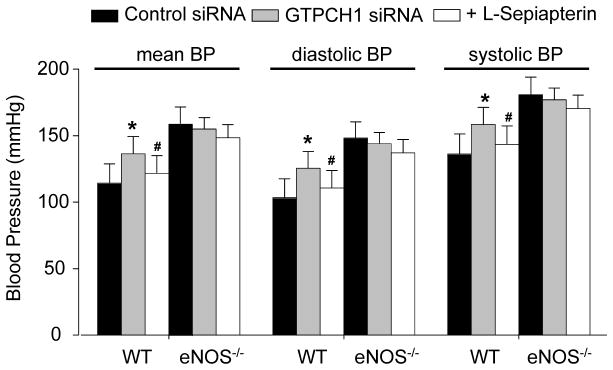
GTP cyclohydrolase 1 (GTPCH1) is the rate-limiting enzyme in de novo synthesis of tetrahydrobiopterin (BH4), an essential cofactor for endothelial NO synthase (eNOS) dictating, at least partly, the balance of NO and superoxide produced by this enzyme. The aim of this study was to determine the effect of acute inhibition of GTPCH1 on BH4, eNOS function, and blood pressure (BP) in vivo. Exposure of bovine or mouse aortic endothelial cells to GTPCH1 inhibitors (2,4-diamino-6-hydroxypyrimidine or N-acetyl-serotonin) or GTPCH1 small-interference RNA (siRNA) significantly reduced BH4 and NO levels but increased superoxide levels. This increase was abolished by sepiapterin (BH4 precursor) or N(G)-nitro-L-arginine methyl ester (nonselective NOS inhibitor). Incubation of isolated murine aortas with 2,4-diamino-6-hydroxypyrimidine or N-acetyl-serotonin impaired acetylcholine-induced endothelium-dependent relaxation but not endothelium-independent relaxation. Aortas from GTPCH1 siRNA-injected mice, but not their control-siRNA injected counterparts, also exhibited impaired endothelium-dependent relaxation. BH4 reduction induced by GTPCH1 siRNA injection was associated with increased aortic levels of superoxide, 3-nitrotyrosine, and adhesion molecules (intercellular adhesion molecule 1 and vascular cell adhesion molecule 1), as well as a significantly elevated systolic, diastolic, and mean BP in C57BL6 mice. GTPCH1 siRNA was unable to elicit these effects in eNOS(-/-) mice. Sepiapterin supplementation, which had no effect on high BP in eNOS(-/-) mice, partially reversed GTPCH1 siRNA-induced elevation of BP in wild-type mice. In conclusion, GTPCH1 via BH4 maintains normal BP and endothelial function in vivo by preserving NO synthesis by eNOS.
Figures
References
-
- Creager MA, Luscher TF, Cosentino F, Beckman JA. Diabetes and vascular disease: pathophysiology, clinical consequences, and medical therapy: Part I. Circulation. 2003;108:1527–1532. - PubMed
-
- Sandrim VC, Yugar-Toledo JC, Desta Z, Flockhart DA, Moreno HJ, Tanus-Santos JE. Endothelial nitric oxide synthase haplotypes are related to blood pressure elevation, but not to resistance to antihypertensive drug therapy. J Hypertens. 2006;24:2393–2397. - PubMed
-
- Cosentino F, Luscher TF. Tetrahydrobiopterin and endothelial nitric oxide synthase activity. Cardiovasc Res. 1999;43:274–278. - PubMed
-
- Satoh M, Fujimoto S, Haruna Y, Arakawa S, Horike H, Komai N, Sasaki T, Tsujioka K, Makino H, Kashihara N. NAD(P)H oxidase and uncoupled nitric oxide synthase are major sources of glomerular superoxide in rats with experimental diabetic nephropathy. Am J Physiol Renal Physiol. 2005;288:F1144–1152. - PubMed
-
- Xia Y, Tsai AL, Berka V, Zweier JL. Superoxide generation from endothelial nitric-oxide synthase. A Ca2+/calmodulin-dependent and tetrahydrobiopterin regulatory process. J Biol Chem. 1998;273:25804–25808. - PubMed
Publication types
MeSH terms
Substances
Grants and funding
LinkOut - more resources
Full Text Sources
Other Literature Sources
Medical
