


Amniotic fluid index versus single deepest vertical pocket as a screening test for preventing adverse pregnancy outcome
- PMID: 18646160
- PMCID: PMC6464731
- DOI: 10.1002/14651858.CD006593.pub2
Amniotic fluid index versus single deepest vertical pocket as a screening test for preventing adverse pregnancy outcome
Abstract
Background: Amniotic fluid volume is an important parameter in the assessment of fetal well-being. Oligohydramnios occurs in many high-risk conditions and is associated with poor perinatal outcomes. Many caregivers practice planned delivery by induction of labor or caesarean section after diagnosis of decreased amniotic fluid volume at term. There is no clear consensus on the best method to assess amniotic fluid adequacy.
Objectives: To compare the use of the amniotic fluid index with the single deepest vertical pocket measurement as a screening tool for decreased amniotic fluid volume in preventing adverse pregnancy outcome.
Search strategy: We searched the Cochrane Pregnancy and Childbirth Group's Trials Register (January 2008), the Cochrane Central Register of Controlled Trials (CENTRAL) (The Cochrane Library 2007, Issue 2), MEDLINE (1966 to May 2007) and the metaRegister of Controlled Trials (May 2007). We handsearched the citation lists of relevant publications, review articles, and included studies.
Selection criteria: Randomised controlled trials involving women with a singleton pregnancy, whether at low or high risk, undergoing ultrasound measurement of amniotic fluid volume as part of antepartum assessment of fetal well-being that compared the amniotic fluid index and the single deepest vertical pocket measurement.
Data collection and analysis: Both authors independently assessed eligibility and quality, and extracted the data.
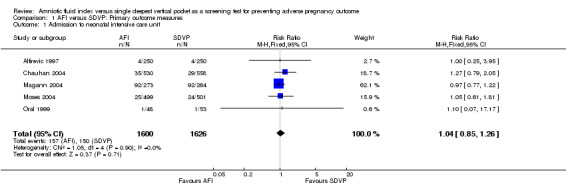
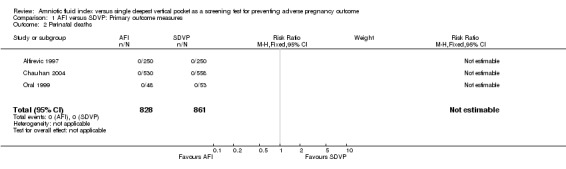
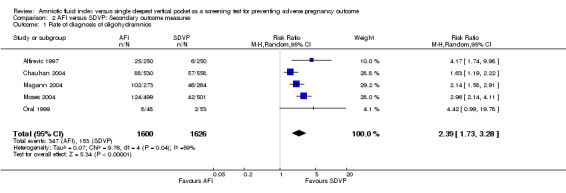
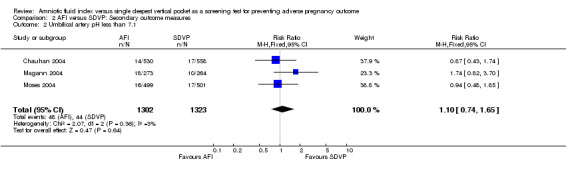
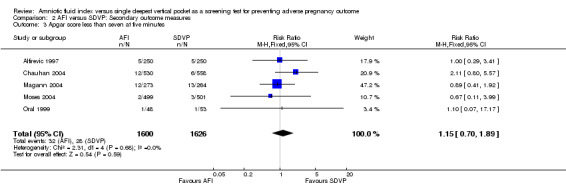
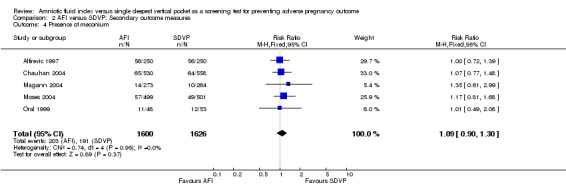
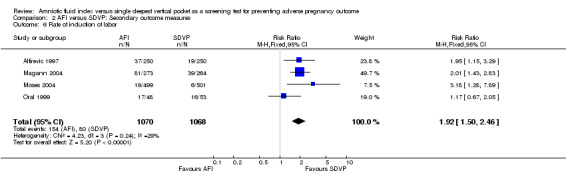
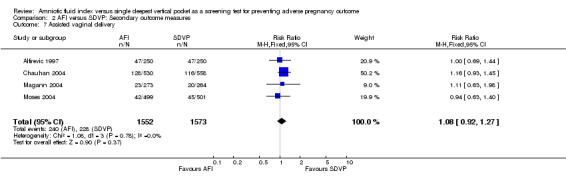
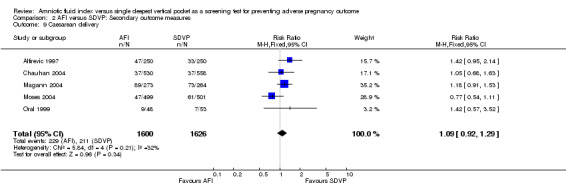
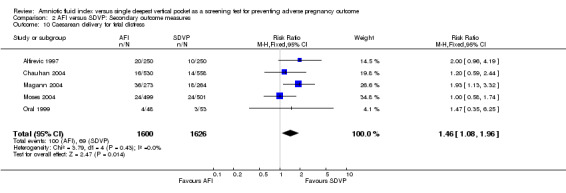
Main results: Four trials (3125 women) met the inclusion criteria. There is no evidence that one method is superior to the other in the prevention of poor peripartum outcomes, including: admission to a neonatal intensive care unit; an umbilical artery pH of less than 7.1; the presence of meconium; an Apgar score of less than 7 at five minutes; or caesarean delivery. When the amniotic fluid index was used, significantly more cases of oligohydramnios were diagnosed (risk ratio (RR, random) 2.33, 95% CI 1.67 to 3.24), and more women had inductions of labor (RR (fixed) 2.10, 95% CI 1.60 to 2.76) and caesarean delivery for fetal distress (RR (fixed) 1.45, 95% CI 1.07 to 1.97).
Authors' conclusions: The single deepest vertical pocket measurement in the assessment of amniotic fluid volume during fetal surveillance seems a better choice since the use of the amniotic fluid index increases the rate of diagnosis of oligohydramnios and the rate of induction of labor without improvement in peripartum outcomes. A systematic review of the diagnostic accuracy of both methods in detecting decreased amniotic fluid volume is required.
Conflict of interest statement
None known.
Figures
Update of
References
References to studies included in this review
Alfirevic 1997 {published data only}
-
- Alfirevic Z, Luckas M, Walkinshaw SA, McFarlane M, Curran R. A randomised comparison between amniotic fluid index and maximum pool depth in the monitoring of post‐term pregnancy. British Journal of Obstetrics and Gynaecology 1997;104:207‐11. - PubMed
Chauhan 2004 {published data only}
-
- Chauhan SP, Doherty DD, Magann EF, Cahanding F, Moreno F, Klausen JH. Amniotic fluid index vs single deepest pocket technique during modified biophysical profile: a randomized clinical trial. American Journal of Obstetrics and Gynecology 2004;191(2):661‐6. - PubMed
Magann 2004 {published data only}
-
- Magann E, Doherty D, Field K, Chauhan S, Muffley PE. Biophysical profile with amniotic fluid volume assessment: a randomized controlled trial of the amniotic fluid index versus single deepest pocket. American Journal of Obstetrics and Gynecology 2003;189(6 Suppl 1):S179.
-
- Magann EF, Doherty DA, Field K, Chauhan SP, Muffley PE, Morrison JC. Biophysical profile with amniotic fluid volume assessments. Obstetrics and Gynecology 2004;104(1):5‐10. - PubMed
Moses 2004 {published data only}
-
- Moses J, Doherty DA, Magann EF, Chauhan SP, Morrison JC. A randomized clinical trial of the intrapartum assessment of amniotic fluid volume: amniotic fluid index versus the single deepest pocket technique. American Journal of Obstetrics and Gynecology 2004;190:1564‐70. - PubMed
Oral 1999 {published data only}
-
- Oral B, Gocen C, Ozbasar D. A comparison between two different ultrasonographic methods for assessing amniotic fluid volume in postterm pregnancies [Postterm gebeliklerde amniyotik sivi hacminin degerlendirilmesinde iki farkli ultrasonografi yonteminin karsilastirimasi]. Ondokuz Mayis Universitesi Tip Dergisi 1999;16:180‐6.
References to studies excluded from this review
Alfirevic 1995 {published data only}
-
- Alfirevic Z, Walkinshaw SA. A randomised controlled trial of simple compared with complex antenatal fetal monitoring after 42 weeks of gestation. British Journal of Obstetrics and Gynaecology 1995;102:638‐43. - PubMed
Callan 1996 {published data only}
-
- Callan FT, Jaekle RK, Karpel BM, Meyer BA. Amniotic fluid index: comparison of curvilinear and linear transducers. American Journal of Obstetrics and Gynecology 1996;174(1 Pt 2):415.
Chauhan 1995 {published data only}
-
- Chauhan SP, Washburne JF, Magann EF, Perry KG, Martin JN, Morrison JC. A randomized study to assess the efficacy of the amniotic fluid index as a fetal admission test. Obstetrics and Gynecology 1995;86:9‐13. - PubMed
Magann 1994 {published data only}
-
- Magann EF, Morton ML, Chauhan SP, Martin JN, Whitworth NS, Morrison JC. Accuracy of ultrasonic techniques for the evaluation of amniotic fluid volume in twins. American Journal of Obstetrics and Gynecology 1994;170:365.
Additional references
Bastide 1986
-
- Bastide A, Manning F, Harman C, Lange I, Morrison I. Ultrasound evaluation of amniotic fluid: outcome of pregnancies with severe oligohydramnios. American Journal of Obstetrics and Gynecology 1986;154(4):895‐900. - PubMed
Casey 2000
-
- Casey BM, McIntire DD, Bloom SL, Lucas MJ, Santos R, Twickler DM, et al. Pregnancy outcomes after antepartum diagnosis of oligohydramnios at or beyond 34 weeks' gestation. American Journal of Obstetrics and Gynecology 2000;182(4):909‐12. - PubMed
Chamberlain 1984
-
- Chamberlain PF, Manning FA, Morrison I, Harman CR, Lange IR. Ultrasound evaluation of amniotic fluid volume. I. The relationship of marginal and decreased amniotic fluid volumes to perinatal outcome. American Journal of Obstetrics and Gynecology 1984;150(3):245‐9. - PubMed
Chauhan 1999
-
- Chauhan SP, Sanderson M, Hendrix NW, Magann EF, Devoe LD. Perinatal outcome and amniotic fluid index in the antepartum and intrapartum periods: a meta‐analysis. American Journal of Obstetrics and Gynecology 1999;181(6):1473‐8. - PubMed
Croom 1992
-
- Croom CS, Banias BB, Ramos‐Santos E, Devoe LD, Bezhadian A, Hiett AK. Do semiquantitative amniotic fluid indexes reflect actual volume?. American Journal of Obstetrics and Gynecology 1992;167(4 Pt 1):995‐9. - PubMed
Fischer 1993
-
- Fischer RL, McDonnell M, Bianculli KW, Perry RL, Hediger ML, Scholl TO. Amniotic fluid volume estimation in the postdate pregnancy: a comparison of techniques. Obstetrics & Gynecology 1993;81(5 Pt 1):698‐704. [0029‐7844 (Print)] - PubMed
Fok 2006
-
- Fok WY, Chan LY, Lau TK. The influence of fetal position on amniotic fluid index and single deepest pocket. Ultrasound in Obstetrics and Gynecology 2006;28(2):162‐5. - PubMed
Garmel 1997
-
- Garmel SH, Chelmow D, Sha SJ, Roan JT, D'Alton ME. Oligohydramnios and the appropriately grown fetus. American Journal of Perinatology 1997;14(6):359‐63. [0735‐1631 (Print)] - PubMed
Goldstein 1988
-
- Goldstein RB, Filly RA. Sonographic estimation of amniotic fluid volume. Subjective assessment versus pocket measurements. Journal of Ultrasound Medicine 1988;7(7):363‐9. [0278‐4297 (Print)] - PubMed
Gramellini 2004
-
- Gramellini D, Fieni S, Verrotti C, Piantelli G, Cavallotti D, Vadora E. Ultrasound evaluation of amniotic fluid volume: methods and clinical accuracy. Acta Bio‐Medica de L'Ateneo Parmense 2004;75 Suppl 1:40‐4. - PubMed
Hashimoto 1987
-
- Hashimoto B, Filly RA, Belden C, Callen PW, Laros RK. Objective method of diagnosing oligohydramnios in postterm pregnancies. Journal of Ultrasound Medicine 1987;6(2):81‐4. - PubMed
Higgins 2008
-
- Higgins JPT, Green S, editors. Cochrane Handbook for Systematic Reviews of Interventions Version 5.0.1 [updated September 2008]. The Cochrane Collaboration, 2008. Available from www.cochrane‐handbook.org.
Hill 1983
-
- Hill LM, Breckle R, Wolfgram KR, O'Brien PC. Oligohydramnios: ultrasonically detected incidence and subsequent fetal outcome. American Journal of Obstetrics and Gynecology 1983;147(4):407‐10. [0002‐9378 (Print)] - PubMed
Hinh 2005
-
- Hinh ND, Ladinsky JL. Amniotic fluid index measurements in normal pregnancy after 28 gestational weeks. International Journal of Gynecology & Obstetrics 2005;91(2):132‐6. - PubMed
Jaba 2005
-
- Jaba B, Mohiuddin AS, Dey SN, Khan NA, Talukder SI. Ultrasonographic determination of amniotic fluid volume in normal pregnancy. Mymensingh Medical Journal 2005;14(2):121‐4. - PubMed
Johnson 2007
-
- Johnson JM, Chauhan SP, Ennen CS, Niederhauser A, Magann EF. A comparison of 3 criteria of oligohydramnios in identifying peripartum complications: a secondary analysis. American Journal of Obstetrics and Gynecology 2007;197(2):207.e1‐7. - PubMed
Kawasaki 2002
-
- Kawasaki N, Nishimura H, Yoshimura T, Okamura H. A diminished intrapartum amniotic fluid index is a predictive marker of possible adverse neonatal outcome when associated with prolonged labor. Gynecologic and Obstetric Investigation 2002;53(1):1‐5. [0378‐7346 (Print)] - PubMed
Locatelli 2004
-
- Locatelli A, Zagarella A, Toso L, Assi F, Ghidini A, Biffi A. Serial assessment of amniotic fluid index in uncomplicated term pregnancies: prognostic value of amniotic fluid reduction. Journal of Maternal‐Fetal & Neonatal Medicine 2004;15(4):233‐6. - PubMed
Magann 1992
-
- Magann EF, Nolan TE, Hess LW, Martin RW, Whitworth NS, Morrison JC. Measurement of amniotic fluid volume: accuracy of ultrasonography techniques. American Journal of Obstetrics and Gynecology 1992;167(6):1533‐7. [0002‐9378 (Print)] - PubMed
Magann 1999a
-
- Magann EF, Chauhan SP, Kinsella MJ, McNamara MF, Whitworth NS, Morrison JC. Antenatal testing among 1001 patients at high risk: the role of ultrasonographic estimate of amniotic fluid volume. American Journal of Obstetrics and Gynecology 1999;180(6 Pt 1):1330‐6. [0002‐9378 (Print)] - PubMed
Magann 1999b
-
- Magann EF, Kinsella MJ, Chauhan SP, McNamara MF, Gehring BW, Morrison JC. Does an amniotic fluid index of </=5 cm necessitate delivery in high‐risk pregnancies? A case‐control study. American Journal of Obstetrics and Gynecology 1999;180:1354‐9. - PubMed
Magann 2000
-
- Magann EF, Isler CM, Chauhan SP, Martin JN, Jr. Amniotic fluid volume estimation and the biophysical profile: a confusion of criteria. Obstetrics & Gynecology 2000;96(4):640‐2. - PubMed
Magann 2003
-
- Magann EF, Chauhan SP, Bofill JA, Martin JN, Jr. Comparability of the amniotic fluid index and single deepest pocket measurements in clinical practice. Australian and New Zealand Journal of Obstetrics and Gynaecology 2003;43(1):75‐7. - PubMed
Manning 1981
-
- Manning FA, Hill LM, Platt LD. Qualitative amniotic fluid volume determination by ultrasound: antepartum detection of intrauterine growth retardation. American Journal of Obstetrics and Gynecology 1981;139(3):254‐8. [0002‐9378 (Print)] - PubMed
Morris 2003
-
- Morris JM, Thompson K, Smithey J, Gaffney G, Cooke I, Chamberlain P, et al. The usefulness of ultrasound assessment of amniotic fluid in predicting adverse outcome in prolonged pregnancy: a prospective blinded observational study. British Journal of Obstetrics and Gynaecology 2003;110(11):989‐94. - PubMed
Myles 2002
-
- Myles TD, Santolaya‐Forgas J. Normal ultrasonic evaluation of amniotic fluid in low‐risk patients at term. Journal of Reproductive Medicine 2002;47(8):621‐4. - PubMed
Peedicayil 1994
-
- Peedicayil A, Mathai M, Regi A, Aseelan L, Rekha K, Jasper P. Inter‐ and intra‐observer variation in the amniotic fluid index. Obstetrics & Gynecology 1994;84(5):848‐51. [0029‐7844 (Print)] - PubMed
Phelan 1987
-
- Phelan JP, Smith CV, Broussard P, Small M. Amniotic fluid volume assessment with the four‐quadrant technique at 36‐42 weeks' gestation. Journal of Reproductive Medicine 1987;32(7):540‐2. - PubMed
RevMan 2008 [Computer program]
-
- The Nordic Cochrane Centre, The Cochrane Collaboration. Review Manager (RevMan). Version 5.0. Copenhagen: The Nordic Cochrane Centre, The Cochrane Collaboration, 2008.
Rogers 1999
-
- Rogers MS, Wang CC. A comparison of three ultrasound estimates of intrapartum oligohydramnios for prediction of fetal hypoxia‐reperfusion injury. Early Human Development 1999;56(2‐3):117‐26. - PubMed
Ross 2001
-
- Ross MG, Brace RA. National Institute of Child Health and Development Conference summary: amniotic fluid biology‐‐basic and clinical aspects. Journal of Maternal‐Fetal Medicine 2001;10(1):2‐19. [MEDLINE: ] - PubMed
Rutherford 1987a
-
- Rutherford SE, Smith CV, Phelan JP, Kawakami K, Ahn MO. Four‐quadrant assessment of amniotic fluid volume. Interobserver and intraobserver variation. Journal of Reproductive Medicine 1987;32:587‐9. - PubMed
Rutherford 1987b
-
- Rutherford SE, Phelan JP, Smith CV, Jacobs N. The four‐quadrant assessment of amniotic fluid volume: an adjunct to antepartum fetal heart rate testing. Obstetrics & Gynecology 1987;70:353‐6. - PubMed
Sarno 1989
-
- Sarno AP Jr, Ahn MO, Brar HS, Phelan JP, Platt LD. Intrapartum Doppler velocimetry, amniotic fluid volume, and fetal heart rate as predictors of subsequent fetal distress. I. An initial report. American Journal of Obstetrics and Gynecology 1989;161:1508‐14. - PubMed
Seffah 1999
-
- Seffah JD, Armah JO. Amniotic fluid index for screening late pregnancies. East African Medical Journal 1999;76(6):348‐51. - PubMed
Sherer 2002
-
- Sherer DM. A review of amniotic fluid dynamics and the enigma of isolated oligohydramnios. American Journal of Perinatology 2002;19(5):253‐66. - PubMed
Williams 1993
-
- Williams K. Amniotic fluid assessment. Obstetrical & Gynecological Survey 1993;48(12):795‐800. - PubMed
Publication types
MeSH terms
LinkOut - more resources
Full Text Sources
Miscellaneous
