Intracranial and abdominal aortic aneurysms: similarities, differences, and need for a new class of computational models
- PMID: 18647115
- PMCID: PMC2742216
- DOI: 10.1146/annurev.bioeng.10.061807.160439
Intracranial and abdominal aortic aneurysms: similarities, differences, and need for a new class of computational models
Abstract
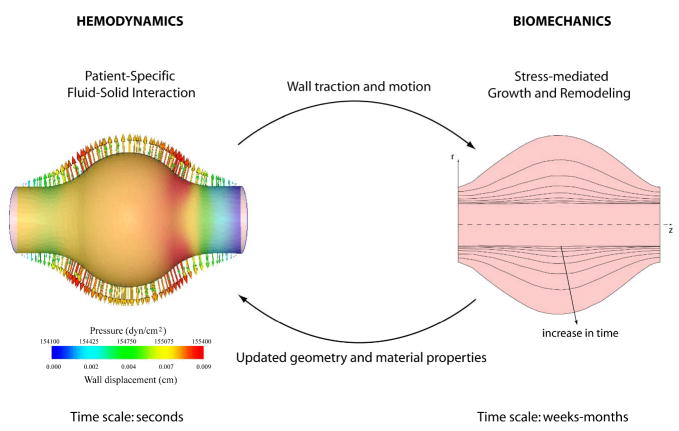
Intracranial saccular and abdominal aortic aneurysms (ISAs and AAAs, respectively) result from different underlying disease processes and exhibit different rupture potentials, yet they share many histopathological and biomechanical characteristics. Moreover, as in other vascular diseases, hemodynamics and wall mechanics play important roles in the natural history and possible treatment of these two types of lesions. The goals of this review are twofold: first, to contrast the biology and mechanics of intracranial and abdominal aortic aneurysms to emphasize that separate advances in our understanding of each disease can aid in our understanding of the other disease, and second, to suggest that research on the biomechanics of aneurysms must embrace a new paradigm for analysis. That is, past biomechanical studies have provided tremendous insight but have progressed along separate lines, focusing on either the hemodynamics or the wall mechanics. We submit that there is a pressing need to couple in a new way the separate advances in vascular biology, medical imaging, and computational biofluid and biosolid mechanics to understand better the mechanobiology, pathophysiology, and treatment of these lesions, which continue to be responsible for significant morbidity and mortality. We refer to this needed new class of computational tools as fluid-solid-growth (FSG) models.
Figures
References
-
- Juvela S. Natural history of unruptured intracranial aneurysms: risks for aneurysm formation, growth, and rupture. Acta Neurochir Suppl. 2002;82:27–30. - PubMed
-
- Stehbens WE. Pathology and pathogenesis of intracranial berry aneurysms. Neurol Res. 1990;12:29–34. - PubMed
-
- Finlay HM, Whittaker P, Canham PB. Collagen organization in the branching region of human brain arteries. Stroke. 1998;29:1595–1601. - PubMed
-
- Inci S, Spetzler RF. Intracranial aneurysms and arterial hypertension: A review and hypothesis. Surg Neurol. 2000;53:530–542. - PubMed
-
- Toth M, Nadasy GL, Nyary I, Kerenyi T, Orosz M, Molnarka G, Monos E. Sterically inhomogeneous viscoelastic behavior of human saccular cerebral aneurysms. J Vasc Res. 1998;35:345–355. - PubMed
Publication types
MeSH terms
Grants and funding
LinkOut - more resources
Full Text Sources
Other Literature Sources
Medical
Miscellaneous