


Evaluation of bias in HIV seroprevalence estimates from national household surveys
- PMID: 18647869
- PMCID: PMC2569831
- DOI: 10.1136/sti.2008.030411
Evaluation of bias in HIV seroprevalence estimates from national household surveys
Abstract
Objectives: To evaluate HIV seroprevalence estimates from demographic and health surveys (DHS) and AIDS indicator surveys (AIS) for potential bias because of non-response and exclusion of non-household population groups.
Methods: Data are from 14 DHS/AIS surveys with HIV testing, conducted during 2003-6. Blood samples were collected and analysed for HIV using standard laboratory and quality control procedures. HIV prevalence among non-tested adults was predicted based on multivariate statistical models of HIV for those who were interviewed and tested, using a common set of predictor variables. Estimates of the size of non-household populations in national censuses were used to assess potential bias because of their exclusion in the household surveys under different assumptions about proportion of adults and HIV prevalence in non-household populations.
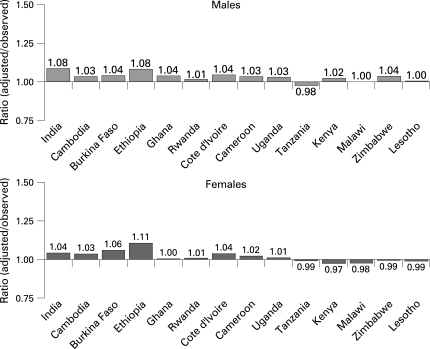
Results: Non-tested men had significantly higher predicted HIV prevalence than those tested in eight of the 14 countries, while non-tested women had significantly higher predicted prevalence than those tested in seven of the 14 countries. Effects of non-response were somewhat stronger in lower-prevalence countries. The overall effect of non-response on observed national HIV estimates was small and insignificant in all countries. Estimated effects of exclusion of non-household population groups were generally small, even in concentrated epidemics in India and Cambodia under the scenario that 75% of the non-household population was adults having 20 times greater HIV prevalence than adults in household surveys.
Conclusions: Non-response and the exclusion of non-household population groups tend to have small, insignificant effects on national HIV seroprevalence estimates obtained from household surveys.
Conflict of interest statement
Figures
References
-
- WHO and UNAIDS Guidelines for measuring national HIV prevalence in population-based surveys. Geneva: WHO and UNAIDS, 2005
-
- Stover J, Ghys PD, Walker N. Testing the accuracy of demographic estimates in countries with generalized epidemics. AIDS 2004;18(Suppl 2):S67–73 - PubMed
-
- http://www.measuredhs.com (accessed 25 April 2008)
-
- Walker N, Grassly NC, Garnett GP, et al. Estimating the global burden of HIV/AIDS: what do we really know about the HIV pandemic? Lancet 2004;363:2180–5 - PubMed
Publication types
MeSH terms
LinkOut - more resources
Full Text Sources
Medical
