


Non-response bias in estimates of HIV prevalence due to the mobility of absentees in national population-based surveys: a study of nine national surveys
- PMID: 18647870
- PMCID: PMC2569192
- DOI: 10.1136/sti.2008.030353
Non-response bias in estimates of HIV prevalence due to the mobility of absentees in national population-based surveys: a study of nine national surveys
Abstract
Objectives: To measure the bias in national estimates of HIV prevalence in population-based surveys caused by mobility and refusal to test.
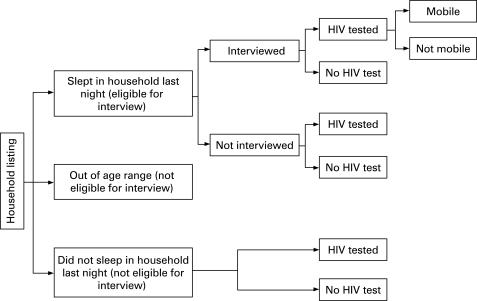
Methods: Data from nine demographic and health surveys and AIDS indicator surveys were used. Non-responders were divided into three groups: (i) "refusals" who were interviewed but not tested; (ii) "refusals" who were present in the household but not interviewed or tested; and (iii) "absentees" who were absent from the household. Correction for HIV status was made for the non-responders using multiple imputation methods with logistic regression models based on a common set of household-level and individual-level sociodemographic and behavioural factors for those tested and stratified by mobility status.
Results: The non-response groups were corrected to have higher risks of HIV than those who participated in the HIV tests, although these were only detected to be statistically significant in some of the countries. In Lesotho, the corrected prevalence for the absent household members was significantly higher than for those who were present in the household. However, the adjusted prevalences differed by less than a percentage point from the prevalences observed among those who were tested, so the overall effects of non-response on national estimates of HIV prevalence are minimal.
Conclusions: The results indicate that the mobility of absentees does not substantially bias estimates of HIV prevalence from population-based surveys. None the less, if levels of non-response are high or if non-responders differ greatly from those who participate in HIV testing with respect to HIV status, non-response could still bias national estimates of HIV prevalence.
Conflict of interest statement
Figures
References
-
- Glynn J, Buve A, Carael M, et al. Factors influencing the difference in HIV prevalence between antenatal clinic and general population in sub-Saharan Africa. AIDS 2001;15:1717–25 - PubMed
-
- Fylkesnes K, Ndhlovu Z, Kasumba K, et al. Studying dynamics of the HIV epidemic: population-based data compared with sentinel surveillance in Zambia. AIDS 1998;12:1227–34 - PubMed
-
- Walker N, Stanecki KA, Brown T, et al. Methods and procedures for estimating HIV/AIDS and its impact: the UNAIDS/WHO estimates for the end of 2001. AIDS 2003;17:2215–25 - PubMed
-
- Zaba B, Carpenter LM, Boerma TJ, et al. Adjusting ante-natal clinic data for improved estimates of HIV prevalence among women in sub-Saharan Africa. AIDS 2000;14:2741–50 - PubMed
Publication types
MeSH terms
LinkOut - more resources
Full Text Sources
Medical
