. 2008 Sep;14(9):1882-94.
doi: 10.1261/rna.1099108. Epub 2008 Jul 22.

A new regulatory circuit in ribosomal protein operons: S2-mediated control of the rpsB-tsf expression in vivo

Affiliations

A new regulatory circuit in ribosomal protein operons: S2-mediated control of the rpsB-tsf expression in vivo

Leonid V Aseev et al. RNA. 2008 Sep.

Abstract

Autogenous regulation is a general strategy of balancing ribosomal protein synthesis in bacteria. Control mechanisms have been studied in detail for most of ribosomal protein operons, except for rpsB-tsf encoding essential r-protein S2 and elongation factor Ts, where even the promoter has remained unknown. By using single-copy translational fusions with the chromosomal lacZ gene and Western-blot analysis, we demonstrate here that S2 serves as a negative regulator of both rpsB and tsf expression in vivo, acting at a single target within the rpsB 5'-untranslated region (5'-UTR). As determined by primer extension, transcription of the Escherichia coli rpsB-tsf operon starts 162 nucleotides upstream of the rpsB initiation codon at a single promoter TGTGGTATAAA belonging to the extended -10 promoter class. Both the promoter signature and the 5'-UTR structure of the rpsB gene appear to be highly conserved in gamma-proteobacteria. Deletion analysis of the rpsB 5'-UTR within rpsB'-'lacZ fusions has revealed that an operator region involved in the S2 autoregulation comprises conserved structural elements located upstream of the rpsB ribosome binding site. The S2-mediated autogenous control is impaired in rpsB mutants and, more surprisingly, in the rpsA mutant producing decreased amounts of truncated r-protein S1 (rpsAIS10), indicating that S2 might act as a repressor in cooperation with S1.


Figures
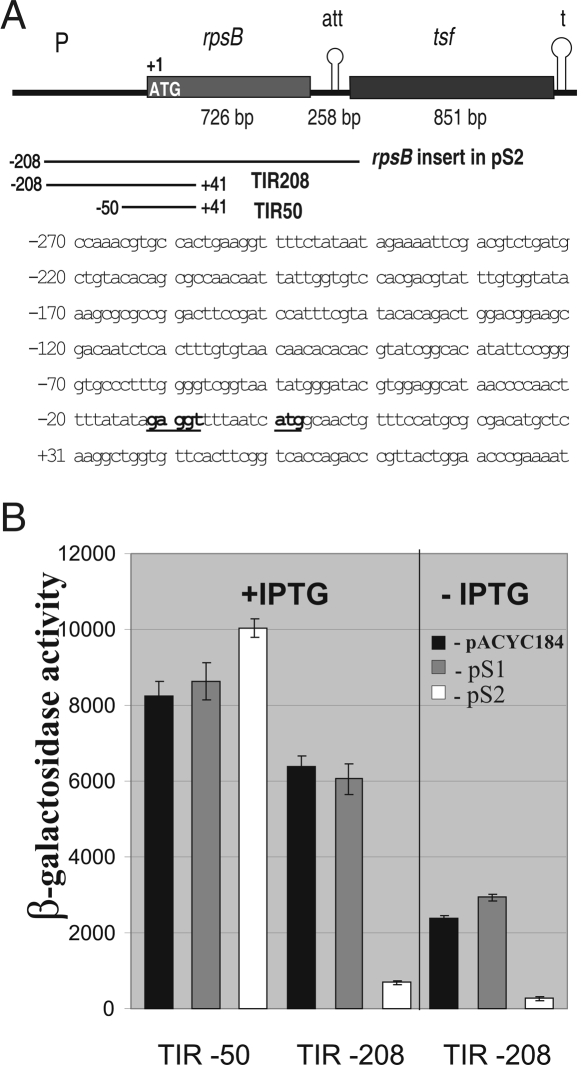
FIGURE 1.
FIGURE 1.
S2 serves as a negative regulator of the rpsB expression. (A) Structure of the E. coli rpsB-tsf operon. (P) Promoter; (att) intergenic attenuator; (t) terminator. Regions amplified by PCR for constructing the plasmid pS2 and rpsB′-′lacZ fusions are shown by lines. (Bottom) The sequence of the 5′-UTR and beginning of the rpsB coding part; the Shine-Dalgarno element and the start codon are in bold underlined. (B) Effects of S2 in trans on rpsB TIR50 and TIR208 activities in the β-galactosidase assay. Average of three independent assays and standard deviations are shown. An empty vector pACYC184 and its derivative pS1 were used as specificity controls.
FIGURE 2.
FIGURE 2.
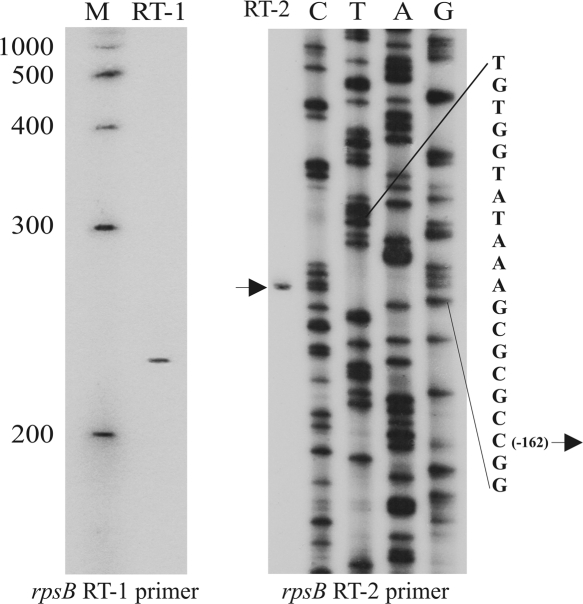
Mapping the rpsB promoter by primer extension. The products of reverse transcription on total RNA with rpsB_RT1 primer were run along with 5′-32P-labeled ssDNA markers (M). To map the 5′-end of the single rpsB transcript, both primer extension on total RNA and pES2TIR208 sequencing were done with the rpsB_RT2 primer.
FIGURE 3.
FIGURE 3.
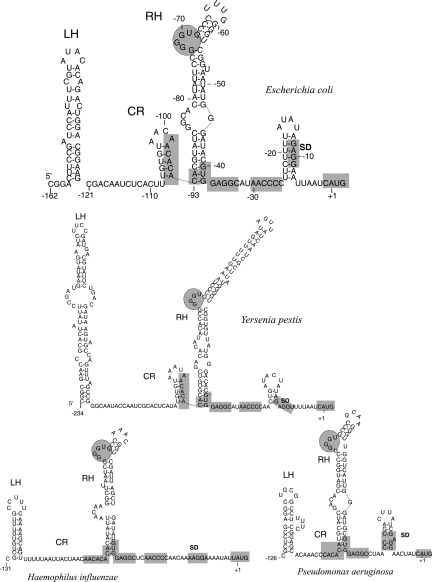
Phylogenetic conservation of the rpsB 5′-UTR fold in γ-proteobacteria revealed by Mfold program. (LH, RH) Conserved stem–loop structures designated “left hand” and “right hand,” (CR) central loosely structured region. In E. coli, CR conventionally covers −121 to −93 positions relative to the AUG codon. Conserved elements within 5′-UTRs are shadowed, conserved GGGU-bulges in the top part of RH are encircled.
FIGURE 4.
FIGURE 4.
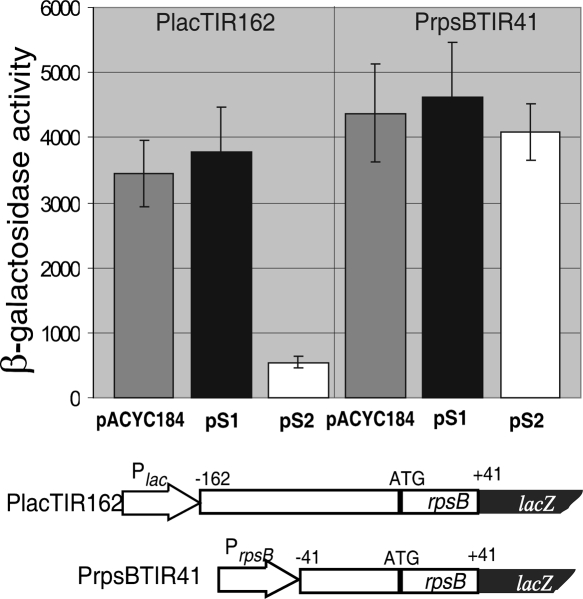
The leader part of the rpsB mRNA, not the promoter design, is essential for the S2 autoregulation. The β-galactosidase activities in the presence of pACYC184, pS1, and pS2 are shown for the PrpsBTIR41 and PlacTIR162 constructs. PrpsBTIR41 is a derivative of the TIR208 with a deleted promoter-proximal region –162 to –41. In PlacTIR162, transcription from the lac-promoter starts from A, which is immediately followed by a complete rpsB TIR.
FIGURE 5.
FIGURE 5.
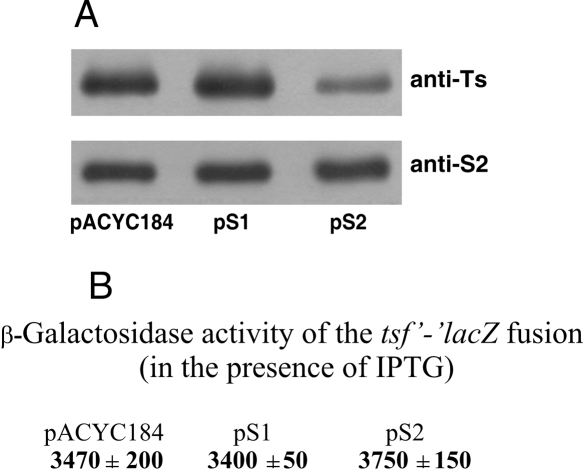
Effects of S2 in trans on the tsf expression as revealed by Western blotting (A) and the β-galactosidase assay of the tsf-lacZ translational fusion (B).
FIGURE 6.
FIGURE 6.
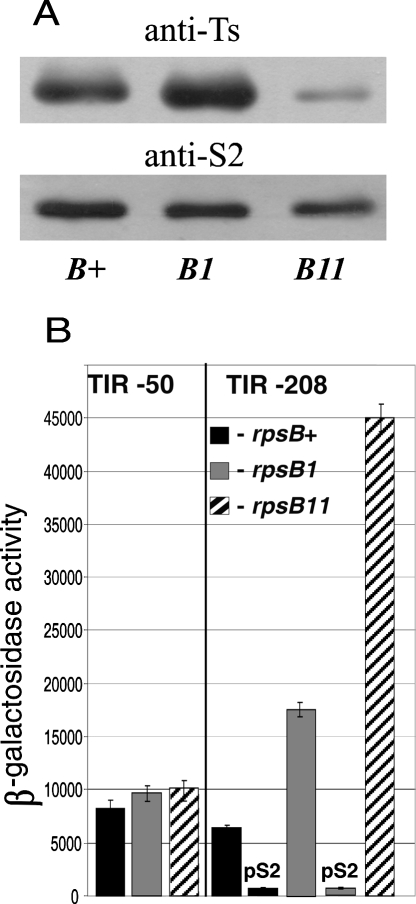
Effects of the mutations rpsB1(ts) and rpsB11 (rpsB∷IS1) on the rpsB-tsf expression. (A) Western blotting to evaluate the S2 and Ts level in the rpsB mutants. (B) β-Galactosidase activities of the rpsB′-′lacZ constructs were measured for cells exponentially grown in the presence of pACYC184 for TIR50, or pACYC184 and pS2 for TIR208. The rpsB11 cells cannot be transformed with pS2.
FIGURE 7.
FIGURE 7.
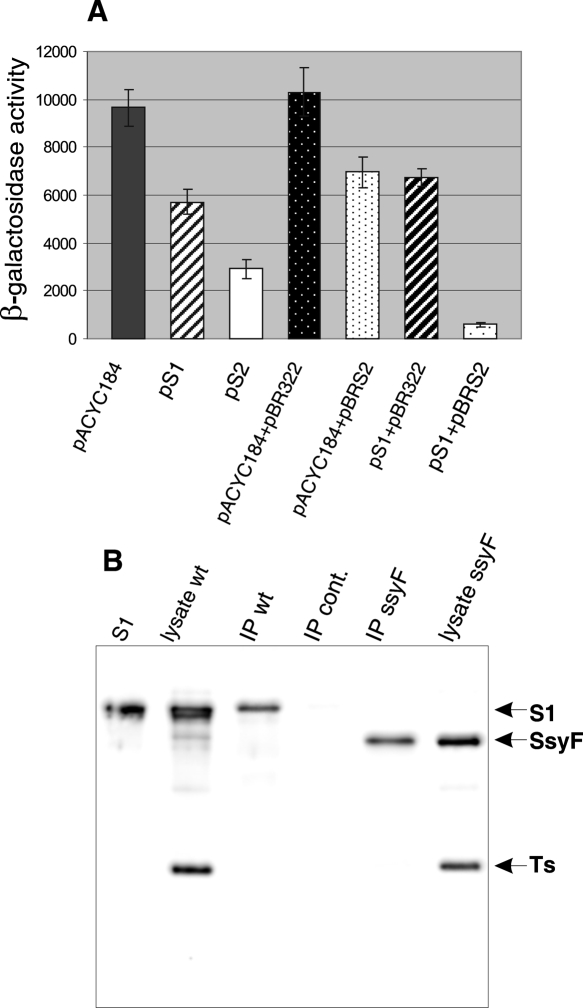
The repressor activity of S2 depends on S1 concentration in a cell. (A) The reduced repressor activity of S2 in the ssyF29 (rpsA∷IS10) mutant producing a subnormal amount of truncated S1. The β-galactosidase activities were measured for TIR208 in the presence of pACYC184, pS1, and pS2, and in a biplasmid system where the high repression level can be achieved only when pS1 and pBRS2 (expressing wt S1 and S2) are simultaneously present. (B) Immunoprecipitation of S2–S1 complex from wild-type (IP wt) and ssyF29 cell lysates (IP ssyF) in the presence of polyclonal goat antibodies against S2. Western blotting of 12.5% PAAG revealed with anti-S1 and anti-Ts rabbit polyclonal antibodies (S1) −50 ng of purified S1; (lysate wt and lysate ssyF) 2 μg of total soluble cell proteins from rpsA+ and ssyF29 exponentially grown cells; (IP cont) a specificity control showing that no S1 is precipitated from wt cell lysate in the presence of goat polyclonal antibodies against ribosomal protein S15.

References

    1. Allen T., Shen P., Samsel L., Liu R., Lindahl L., Zengel J.M. Phylogenetic analysis of L4-mediated autogenous control of the S10 ribosomal protein operon. J. Bacteriol. 1999;181:6124–6132. - PMC - PubMed
    1. Allen T.D., Watkins T., Lindahl L., Zengel J.M. Regulation of ribosomal protein synthesis in Vibrio cholerae . J. Bacteriol. 2004;186:5933–5937. - PMC - PubMed
    1. An G., Bendiak D.S., Mamelak L.A., Friesen J.D. Organization and nucleotide sequence of a new ribosomal operon in Escherichia coli containing the genes for ribosomal protein S2 and elongation factor Ts. Nucleic Acids Res. 1981;9:4163–4172. - PMC - PubMed
    1. Ardini E., Pesole G., Tagliabue E., Magnifico A., Castronovo V., Sobel M.E., Colnaghi M.I., Menard S. The 67-kDa laminin receptor originated from a ribosomal protein that acquired a dual function during evolution. Mol. Biol. Evol. 1998;15:1017–1025. - PubMed
    1. Barne K.A., Bown J.A., Busby S.J., Minchin S.D. Region 2.5 of the Escherichia coli RNA polymerase σ70 subunit is responsible for the recognition of the “extended –10” motif at promoters. EMBO J. 1997;16:4034–4040. - PMC - PubMed

Publication types

MeSH terms

LinkOut - more resources