


Which DNA damage is likely to be relevant in hormetic responses?
- PMID: 18648576
- PMCID: PMC2478520
- DOI: 10.2203/dose-response.07-009.Bernhard
Which DNA damage is likely to be relevant in hormetic responses?
Abstract
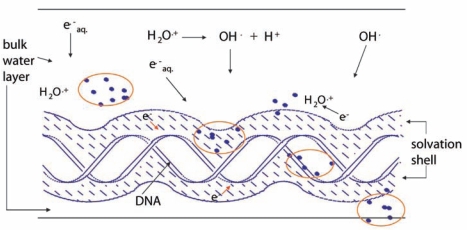
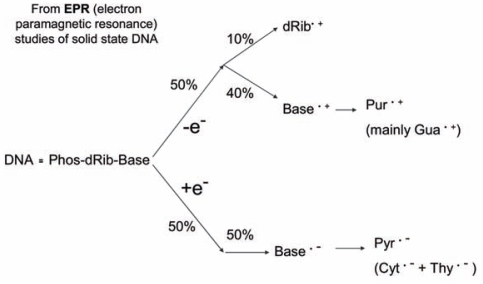
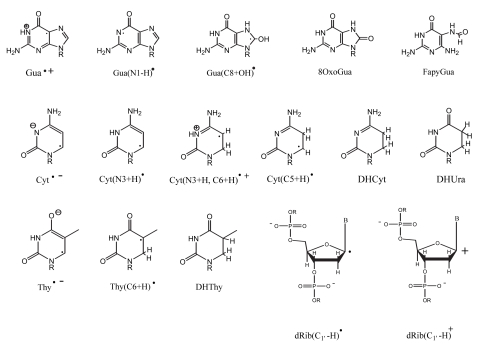
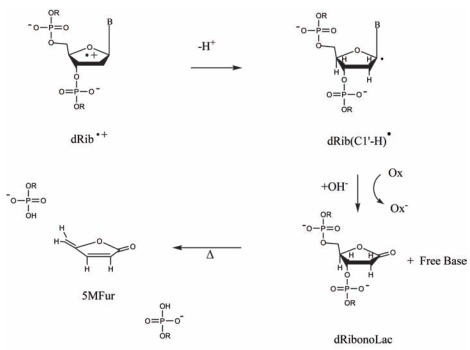
Working under the assumption that hormesis is triggered by specific types of DNA damage, this report focuses on the types of damage which form the signature of ionizing radiation. The key attribute of the signature is the clustering of damage, arising from clusters of energy deposition such that more than one site within a 10 base pair segment of DNA has been chemically altered. A brief overview is given on what is currently believed to be the primary components of clustered damage produced by the direct effect. The overview draws primarily on studies that utilize electron paramagnetic resonance to measure free radical intermediates and gel electrophoresis to measure clustered damage in plasmid DNA. Based on this information, the threshold for a radiation induced biological response is calculated.
Keywords: DNA damage; Direct effect; Plasmid DNA; Radiation chemistry; Radiation products.
Figures
References
-
- Adhikary A, Kumar A, Sevilla MD. Photo-induced hole transfer from base to sugar in DNA: relationship to primary radiation damage. Radiat Res. 2006;165:479–484. - PubMed
-
- Becker D, Razskazovskii Y, Callaghan MU, Sevilla MD. Electron spin resonance of DNA irradiated with a heavy-ion beam (16O8+): evidence for damage to the deoxyribose phosphate backbone. Radiat Res. 1996;146:361–368. - PubMed
-
- Becker D, Sevilla MD. The chemical consequences of radiation damage to DNA. In: Lett JT, Sinclair WK, editors. Advances in Radiation Biology. Academic Press; San Diego: 1993. pp. 121–180.
-
- Becker D, Sevilla MD, Wang W, LaVere T. The role of waters of hydration in direct-effect radiation damage to DNA. Radiat Res. 1997;148:508–510.
Grants and funding
LinkOut - more resources
Full Text Sources
