


Bovine tuberculosis in Doñana Biosphere Reserve: the role of wild ungulates as disease reservoirs in the last Iberian lynx strongholds
- PMID: 18648665
- PMCID: PMC2464716
- DOI: 10.1371/journal.pone.0002776
Bovine tuberculosis in Doñana Biosphere Reserve: the role of wild ungulates as disease reservoirs in the last Iberian lynx strongholds
Abstract
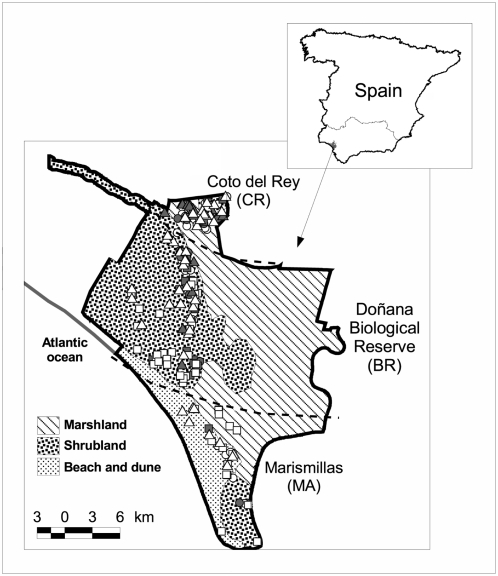
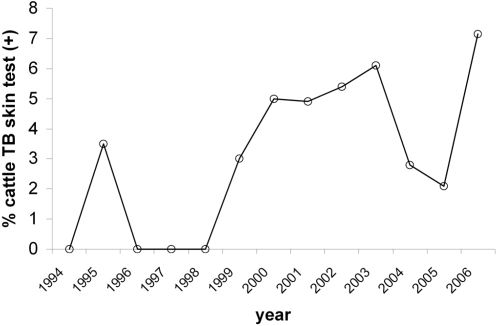
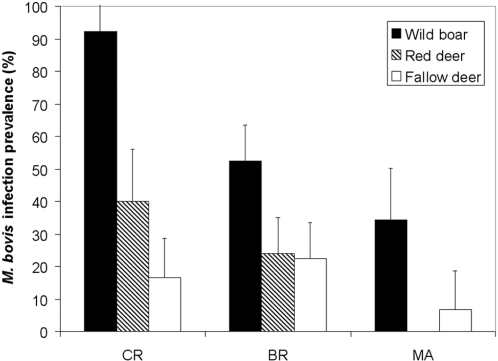
Doñana National Park (DNP) in southern Spain is a UNESCO Biosphere Reserve where commercial hunting and wildlife artificial feeding do not take place and traditional cattle husbandry still exists. Herein, we hypothesized that Mycobacterium bovis infection prevalence in wild ungulates will depend on host ecology and that variation in prevalence will reflect variation in the interaction between hosts and environmental risk factors. Cattle bTB reactor rates increased in DNP despite compulsory testing and culling of infected animals. In this study, 124 European wild boar, 95 red deer, and 97 fallow deer were sampled from April 2006 to April 2007 and analyzed for M. bovis infection. Modelling and GIS were used to identify risk factors and intra and inter-species relationships. Infection with M. bovis was confirmed in 65 (52.4%) wild boar, 26 (27.4%) red deer and 18 (18.5%) fallow deer. In the absence of cattle, wild boar M. bovis prevalence reached 92.3% in the northern third of DNP. Wild boar showed more than twice prevalence than that in deer (p<0.001). Modelling revealed that M. bovis prevalence decreased from North to South in wild boar (p<0.001) and red deer (p<0.01), whereas no spatial pattern was evidenced for fallow deer. Infection risk in wild boar was dependent on wild boar M. bovis prevalence in the buffer area containing interacting individuals (p<0.01). The prevalence recorded in this study is among the highest reported in wildlife. Remarkably, this high prevalence occurs in the absence of wildlife artificial feeding, suggesting that a feeding ban alone would have a limited effect on wildlife M. bovis prevalence. In DNP, M. bovis transmission may occur predominantly at the intra-species level due to ecological, behavioural and epidemiological factors. The results of this study allow inferring conclusions on epidemiological bTB risk factors in Mediterranean habitats that are not managed for hunting purposes. Our results support the need to consider wildlife species for the control of bTB in cattle and strongly suggest that bTB may affect animal welfare and conservation.
Conflict of interest statement
Figures
References
-
- Gortazar C, Ferroglio E, Hofle U, Frolich K, Vicente J. Diseases shared between wildlife and livestock: a European perspective. Eur J Wildl Res. 2007;53:241–256.
-
- Nishi JS, Stephen C, Elkin BT. Implications of agricultural and wildlife policy on management and eradication of bovine tuberculosis and brucellosis in free-ranging wood bison of northern Canada. Ann N Y Acad Sci. 2002;969:236–244. - PubMed
-
- Parra A, García A, Inglis NF, Tato A, Alonso JM, et al. An epidemiological evaluation of Mycobacterium bovis infections in wild game animals of the Spanish Mediterranean ecosystem. Res Vet Sci. 2006;80:140–146. - PubMed
-
- Vicente J, Höfle U, Garrido JM, Fernández-de-Mera IG, Juste R, et al. Wild boar and red deer display high prevalences of tuberculosis-like lesions in Spain. Vet Res. 2006;37:107–119. - PubMed
Publication types
MeSH terms
LinkOut - more resources
Full Text Sources
Miscellaneous
