Genotypic analysis of two hypervariable human cytomegalovirus genes
- PMID: 18649324
- PMCID: PMC2658010
- DOI: 10.1002/jmv.21241
Genotypic analysis of two hypervariable human cytomegalovirus genes
Abstract
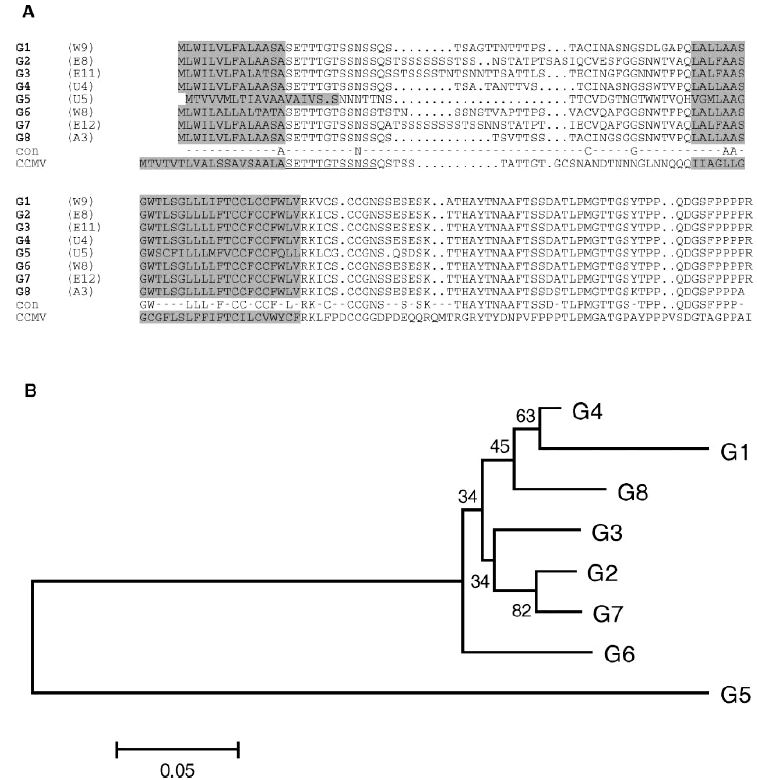
Most human cytomegalovirus (HCMV) genes are highly conserved in sequence among strains, but some exhibit a substantial degree of variation. Two of these genes are UL146, which encodes a CXC chemokine, and UL139, which is predicted to encode a membrane glycoprotein. The sequences of these genes were determined from a collection of 184 HCMV samples obtained from Africa, Australia, Asia, Europe, and North America. UL146 is hypervariable throughout, whereas variation in UL139 is concentrated in a sequence encoding a potentially highly glycosylated region. The UL146 sequences fell into 14 genotypes, as did all previously reported sequences. The UL139 sequences grouped into 8 genotypes, and all previously reported sequences fell into a subset of these. There were minor differences among continents in genotypic frequencies for UL146 and UL139, but no clear geographical separation, and identical nucleotide sequences were represented among communities distant from each other. The frequent detection of multiple genotypes indicated that mixed infections are common. For both genes, the degree of divergence was sufficient to preclude reliable sequence alignments between genotypes in the most variable regions, and the mode of evolution involved in generating the genotypes could not be discerned. Within genotypes, constraint appears to have been the predominant mode, and positive selection was detected marginally at best. No evidence was found for linkage disequilibrium. The emerging scenario is that the HCMV genotypes developed in early human populations (or even earlier), becoming established via founder or bottleneck effects, and have spread, recombined and mixed worldwide in more recent times.
Figures
References
-
- Arav-Boger R, Foster CB, Zong JC, Pass RF. Human cytomegalovirus-encoded α-chemokines exhibit high sequence variability in congenitally infected newborns. J Infect Dis. 2006;193:788–791. - PubMed
-
- Arav-Boger R, Zong JC, Foster CB. Loss of linkage disequilibrium and accelerated protein divergence in duplicated cytomegalovirus chemokine genes. Virus Genes. 2005;31:65–72. - PubMed
-
- Baggiolini M, Dewald B, Moser B. Human chemokines: An update. Annu Rev Immunol. 1997;15:675–705. - PubMed
-
- Beyari MM, Hodgson TA, Kondowe W, Molyneux EM, Scully C, Porter SR, Teo CG. Inter-and intra-person cytomegalovirus infection in Malawian families. J Med Virol. 2005;75:575–582. - PubMed
Publication types
MeSH terms
Substances
Grants and funding
LinkOut - more resources
Full Text Sources