. 2008 Jul 23;28(30):7659-69.
doi: 10.1523/JNEUROSCI.1760-08.2008.

A role for polymodal C-fiber afferents in nonhistaminergic itch

Affiliations

A role for polymodal C-fiber afferents in nonhistaminergic itch

Lisa M Johanek et al. J Neurosci. .

Abstract

Recent psychophysical and electrophysiological studies in humans suggest the existence of two peripheral pathways for itch, one that is responsive to histamine and a second pathway that can be activated by nonhistaminergic pruritogens (e.g., cowhage spicules). To explore the peripheral neuronal pathway for nonhistaminergic itch, behavioral responses and neuronal activity in unmyelinated afferent fibers were assessed in monkey after topical application of cowhage spicules or intradermal injection of histamine and capsaicin. Cowhage and histamine, but not capsaicin, evoked scratching behavior indicating the presence of itch. In single-fiber recordings, cowhage, histamine and/or capsaicin were applied to the cutaneous receptive field of 43 mechano-heat-sensitive C-fiber (CMH) nociceptors. The majority of CMHs exhibited a prolonged response to cowhage (39 of 43) or histamine (29 of 38), but not to capsaicin (3 of 34). Seven CMHs were activated by cowhage but not histamine. The average response to cowhage was more than twice the response to histamine, and responses were not correlated. The response of the CMHs to a stepped heat stimulus (49 degrees C, 3 s) was either quickly adapting (QC) or slowly adapting (SC). In contrast, the cowhage response was characterized by bursts of two or more action potentials (at approximately 1 Hz). The total cowhage response of the QC fibers (97 action potentials/5 min) was twice that of the SC fibers (49 action potentials/5 min). A subset of QC fibers exhibited high-frequency intraburst discharges ( approximately 30 Hz). These results suggest multiple mechanisms by which CMHs may encode itch to cowhage as well as pain to mechanical and heat stimuli.


Figures

Figure 1.
Figure 1.
Cutaneous administration of histamine and active cowhage spicules induces scratching behavior in monkey (n = 3). Scratching was not observed after the application of saline, inactive cowhage spicules, or capsaicin and its vehicle. The number of scratches was counted by a blinded observer for 30 min after stimulus application. Error bars indicate mean ± SEM.
Figure 2.
Figure 2.
Two types of heat responses are observed in heat-sensitive C-fibers. A, Stimulus waveform of the laser heat stimulus (49°C, 3 s) used to differentiate responses to heat. B, The QC fiber (open circles) exhibits a high-frequency neuronal discharge at stimulus onset, but this response adapts within <1 s. In contrast, the SC fiber (filled circles) shows an almost constant discharge over the stimulation period. In B, each dot corresponds to time of occurrence of an action potential. Instantaneous frequency is computed based on the reciprocal of the interval after the action potential. C, Histogram for the heat thresholds in QC and SC fibers shows two almost nonoverlapping distributions. Heat thresholds were determined with a staircase heat stimulus from 38°C to 49°C with an increment of 1°C per 1 s.
Figure 3.
Figure 3.
Active cowhage causes bursting discharge in CMH afferent. A, Response induced by inactive cowhage (4 spicules) in unit AB59.3C. Inset, Superimposed action potential waveforms (n = 10). B, Response of the same afferent to active cowhage (8 spicules). Instantaneous action potential frequency is plotted as function of time after stimulus application. Each black dot indicates the occurrence of an action potential. The gray bar indicates the time of application of the spicules to the receptive field. A large mechanical response was typically observed during the cowhage application period. Inset, Expanded time course of response over two different intervals (vertical line corresponds to time of action potential). C, Histogram of the interspike frequencies for the response to active cowhage shown in B. Two peaks are apparent. Note that bins are in log increments (factors of 2). D, Response of the same unit to the heat stimulus (49°C, 3 s). Although this unit showed a bursting discharge to cowhage, the response to heat was slowly adapting and the unit was classified as an SC fiber.
Figure 4.
Figure 4.
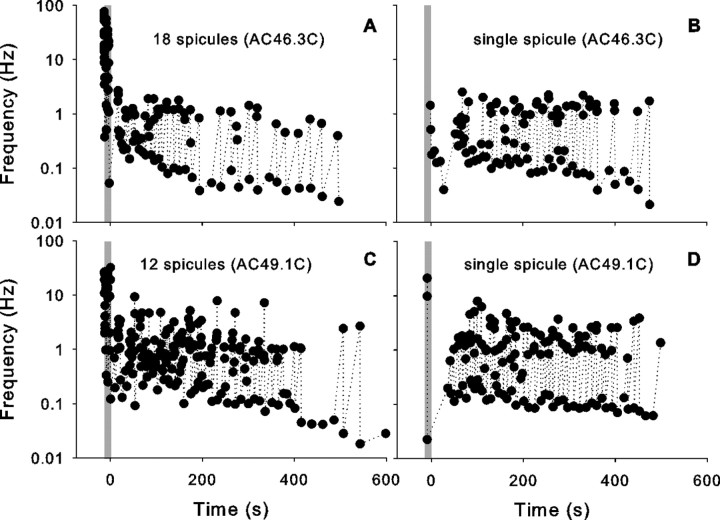
The response to a single cowhage spicule can be quite vigorous. A, C, Response elicited after insertion of multiple active cowhage spicules into the receptive field of two different units (AC46.3C, AC49.1C). B, D, The activity elicited after insertion of a single cowhage spicule can be comparable with that evoked by multiple spicules. The format similar to that used in Figure 3B. Note that the mechanically-evoked response during the application period (gray bar) is much less when a single spicule is inserted.
Figure 5.
Figure 5.
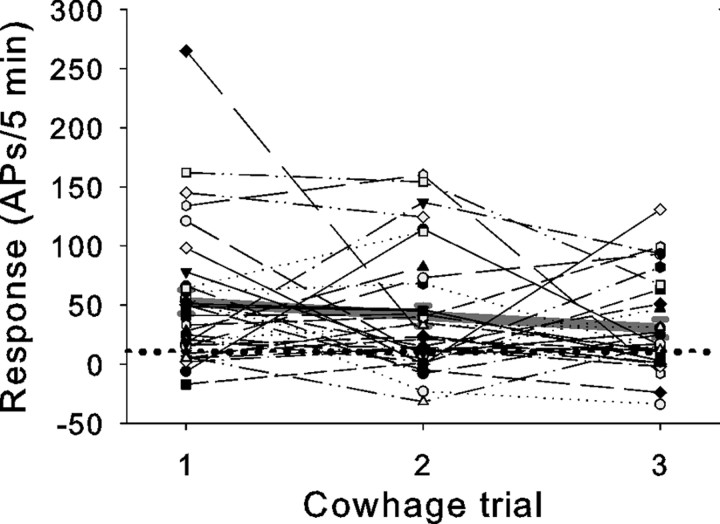
Responses to cowhage varied within fibers. For each fiber tested with multiple applications of cowhage, the number of action potentials in each 5 min trial was plotted. Responses were corrected for ongoing spontaneous activity observed during the baseline period before the application of cowhage. This explains negative responses. The average response for each trial is plotted in gray. Trials resulting in ≥10 action potentials were regarded as a positive responses (dotted line) if the number of action potentials was at least twice as large as the number observed after administration of inactive spicules.
Figure 6.
Figure 6.
Three different types of discharge patterns were seen in response to active cowhage. A, Bursting discharge at intermediate frequency in unit AC48.2C. B, High-frequency bursting discharge in unit AB61.1C. Note that the scale is changed. C, Slow irregular discharge with intermittent bursts in unit AB58.2C. Gray areas mark time period of cowhage application. The format similar to that used in Figure 3B. D, Instantaneous frequency histogram averaged across all cowhage trials from cowhage responsive afferents. Three peaks are apparent. The format is similar to that used in Figure 3C.
Figure 7.
Figure 7.
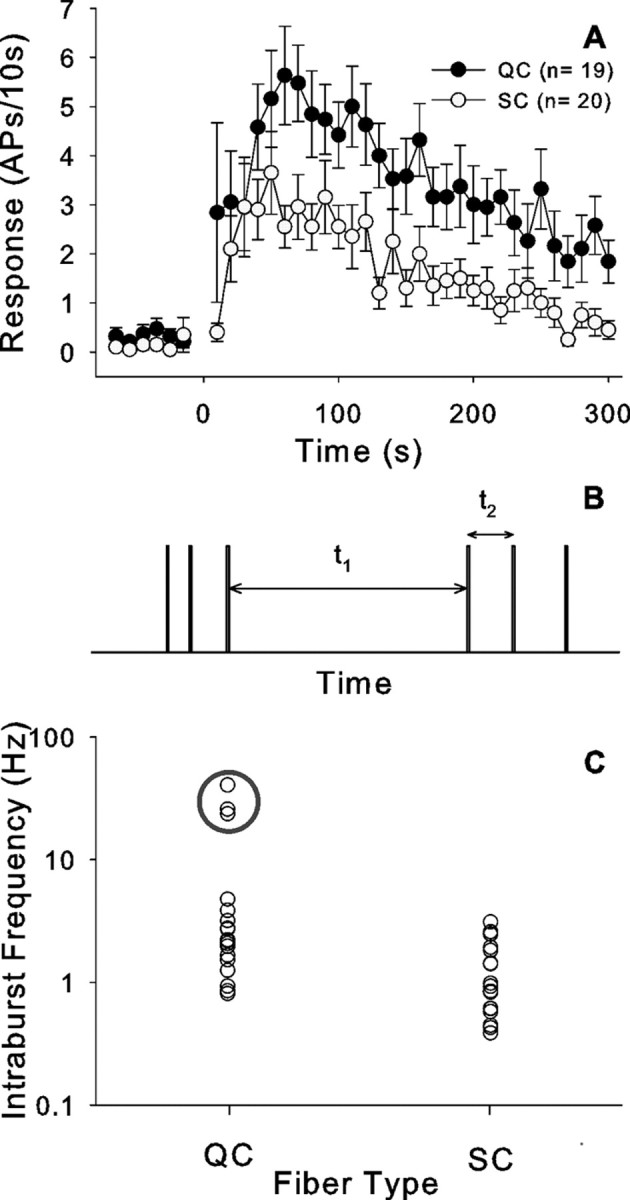
QC and SC fibers respond differently to cowhage application. A, Time course of cowhage-induced excitation in QC and SC fibers looks similar, but the discharge in QC fibers is larger (bin size, 10 s). B, Parameters extracted from the discharge pattern to define a burst: t1, interburst interval, t2, intraburst interval. The onset of a burst was defined by t1/t2 ≥ 5. C, Intraburst frequency (1/t2) in QC and SC fibers. Each circle corresponds to a different fiber. The average intraburst frequency for that fiber is plotted. QC fibers had significantly higher intraburst frequencies than SC fibers. Three QC fibers had particularly high intraburst frequencies (enclosed by gray circle). Error bars indicate SEM.
Figure 8.
Figure 8.
CMH response to histamine. A, The fiber (AB59.3C) responded to insertion of the needle and injection of the volume of saline (10 μl), but responded only weakly (5 APs) during the 5 min after the injection. B, Histamine injection (1 μg) produced a long-lasting bursting discharge (same fiber as in Fig. 3). The format is similar to that used in Figure 3B. Gray areas mark the time period of needle insertion and injection.
Figure 9.
Figure 9.
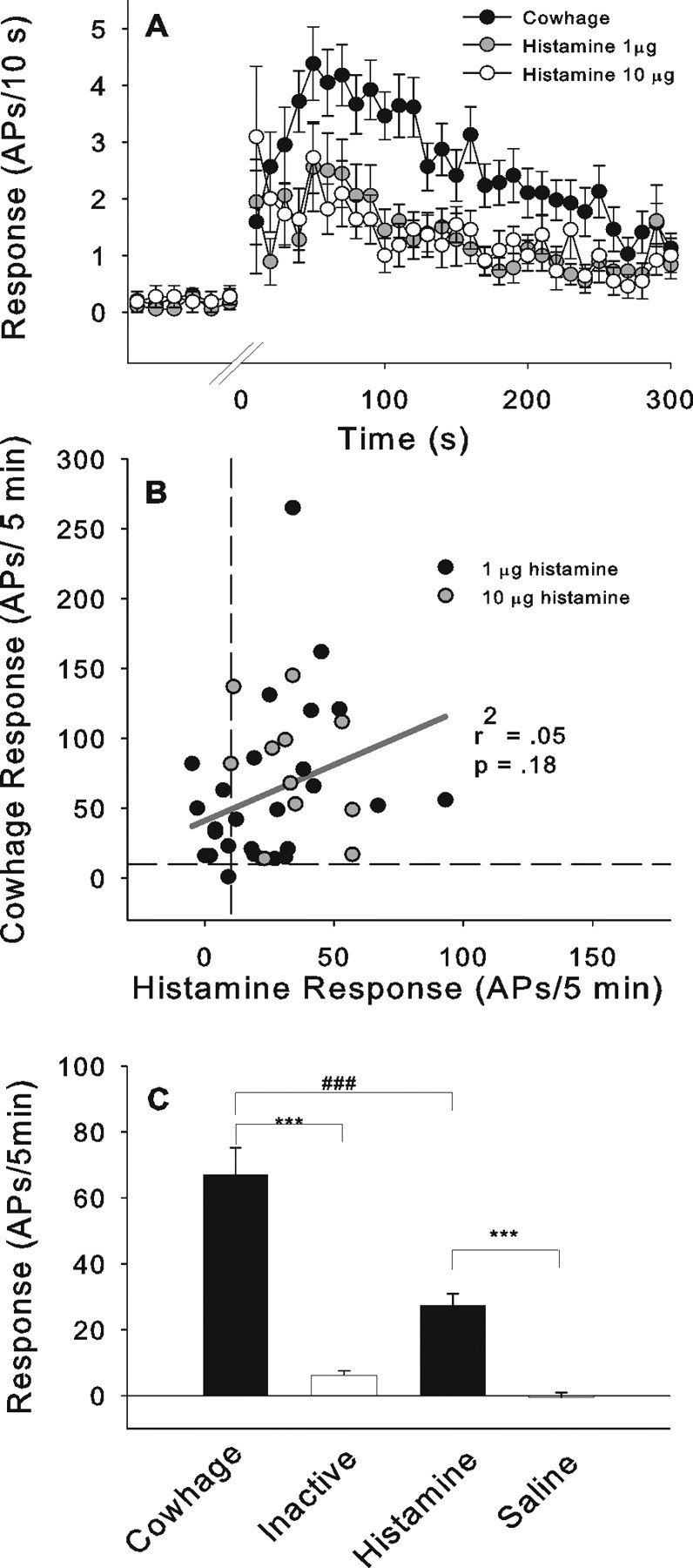
A, Time course of the neuronal activity after the administration of cowhage or histamine (1 μg, 10 μg). Time courses of cowhage (n = 39) and histamine (1 μg, n = 18; 10 μg, n = 11) excitation were similar. Time courses for high and low dose histamine were not different. B, Scatter plot of the total response to cowhage and histamine. There was no correlation between responses suggesting that the excitations are induced by two independent mechanisms. C, Comparison between the total response during the 5 min after the application of cowhage and histamine and respective controls. Responses to cowhage were significantly larger than those to histamine (ANOVA, F(41,3)=40.6, p < 0.01; followed by Bonferroni test, ***p < 0.001, ###p < 0.001). For units tested with multiple cowhage applications, only the maximal response was used in the analysis. Error bars indicate SEM.

References

    1. Amir R, Liu CN, Kocsis JD, Devor M. Oscillatory mechanism in primary sensory neurones. Brain. 2002;125:421–435. - PubMed
    1. Andrew D, Craig AD. Spinothalamic lamina I neurons selectively sensitive to histamine: a central neural pathway for itch. Nat Neurosci. 2001;4:72–77. - PubMed
    1. Baumann TK, Simone DA, Shain CN, LaMotte RH. Neurogenic hyperalgesia: the search for the primary cutaneous afferent fibers that contribute to capsaicin-induced pain and hyperalgesia. J Neurophysiol. 1991;66:212–227. - PubMed
    1. Campbell JN, Meyer RA. Sensitization of unmyelinated nociceptive afferents in the monkey varies with skin type. J Neurophysiol. 1983;49:98–110. - PubMed
    1. Carstens E. Responses of rat spinal dorsal horn neurons to intracutaneous microinjection of histamine, capsaicin, and other irritants. J Neurophysiol. 1997;77:2499–2514. - PubMed

Publication types

MeSH terms