


Testosterone concentration in young patients with diabetes
- PMID: 18650372
- PMCID: PMC2551646
- DOI: 10.2337/dc08-0851
Testosterone concentration in young patients with diabetes
Abstract
Objective: We have previously shown that hypogonadotrophic hypogonadism is common in middle-aged patients with type 2, but not with type 1, diabetes. We have now investigated the total and free testosterone concentrations in young (aged 18-35 years) type 1 and type 2 diabetic patients.
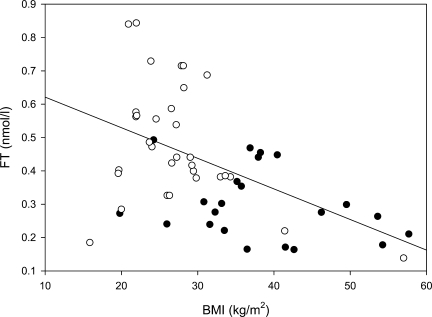
Research design and methods: In this study carried out in a tertiary referral center, serum concentrations of total and free testosterone were measured in 38 type 1 diabetic (mean age 26.45 +/- 0.89 years) and 24 type 2 diabetic (mean age 27.87 +/- 0.97 years) subjects. The mean BMI of type 1 and type 2 diabetic patients was 27.41 +/- 1.18 and 38.55 +/- 2.04 kg/m(2), respectively (P < 0.001).
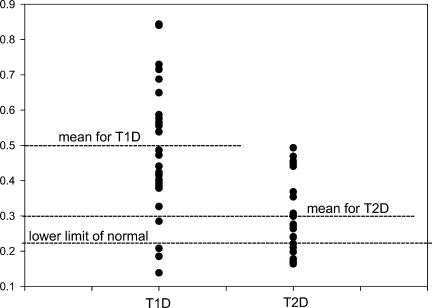
Results: The mean total testosterone concentration of type 1 and type 2 diabetic patients was 22.89 +/- 1.23 and 11.14 +/- 0.99 nmol/l, respectively (P < 0.001). The mean free testosterone concentration of type 1 and type 2 diabetic patients was 0.489 +/- 0.030 and 0.296 +/- 0.022 nmol/l, respectively (P < 0.001). Eight of 24 (33%) type 2 diabetic patients had subnormal free testosterone concentrations (<0.225 nmol/l). Using an age-based reference range, 14 of 24 (58%) type 2 diabetic patients had low free testosterone concentrations (<0.278 nmol/l). Three of 38 (8%) type 1 diabetic patients had free testosterone concentrations below the lower limit of normal (P = 0.02 when compared with type 2 diabetes). Luteinizing hormone (LH) and follicle-stimulating hormone (FSH) concentrations in type 2 diabetic patients with low free testosterone concentrations were in the normal range and were similar to those in type 1 diabetic patients.
Conclusions: Young type 2 diabetic patients have significantly lower plasma concentrations of total and free testosterone and inappropriately low LH and FSH concentrations with a very high prevalence of hypogonadotrophic hypogonadism, when compared with type 1 diabetic patients of a comparable age. The potential implications for their sexual and reproductive function during prime reproductive years are profound.
Figures
References
-
- Dhindsa S, Prabhakar S, Sethi M, Bandyopadhyay A, Chaudhuri A, Dandona P: Frequent occurrence of hypogonadotropic hypogonadism in type 2 diabetes. J Clin Endocrinol Metab 89:5462–5468, 2004 - PubMed
-
- Kapoor D, Aldred H, Clark S, Channer KS, Jones TH: Clinical and biochemical assessment of hypogonadism in men with type 2 diabetes: correlations with bioavailable testosterone and visceral adiposity. Diabetes Care 30:911–917, 2007 - PubMed
-
- Tomar R, Dhindsa S, Chaudhuri A, Mohanty P, Garg R, Dandona P: Contrasting testosterone concentrations in type 1 and type 2 diabetes. Diabetes Care 29:1120–1122, 2006 - PubMed
-
- Woodhouse LJ, Gupta N, Bhasin M, Singh AB, Ross R, Phillips J, Bhasin S: Dose-dependent effects of testosterone on regional adipose tissue distribution in healthy young men. J Clin Endocrinol Metab 89:718–726, 2004 - PubMed
Publication types
MeSH terms
Substances
Grants and funding
LinkOut - more resources
Full Text Sources
Medical
