. 2008 Jul 29;105(30):10547-52.
doi: 10.1073/pnas.0711666105. Epub 2008 Jul 23.

In vivo selection of genetically modified erythroblastic progenitors leads to long-term correction of beta-thalassemia

Affiliations

In vivo selection of genetically modified erythroblastic progenitors leads to long-term correction of beta-thalassemia

Annarita Miccio et al. Proc Natl Acad Sci U S A. .

Abstract

Gene therapy for beta-thalassemia requires stable transfer of a beta-globin gene into hematopoietic stem cells (HSCs) and high and regulated hemoglobin expression in the erythroblastic progeny. We developed an erythroid-specific lentiviral vector driving the expression of the human beta-globin gene from a minimal promoter/enhancer element containing two hypersensitive sites from the beta-globin locus control region. Transplantation of transduced HSCs into thalassemic mice leads to stable and long-term correction of anemia with all red blood cells expressing the transgene. A frequency of 30-50% of transduced HSCs, harboring an average vector copy number per cell of 1, was sufficient to fully correct the thalassemic phenotype. In the mouse model of Cooley's anemia transplantation of transduced cells rescues lethality, leading to either a normal or a thalassemia intermedia phenotype. We show that genetically corrected erythroblasts undergo in vivo selection with preferential survival of progenitors harboring proviral integrations in genome sites more favorable to high levels of vector-derived expression. These data provide a rationale for a gene therapy approach to beta-thalassemia based on partially myeloablative transplantation protocols.


Conflict of interest statement

The authors declare no conflict of interest.

Figures
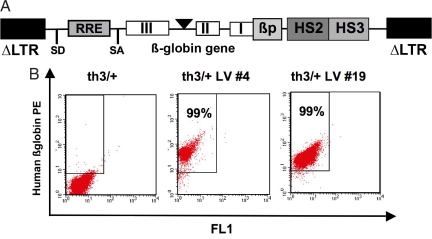
Fig. 1.
Fig. 1.
GLOBE LV-derived human β-globin expression in RBCs of th3/+ transplanted mice. (A) Schematic representation of GLOBE LV in its proviral form. LTRs deleted of 400 bp in the HIV U3 region (ΔLTR), rev-responsive element (RRE), splicing donor (SD) and splicing acceptor (SA) sites, human β-globin gene, β-globin promoter (βp), and DNase I-hypersensitive sites HS2 and HS3 from β-globin LCR are shown. (B) FACS analysis of peripheral blood samples 6 months after BM transplantation from mice transplanted with mock-transduced (th3/+) and transduced (th3/+ LV) cells. PE, phycoerythrin.
Fig. 2.
Fig. 2.
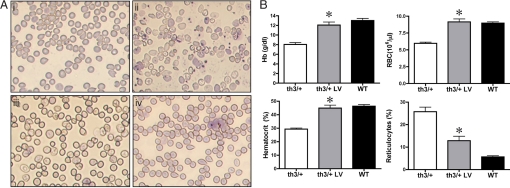
Correction of hematological parameters in mice transplanted with transduced BM. (A) May–Grunwald/Giemsa staining of blood smears derived from mice transplanted with mock-transduced normal (i), th3/+ (ii), and transduced th3/+ (iii and iv) HSCs. Abnormal RBC morphology and reticulocytosis, which are typical in thalassemic mice (ii), were completely corrected in mice transplanted with transduced HSCs (iii and iv). (Original magnification ×40.) (B) Hb concentration, RBC count, Hct, and percentages of reticulocytes in peripheral blood of mice transplanted with mock-transduced th3/+ (white column; n = 8), normal (WT; black column; n = 9), and transduced th3/+ (th3/+ LV; gray column; n = 8) cells. Values represent the mean and SEM for each group of animals. Hematological parameters were significantly different in th3/+ mice transplanted with transduced HSCs compared with control th3/+ mice (Hb concentration, P < 0.001; RBC count, P < 0.001; Hct, P < 0.01; reticulocyte count, P < 0.001). No statistically significant difference was found compared with normal controls.
Fig. 3.
Fig. 3.
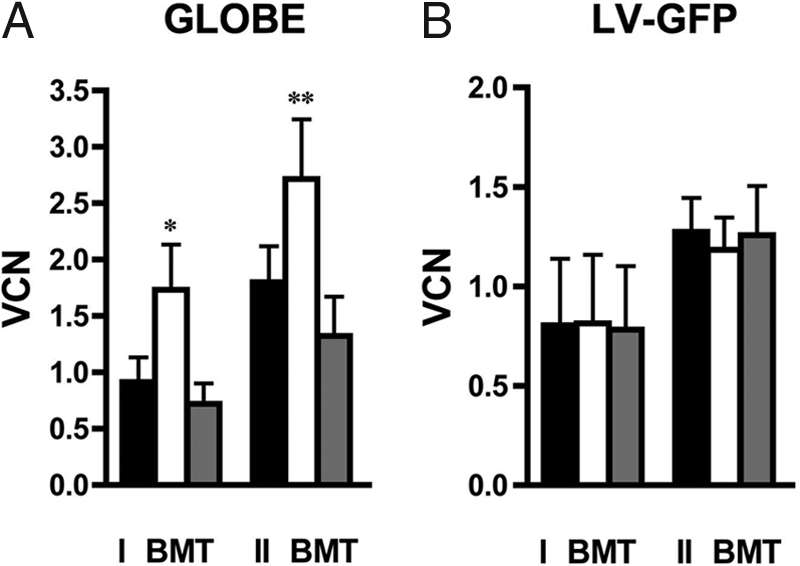
In vivo selection of transduced erythroid progenitors. (A) VCN in total BM (black bar), Ter119+ (white bar), and Ter119 (gray bar) cells from primary (I BMT) and secondary (II BMT) recipients transplanted with HSCs transduced by GLOBE. (B) VCN analysis in control th3/+ recipients of HSCs transduced with LV-GFP. *, P > 0.005; **, P = 0.05).
Fig. 4.
Fig. 4.
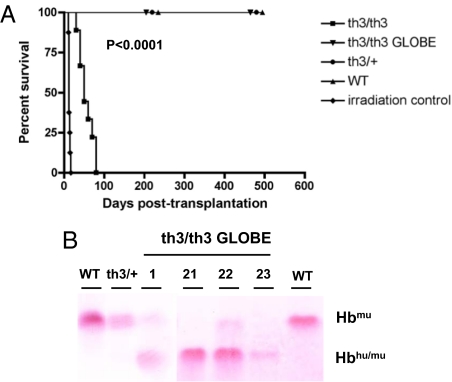
Rescue from death and Hb production in th3/th3 hematopoietic chimeras. (A) Lethally irradiated recipients were transplanted with mock-transduced (th3/th3; n = 9) and transduced th3/th3 FLCs (th3/th3 GLOBE; n = 16). Control mice received mock-transduced th3/+ (n = 8), normal (WT) FLCs (n = 8), or were lethally irradiated (irradiation controls, n = 8). Survival was monitored and Kaplan–Meier analysis was performed. Mice transplanted with mock-transduced th3/th3 FLCs died (T50 = 50 days) significantly later than the irradiation controls (T50 = 12 days; P < 0.0001, log-rank test). All mice transplanted with transduced th3/th3 FLCs survived long-term (P < 0.0001 for th3/th3 vs. th3/th3 GLOBE, log-rank test). (B) Analysis of murine (Hbmu) and chimeric (Hbhu/mu) Hb tetramers by cellulose acetate. In mice transplanted with transduced FLCs (th3/th3 GLOBE), the percentage of Hbhu/mu tetramers reached more than 90% of total Hb, as determined by densitometric analysis of Ponceau S-stained bands.

References

    1. Lucarelli G, Andreani M, Angelucci E. The cure of thalassemia by bone marrow transplantation. Blood Rev. 2002;16:81–85. - PubMed
    1. May C, et al. Therapeutic haemoglobin synthesis in beta-thalassaemic mice expressing lentivirus-encoded human beta-globin. Nature. 2000;406:82–86. - PubMed
    1. Imren S, et al. Permanent and panerythroid correction of murine β thalassemia by multiple lentiviral integration in hematopoietic stem cells. Proc Natl Acad Sci USA. 2002;99:14380–14385. - PMC - PubMed
    1. Puthenveetil G, et al. Successful correction of the human beta-thalassemia major phenotype using a lentiviral vector. Blood. 2004;104:3445–3453. - PubMed
    1. Sadelain M. Recent advances in globin gene transfer for the treatment of beta-thalassemia and sickle cell anemia. Curr Opin Hematol. 2006;13:142–148. - PubMed

Publication types