


Generation of mTert-GFP mice as a model to identify and study tissue progenitor cells
- PMID: 18650388
- PMCID: PMC2492454
- DOI: 10.1073/pnas.0804800105
Generation of mTert-GFP mice as a model to identify and study tissue progenitor cells
Abstract
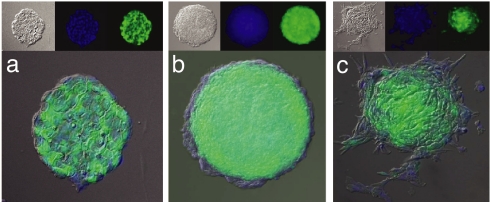
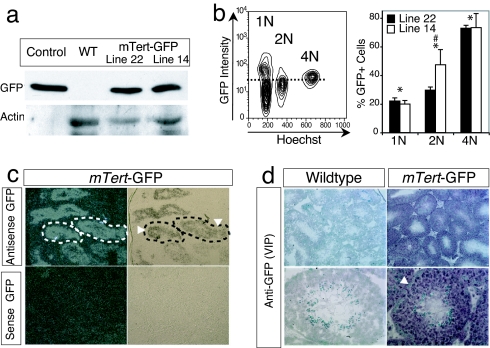
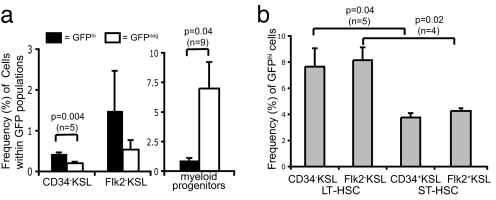
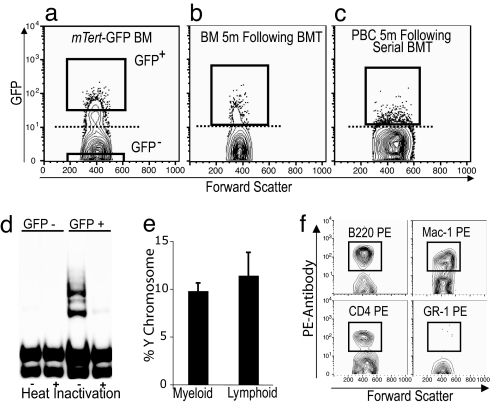
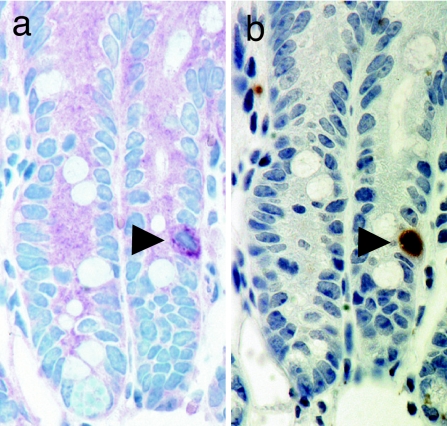
Stem cells hold great promise for regenerative medicine, but remain elusive in many tissues in part because universal markers of "stemness" have not been identified. The ribonucleoprotein complex telomerase catalyzes the extension of chromosome ends, and its expression is associated with failure of cells to undergo cellular senescence. Because such resistance to senescence is a common characteristic of many stem cells, we hypothesized that telomerase expression may provide a selective biomarker for stem cells in multiple tissues. In fact, telomerase expression has been demonstrated within hematopoietic stem cells. We therefore generated mouse telomerase reverse transcriptase (mTert)-GFP-transgenic mice and assayed the ability of mTert-driven GFP to mark tissue stem cells in testis, bone marrow (BM), and intestine. mTert-GFP mice were generated by using a two-step embryonic stem cell-based strategy, which enabled primary and secondary screening of stably transfected clones before blastocyst injection, greatly increasing the probability of obtaining mTert reporter mice with physiologically appropriate regulation of GFP expression. Analysis of adult mice showed that GFP is expressed in differentiating male germ cells, is enriched among BM-derived hematopoietic stem cells, and specifically marks long-term BrdU-retaining intestinal crypt cells. In addition, telomerase-expressing GFP(+) BM cells showed long-term, serial, multilineage BM reconstitution, fulfilling the functional definition of hematopoietic stem cells. Together, these data provide direct evidence that mTert-GFP expression marks progenitor cells in blood and small intestine, validating these mice as a useful tool for the prospective identification, isolation, and functional characterization of progenitor/stem cells from multiple tissues.
Conflict of interest statement
The authors declare no conflict of interest.
Figures
References
-
- Kondo M, et al. Biology of hematopoietic stem cells and progenitors: Implications for clinical application. Annu Rev Immunol. 2003;21:759–806. - PubMed
-
- Lovell-Badge R. The future for stem cell research. Nature. 2001;414:88–91. - PubMed
-
- Blackburn EH. Structure and function of telomeres. Nature. 1991;350:569–573. - PubMed
-
- Armstrong L, Lako M, Lincoln J, Cairns PM, Hole N. mTert expression correlates with telomerase activity during the differentiation of murine embryonic stem cells. Mech Dev. 2000;97:109–116. - PubMed
Publication types
MeSH terms
Substances
Grants and funding
LinkOut - more resources
Full Text Sources
Other Literature Sources
Medical
Molecular Biology Databases
