


doi: 10.1039/b805456h.
Epub 2008 Jun 13.
Controlled encapsulation of single-cells into monodisperse picolitre drops
Affiliations
- PMID: 18651066
- PMCID: PMC2570196
- DOI: 10.1039/b805456h
Item in Clipboard
Controlled encapsulation of single-cells into monodisperse picolitre drops
Lab Chip.
2008 Aug.
Abstract
Encapsulation of cells within picolitre-size monodisperse drops provides new means to perform quantitative biological studies on a single-cell basis for large cell populations. Variability in the number of cells per drop due to stochastic cell loading is a major barrier to these techniques. We overcome this limitation by evenly spacing cells as they travel within a high aspect-ratio microchannel; cells enter the drop generator with the frequency of drop formation.
Figures
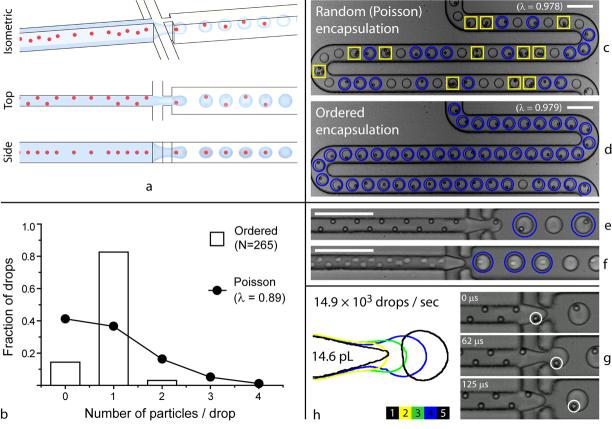
Ordered encapsulation. As depicted schematically in (a), hydrodynamic interactions cause particles to self-organize along one side of the microchannel or into a diagonal/alternating pattern. The uniform spacing in the direction of flow (see side view) leads to the formation of single-particle drops when the two lateral flows of oil pull drops from the aqueous stream (see isometric view) with the same (or slower) frequency that particles reach the microdrop generator (g). As the results for 0.89 beads per drop on average in (b) indicate, ordered encapsulation of beads (d-e) generates more single-particle drops (circles) and fewer empty (not marked) or multiple-particle drops (boxes) than would have been possible from (c) stochastic (Poisson) loading. With little or no loss in membrane integrity, cells also self-organize (f), where drops formed as in (h). Scale bars: 100 μm.
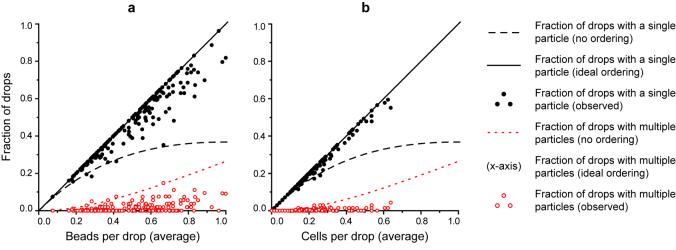
Fraction of drops that contain a single particle (singles) and of drops that contain more than one particle (multiples) vs. average number of particles per drop (λ) for (a) beads and (b) cells. Data points (experiment) are plotted alongside curves expected for perfect (ordered) and random (Poisson) encapsulation. Fractions of singles fit a linear trend versus concentration, where they occurred with a frequency of 0.937 λ for beads and 0.966 λ for cells (1 λ is ideal). Multiples should not occur for perfect ordering but resulted sporadically from pre-existing particle aggregates (0.0303 λ and 0.0171 λ for beads and cells, respectively). Each presented data point represents an analysis of 50 – 250 drops in one of many wide-field frames of video, chosen at regular intervals from high-speed videos up to 5 ½ minutes long, totaling 8.42 × 10³ beads in 18.9 × 10³ drops and 4.46 × 10³ cells in 21.6 × 10³ drops.
References
Publication types
MeSH terms
Grants and funding
LinkOut - more resources
Full Text Sources
Other Literature Sources
