International funding for malaria control in relation to populations at risk of stable Plasmodium falciparum transmission
- PMID: 18651785
- PMCID: PMC2488181
- DOI: 10.1371/journal.pmed.0050142
International funding for malaria control in relation to populations at risk of stable Plasmodium falciparum transmission
Abstract
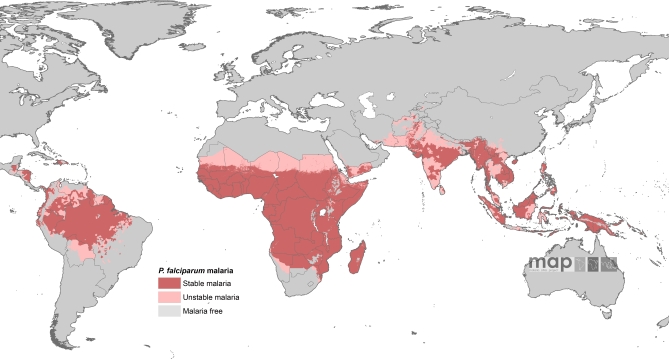
Background: The international financing of malaria control has increased significantly in the last ten years in parallel with calls to halve the malaria burden by the year 2015. The allocation of funds to countries should reflect the size of the populations at risk of infection, disease, and death. To examine this relationship, we compare an audit of international commitments with an objective assessment of national need: the population at risk of stable Plasmodium falciparum malaria transmission in 2007.
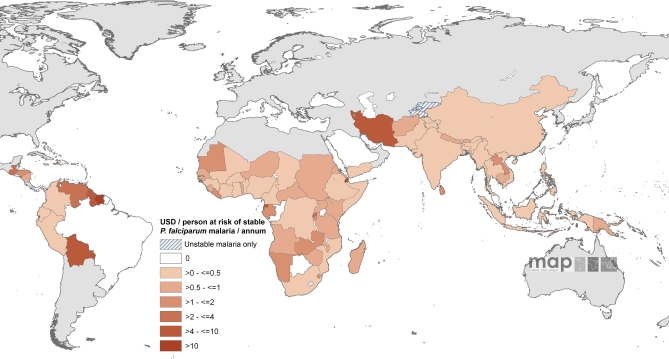
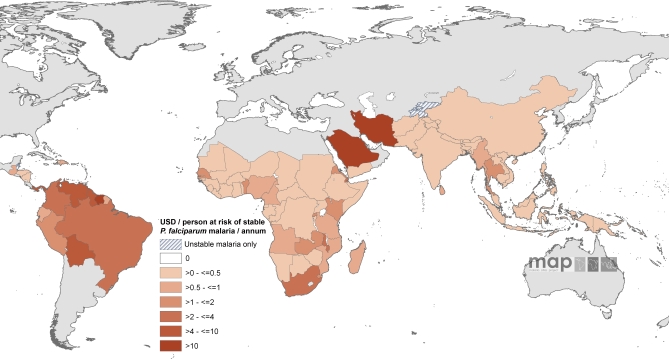
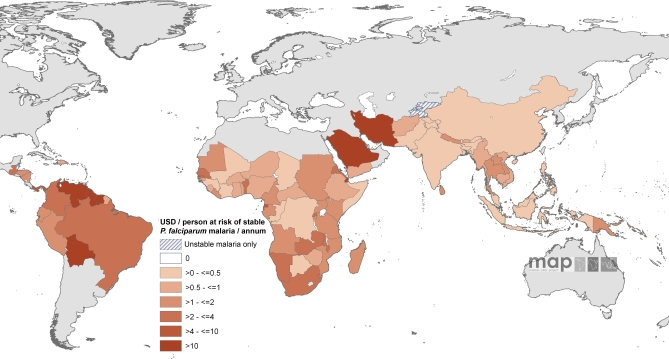
Methods and findings: The national distributions of populations at risk of stable P. falciparum transmission were projected to the year 2007 for each of 87 P. falciparum-endemic countries. Systematic online- and literature-based searches were conducted to audit the international funding commitments made for malaria control by major donors between 2002 and 2007. These figures were used to generate annual malaria funding allocation (in US dollars) per capita population at risk of stable P. falciparum in 2007. Almost US$1 billion are distributed each year to the 1.4 billion people exposed to stable P. falciparum malaria risk. This is less than US$1 per person at risk per year. Forty percent of this total comes from the Global Fund to Fight AIDS, Tuberculosis and Malaria. Substantial regional and national variations in disbursements exist. While the distribution of funds is found to be broadly appropriate, specific high population density countries receive disproportionately less support to scale up malaria control. Additionally, an inadequacy of current financial commitments by the international community was found: under-funding could be from 50% to 450%, depending on which global assessment of the cost required to scale up malaria control is adopted.
Conclusions: Without further increases in funding and appropriate targeting of global malaria control investment it is unlikely that international goals to halve disease burdens by 2015 will be achieved. Moreover, the additional financing requirements to move from malaria control to malaria elimination have not yet been considered by the scientific or international community.
Conflict of interest statement
Figures
Comment in
-
Divergent goals and commitments in global malaria intervention.PLoS Med. 2008 Jul 22;5(7):e159. doi: 10.1371/journal.pmed.0050159. PLoS Med. 2008. PMID: 18651789 Free PMC article.
References
-
- GFATM. The framework document of the Global Fund to Fight AIDS, Tuberculosis and Malaria. Title, purpose, principles and scope of the fund. Geneva: GFTAM; 2007. Available: http://www.theglobalfund.org/en/files/publicdoc/Framework_uk.pdf. Accessed 28 January 2008.
-
- GFTAM. The Global Fund. Who we are what we do. Geneva: GFTAM; 2007. Available: http://www.theglobalfund.org/en/media_center/publications/brochure/. Accessed 28 January 2008.
-
- GFTAM. The Global Fund to Fight AIDS, Tuberculosis and Malaria. Geneva: GFTAM; 2008. Investing in our future. Available: http://www.theglobalfund.org/. Accessed: 28 January 2008.
-
- Feachem RGA, Sabot OJ. An examination of the Global Fund at 5 years. Lancet. 2006;368:537–540. - PubMed
-
- Nahlen BL, Low-Beer D. Building to collective impact: the global fund support for measuring reduction in the burden of malaria. Am J Trop Med Hyg. 2007;77:321–327. - PubMed
Publication types
MeSH terms
Substances
Grants and funding
LinkOut - more resources
Full Text Sources