


Shape effects of filaments versus spherical particles in flow and drug delivery
- PMID: 18654271
- PMCID: PMC2740330
- DOI: 10.1038/nnano.2007.70
Shape effects of filaments versus spherical particles in flow and drug delivery
Abstract
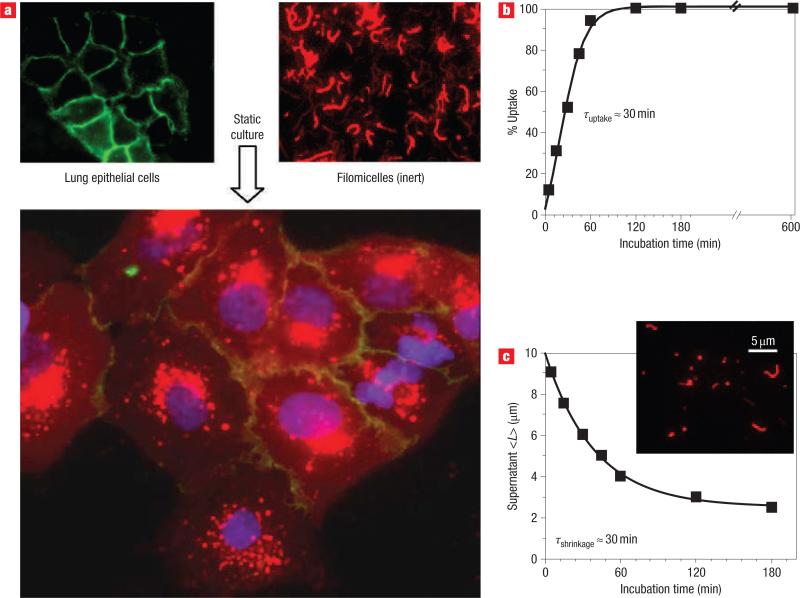
Interaction of spherical particles with cells and within animals has been studied extensively, but the effects of shape have received little attention. Here we use highly stable, polymer micelle assemblies known as filomicelles to compare the transport and trafficking of flexible filaments with spheres of similar chemistry. In rodents, filomicelles persisted in the circulation up to one week after intravenous injection. This is about ten times longer than their spherical counterparts and is more persistent than any known synthetic nanoparticle. Under fluid flow conditions, spheres and short filomicelles are taken up by cells more readily than longer filaments because the latter are extended by the flow. Preliminary results further demonstrate that filomicelles can effectively deliver the anticancer drug paclitaxel and shrink human-derived tumours in mice. Although these findings show that long-circulating vehicles need not be nanospheres, they also lend insight into possible shape effects of natural filamentous viruses.
Figures



References
-
- Cai D, et al. Highly efficient molecular delivery into mammalian cells using carbon nanotube spearing. Nature Methods. 2005;2:449–454. - PubMed
-
- Kam NWS, Dai HJ. Carbon nanotubes as intracellular protein transporters: Generality and biological functionality. J. Am. Chem. Soc. 2005;127:6021–6026. - PubMed
-
- Shortridge KF, et al. Characterization of avian H5N1 influenza viruses from poultry in Hong Kong. Virology. 1998;252:331–342. - PubMed
-
- Geisbert TW, Jahrling PB. Exotic emerging viral diseases: progress and challenges. Nature Med. 2004;10:S110–S121. - PubMed
Publication types
MeSH terms
Substances
Grants and funding
LinkOut - more resources
Full Text Sources
Other Literature Sources
Medical
