Pain genes
- PMID: 18654615
- PMCID: PMC2432024
- DOI: 10.1371/journal.pgen.1000086
Pain genes
Abstract
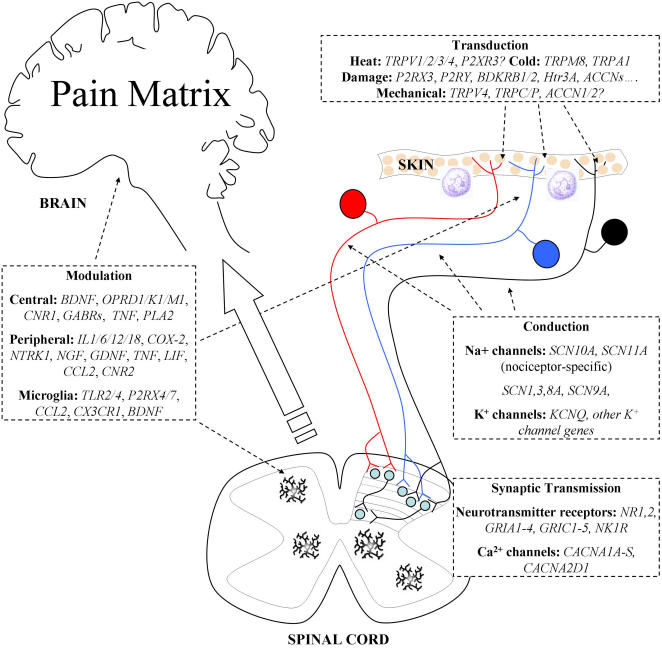
Pain, which afflicts up to 20% of the population at any time, provides both a massive therapeutic challenge and a route to understanding mechanisms in the nervous system. Specialised sensory neurons (nociceptors) signal the existence of tissue damage to the central nervous system (CNS), where pain is represented in a complex matrix involving many CNS structures. Genetic approaches to investigating pain pathways using model organisms have identified the molecular nature of the transducers, regulatory mechanisms involved in changing neuronal activity, as well as the critical role of immune system cells in driving pain pathways. In man, mapping of human pain mutants as well as twin studies and association studies of altered pain behaviour have identified important regulators of the pain system. In turn, new drug targets for chronic pain treatment have been validated in transgenic mouse studies. Thus, genetic studies of pain pathways have complemented the traditional neuroscience approaches of electrophysiology and pharmacology to give us fresh insights into the molecular basis of pain perception.
Conflict of interest statement
The authors have declared that no competing interests exist.
Figures
References
-
- Indo Y, Tsuruta M, Hayashida Y, Karim MA, Ohta K, et al. Mutations in the TRKA/NGF receptor gene in patients with congenital insensitivity to pain with anhidrosis. Nat Genet. 1996;13:485–488. - PubMed
-
- Mogil JS, Yu L, Basbaum AI. Pain genes?: natural variation and transgenic mutants. Annu Rev Neurosci. 2000;23:777–811. - PubMed
-
- Tracey I, Mantyh PW. The cerebral signature for pain perception and its modulation. Neuron. 2007;55:377–391. - PubMed
-
- Lacroix-Fralish ML, Ledoux JB, Mogil JS. The Pain Genes Database: an interactive web browser of pain-related transgenic knockout studies. Pain. 2007;131:3–4. - PubMed
Publication types
MeSH terms
Grants and funding
LinkOut - more resources
Full Text Sources
Other Literature Sources
Medical