


Neurochemistry of the nucleus accumbens and its relevance to depression and antidepressant action in rodents
- PMID: 18654637
- PMCID: PMC2475798
- DOI: 10.2174/157015906778520773
Neurochemistry of the nucleus accumbens and its relevance to depression and antidepressant action in rodents
Abstract
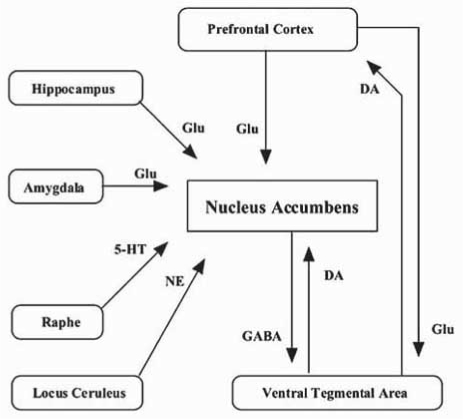
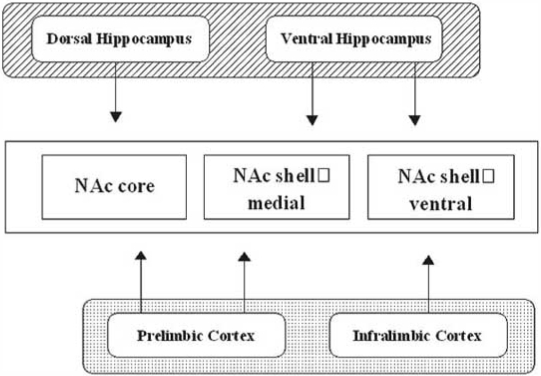
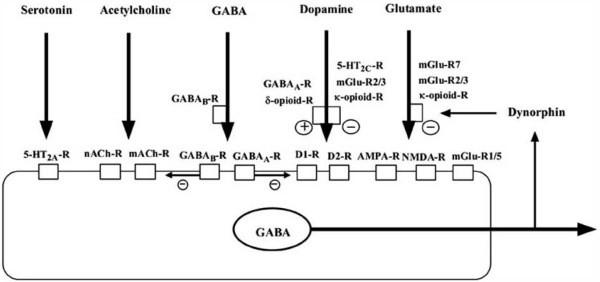
There is accumulating evidence that the nucleus accumbens (NAc) plays an important role in the pathophysiology of depression. Given that clinical depression is marked by anhedonia (diminished interest or pleasure), dysfunction of the brain reward pathway has been suggested as contributing to the pathophysiology of depression.Since the NAc is the center of reward and learning, it is hypothesized that anhedonia might be produced by hampering the function of the NAc. Indeed, it has been reported that stress, drug exposure and drug withdrawal, all of which produce a depressive-phenotype, alter various functions within the NAc, leading to inhibited dopaminergic activity in the NAc.In this review, we describe various factors as possible candidates within the NAc for the initiation of depressive symptoms. First, we discuss the roles of several neurotransmitters and neuropeptides in the functioning of the NAc, including dopamine, glutamate, gamma-aminobutyric acid (GABA), acetylcholine, serotonin, dynorphin, enkephaline, brain-derived neurotrophic factor (BDNF), cAMP response element-binding protein (CREB), melanin-concentrating hormone (MCH) and cocaine- and amphetamine-regulated transcript (CART). Second, based on previous studies, we propose hypothetical relationships among these substances and the shell and core subregions of the NAc.
Keywords: Depression; acetylcholine; cAMP response element-binding protein (CREB); dopamine; dynorphin; glutamate; nucleus accumbens; γ-aminobutyric acid (GABA).
Figures
References
-
- Ainsworth K, Smith SE, Zetterstrom TS, Pei Q, Franklin M, Sharp T. Effect of antidepressant drugs on dopamine D1 and D2 receptor expression and dopamine release in the nucleus accumbens of the rat. Psychopharmacology. 1998;140:470–477. - PubMed
-
- Akiyama G, Ikeda H, Matsuzaki S, Sato M, Moibe S, Koshikawa N, Cools AR. GABAA and GABAB receptors in the nucleus accumbens shell differentially modulate dopamine and acetylcholine receptor-mediated turning behaviour. Neuropharmacology. 2004;46:1082–1088. - PubMed
-
- Altamura CA , Mauri M C, Ferrara A, Moro A R, D’Andrea G, Zamberlan F. Plasma and platelet excitatory amino acids in psychiatry disorders. Am J Psychiatry. 1993;150:1731–1733. - PubMed
-
- American Psychiatric Association. 4th Edition. Washington DC: American Psychiatric Press; 1994. Diagnostic and Statistical Manual of Mental Disorders.
LinkOut - more resources
Full Text Sources