. 2008 Sep 26;374(3):553-8.
doi: 10.1016/j.bbrc.2008.07.062. Epub 2008 Jul 23.

Phosphate and pyrophosphate mediate PKA-induced vascular cell calcification

Affiliations

Phosphate and pyrophosphate mediate PKA-induced vascular cell calcification

Michael S Huang et al. Biochem Biophys Res Commun. .

Abstract

Vascular calcification is associated with increased cardiovascular risk and occurs by osteochondrogenic differentiation of vascular cells. Many of the same regulatory factors that control skeletal mineralization, including the complex metabolic pathway controlling levels of the activator, inorganic phosphate, and the potent inhibitor, pyrophosphate, also govern vascular calcification. We previously found that the cAMP/PKA signaling pathway mediates in vitro vascular cell calcification induced by inflammatory factors including tumor necrosis factor-alpha 1 and oxidized phospholipids. In this report, we tested whether this signaling pathway modulates phosphate and pyrophosphate metabolism. Treatment of primary murine aortic cells with the PKA activator, forskolin, significantly induced osteoblastic differentiation markers, including alkaline phosphatase (ALP), osteopontin, and osteocalcin as well as the pyrophosphate generator, ectonucleotide-pyrophosphatase/phosphodiesterase-1 (Enpp1) and the pyrophosphate transporter, ankylosis protein, but not the sodium/phosphate cotransporter, Pit-1. In the presence of a substrate for ALP, beta-glycerophosphate, which generates inorganic phosphate, forskolin also enhanced matrix mineralization. Inhibitors of ALP or Pit-1 abrogated forskolin-induced osteopontin expression and mineralization but not forskolin-induced osteocalcin or ALP. These results suggest that phosphate is necessary for PKA-induced calcification of vascular cells and that the extent of PKA-induced calcification is controlled by feedback induction of the inhibitor, pyrophosphate.


Figures
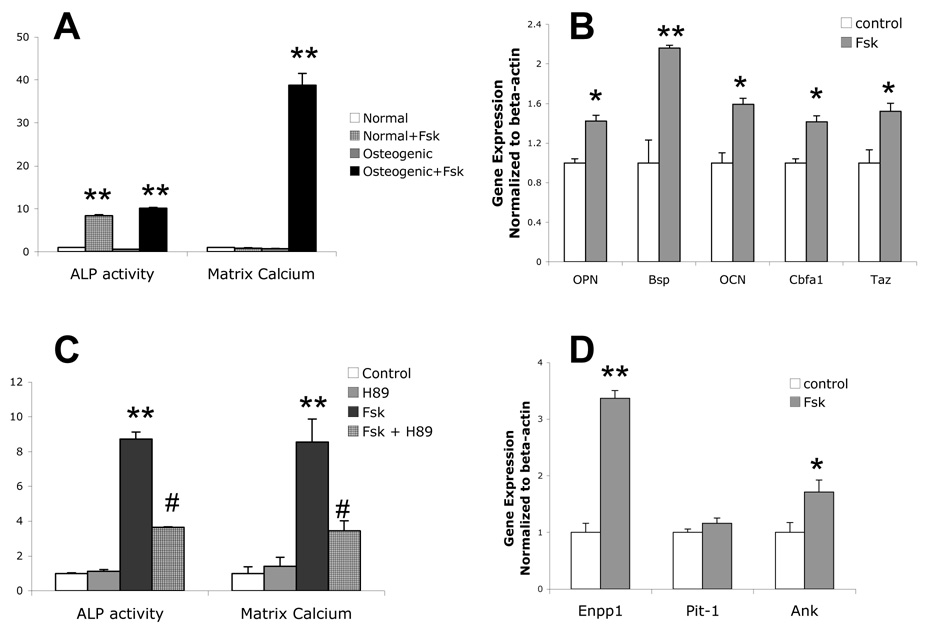
Figure 1
Figure 1. Effects of forskolin on osteoblastic differentiation and calcification
A) ALP activity and matrix calcium from mouse aortic cells treated for 4 days and 10 days, respectively with or without forskolin (Fsk; 25 µM) in normal or osteogenic medium (normal medium supplemented with 5 mM βGP). Both ALP activity and matrix calcium were normalized to total protein, as described in Methods. B) RT-qPCR analysis of osteopontin (OPN), bone sialoprotein (BSP), osteocalcin (OCN), Cbfa1 and Taz expression from cells treated with control or Fsk (25 µM) for 7 days in osteogenic medium. C) ALP activity and matrix calcification of cells cotreated with control (DMSO) or Fsk (25 µM) and/or H89 (10 µM), as indicated, in the osteogenic medium. D) RT-qPCR analysis of Enpp1, Pit-1 and Ank expression from cells treated with control or Fsk (25 µM) for 7 days in osteogenic medium. *p < 0.05 compared to control; **p < 0.001 compared to control; #p < 0.0001 compared to Fsk-treated.
Figure 2
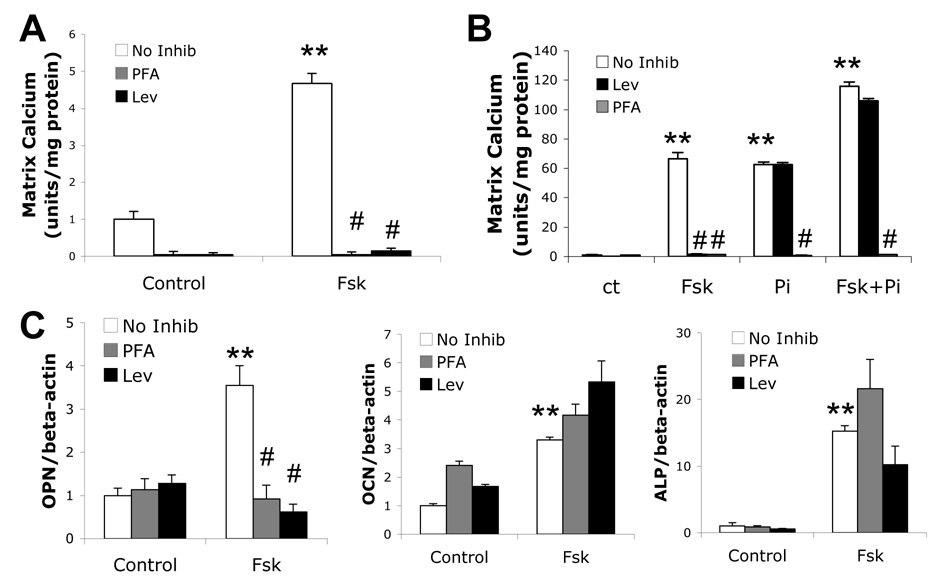
Figure 2. Effects of phosphate transport on forskolin-induced osteoblastic differentiation and mineralization
A) Matrix calcification of cells cotreated with control, Fsk (25 µM), PFA (0.5 mM) and/or Lev (10−4 M), as indicated, for 11 days in osteogenic medium. B) Matrix calcification of cells cotreated with control, Pi (3 mM), PFA (0.5 mM), and/or Lev (10−4 M), as indicated, for 11 days in osteogenic medium. C) RT-qPCR analysis of ALP, OPN and OCN expression from cells treated with control or Fsk (25 µM), PFA (0.5 mM), and/or Lev (10−4 M) for 12 days in osteogenic medium. **p < 0.001 compared to non-Fsk-treated control; #p < 0.0001 compared to Fsk-alone-treated.
Figure 3
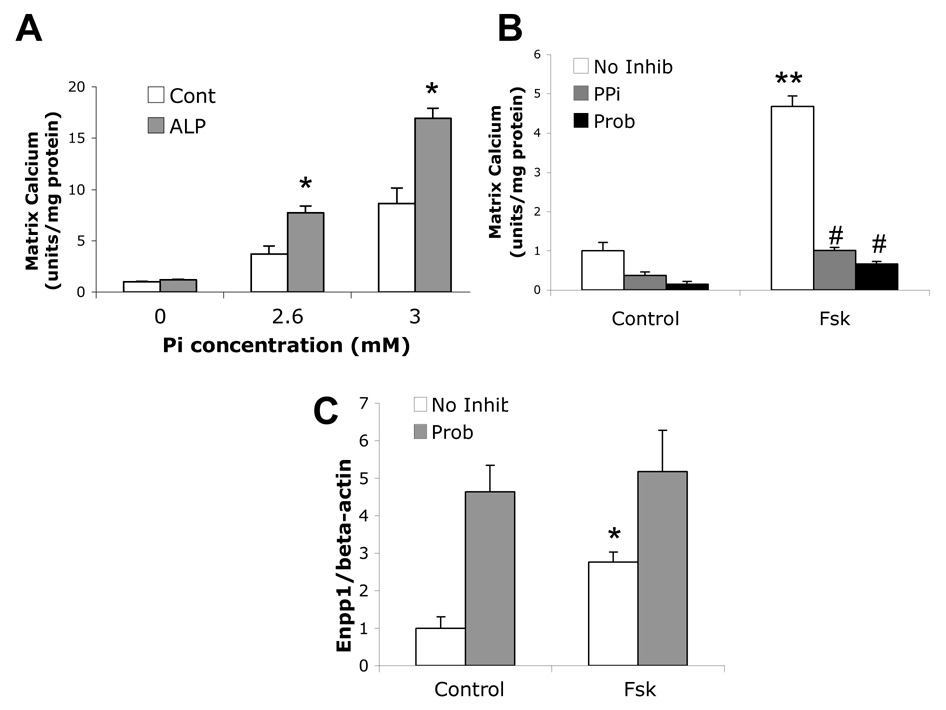
Figure 3. Effects of pyrophosphate on forskolin-induced osteoblastic differentiation and mineralization
Matrix calcification of cells treated with control, Pi (2.6 or 3.0 mM), and/or purified porcine ALP (1 unit/mL), as indicated, for 10 days in normal medium. B) Matrix calcification of cells cotreated with control, Fsk (25 µM), PPi (0.1 mM), probenecid (Prob, 1 mM) as indicated in osteogenic medium. C) RT-qPCR analysis of Enpp1 expression from cells treated with control or Fsk (25 µM), or probenecid (1 mM) for 12 days in osteogenic medium. *p < 0.05 compared to control; **p < 0.001 compared to control; #p < 0.0001 compared to Fsk-treated.
Figure 4
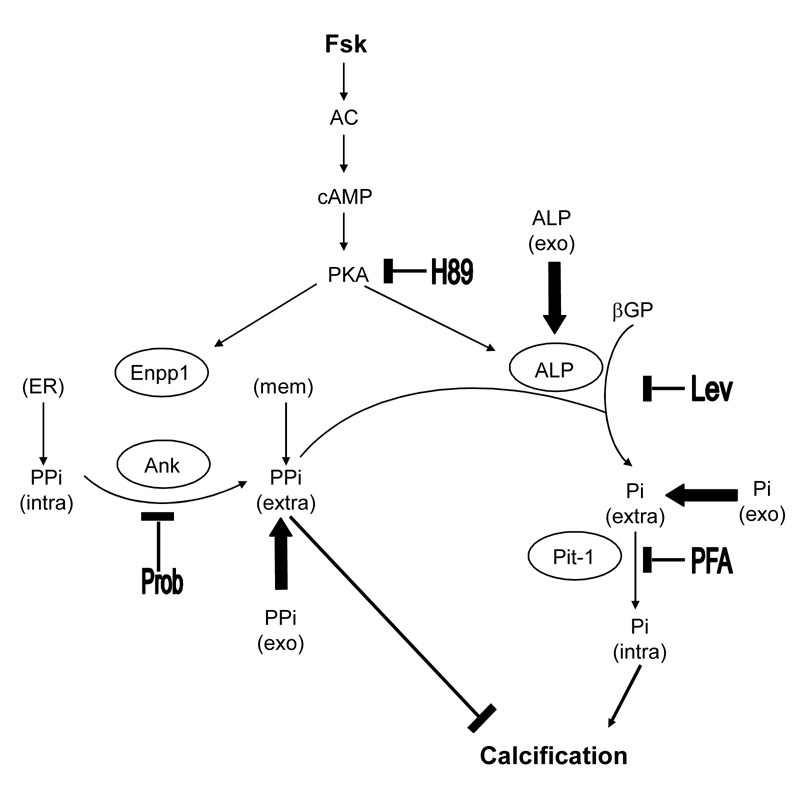
Figure 4. Schematic illustration of forskolin-induced mineralization in murine aortic cells
cAMP/PKA activation by Fsk induces expression of ALP and Enpp1, generating activator Pi and inhibitor PPi, respectively. In vitro, ALP cleaves βGP to provide extracellular inorganic phosphate (Pi-extra), which is transported by Pit-1 to the cell interior where it influences gene expression. It has been postulated that intracellular Pi (Pi-intra) ultimately accumulates in matrix vesicles that bud off and serve as initiators of hydroxyapatite crystals. Intracellular inorganic PPi (PPi-intra), produced by endoplasmic reticulum (ER)-bound Enpp1, is transported to the extracellular milieu by Ank protein, where it acts as a potent calcification inhibitor. Extracellular PPi (PPi-extra) is also produced by plasma membrane-bound (memb)-Enpp1. Upregulation of ALP reduces the extracellular PPi level, causing calcification. The exogenously added Pi, PPi, ALP as well as inhibitors at each step are shown; H89, levamisole (Lev), probenecid (Prob) and PFA.

References

    1. Jeziorska M, Woolley DE. Neovascularization in early atherosclerotic lesions of human carotid arteries: its potential contribution to plaque development. Hum Pathol. 1999;30:919–925. - PubMed
    1. Jeziorska M, Woolley DE. Local neovascularization and cellular composition within vulnerable regions of atherosclerotic plaques of human carotid arteries. J Pathol. 1999;188:189–196. - PubMed
    1. Stary HC. Natural history of calcium deposits in atherosclerosis progression and regression. Z Kardiol. 2000;89 Suppl 2:28–35. - PubMed
    1. Abedin M, Lim J, Tang TB, Park D, Demer LL, Tintut Y. N-3 fatty acids inhibit vascular calcification via the p38-mitogen-activated protein kinase and peroxisome proliferator-activated receptor-gamma pathways. Circ Res. 2006;98:727–729. - PubMed
    1. Moe SM, Chen NX. Pathophysiology of vascular calcification in chronic kidney disease. Circ Res. 2004;95:560–567. - PubMed

Publication types

MeSH terms