


A nomenclature for ligand-gated ion channels
- PMID: 18655795
- PMCID: PMC2847504
- DOI: 10.1016/j.neuropharm.2008.06.063
A nomenclature for ligand-gated ion channels
Abstract
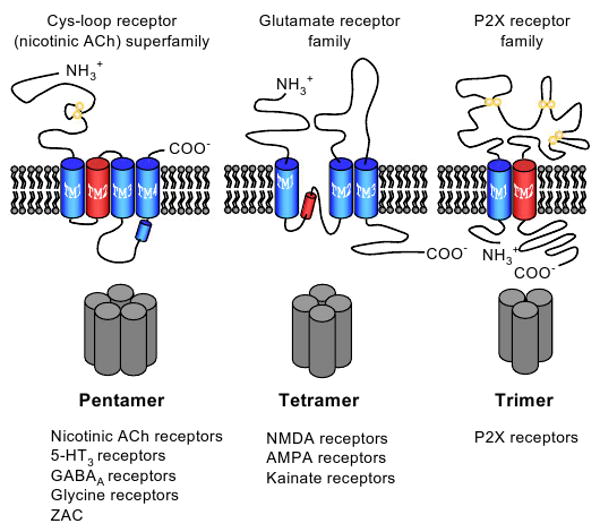
The ligand-gated ion channels that participate in fast synaptic transmission comprise the nicotinic acetylcholine, 5-hydroxytryptamine3 (5-HT3), gamma-aminobutyric acidA (GABA(A)), glycine, ionotropic glutamate and P2X receptor families. A consistent and systematic nomenclature for the individual subunits that comprise these receptors and the receptors that result from their co-assembly is highly desirable. There is also a need to develop criteria that aid in deciding which of the vast number of heteromeric combinations of subunits that can be assembled in heterologous expression systems in vitro, are known, or likely, to exist as functional receptors in vivo. The aim of this short article is to summarize the progress being made by the nomenclature committee of IUPHAR (NC-IUPHAR) in formulating recommendations that attempt to address these issues.
Figures
References
-
- Barnard EA, Skolnick P, Olsen RW, Mohler H, Sieghart W, Biggio G, Braestrup C, Bateson AN, Langer SZ. International Union of Pharmacology. XV. Subtypes of gamma-aminobutyric acid A receptors: classification on the basis of subunit structure and receptor function. Pharmacol Rev. 1998 Jun;50(2):291–313. - PubMed
-
- Bettler B, Boulter J, Hermans-Borgmeyer I, O'Shea-Greenfield A, Deneris ES, Moll C, Borgmeyer U, Hollmann M, Heinemann S. Cloning of a novel glutamate receptor subunit, GluR5: expression in the nervous system during development. Neuron. 1990;5:583–595. - PubMed
-
- Boulter J, Hollmann M, O'Shea-Greenfield A, Hartley M, Deneris E, Maron C, Heinemann S. Molecular cloning and functional expression of glutamate receptor subunit genes. Science. 1990;249:1033–1037. - PubMed
-
- Catterall WA, Perez-Reyes E, Snutch TP, Striessnig J. International Union of Pharmacology. XLVIII. Nomenclature and structure-function relationships of voltage-gated calcium channels. Pharmacol Rev. 2005;57:411–425. - PubMed
-
- Clapham DE, Julius D, Montell C, Schultz G. International Union of Pharmacology. XLIX. Nomenclature and structure-function relationships of transient receptor potential channels. Pharmacol Rev. 2005;57:427–450. - PubMed
Publication types
MeSH terms
Substances
Grants and funding
LinkOut - more resources
Full Text Sources
Other Literature Sources
Molecular Biology Databases
