


Dietary intake and the metabolic syndrome in overweight Latino children
- PMID: 18656576
- PMCID: PMC2882193
- DOI: 10.1016/j.jada.2008.05.006
Dietary intake and the metabolic syndrome in overweight Latino children
Abstract
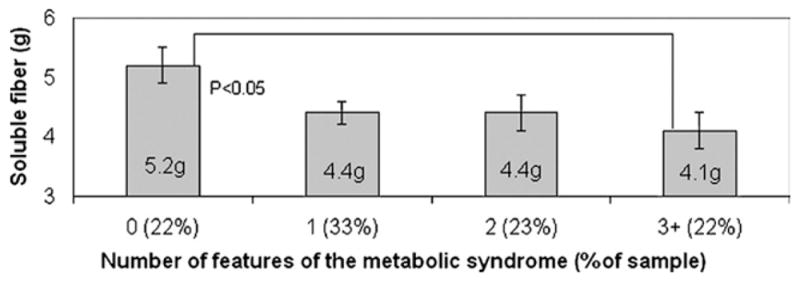
Little is known about the relationship between diet and metabolic health in Latino children, a population at increased risk for diabetes. The present study evaluates diet composition and the metabolic syndrome in a cross-sectional sample of 109 overweight Latino children aged 10 to 17 years with a family history of type 2 diabetes. Dietary intake was assessed by two 24-hour recalls. Associations between nutrients and features of the metabolic syndrome were examined using multiple linear regression and analysis of covariance. Log cholesterol intake was positively associated with log systolic blood pressure (beta=0.034, P=0.017) and log soluble dietary fiber intake was inversely associated with log waist circumference (beta=-0.069, P=0.036). Log soluble fiber intake was significantly higher in participants with 0 features compared to those with 3+ features of the metabolic syndrome (P=0.046), which translates to 5.2 g vs 4.1 g soluble fiber daily. No other significant associations were found between dietary variables and either the individual features of the metabolic syndrome or the clustering of metabolic syndrome components. Increases in soluble fiber through the daily consumption of fruits, vegetables, and beans may improve metabolic health in Latino children.
Figures
Comment in
-
Metabolic syndrome in adolescents: issues and opportunities.J Am Diet Assoc. 2011 Nov;111(11):1674-9. doi: 10.1016/j.jada.2011.08.012. J Am Diet Assoc. 2011. PMID: 22027049 No abstract available.
References
-
- Cook S, Weitzman M, Auinger P, Nguyen M, Dietz WH. Prevalence of a metabolic syndrome phenotype in adolescents: Findings from the third National Health and Nutrition Examination Survey, 1988–1994. Arch Pediatr Adolesc Med. 2003;157:821–827. - PubMed
-
- Sonnenberg L, Pencina M, Kimokoti R, Quatromoni P, Nam BH, D’Agostino R, Meigs JB, Ordovas J, Cobain M, Millen B. Dietary patterns and the metabolic syndrome in obese and non-obese Framingham women. Obes Res. 2005;13:153–162. - PubMed
-
- Wirfalt E, Hedblad B, Gullberg B, Mattisson I, Andren C, Rosander U, Janzon L, Berglund G. Food patterns and components of the metabolic syndrome in men and women: A cross-sectional study within the Malmo Diet and Cancer cohort. Am J Epidemiol. 2001;154:1150–1159. - PubMed
-
- Kim JA, Kim SM, Lee JS, Oh HJ, Han JH, Song Y, Joung H, Park HS. Dietary patterns and the metabolic syndrome in Korean adolescents: 2001 Korean National Health and Nutrition Survey. Diabetes Care. 2007;30:1904–1905. - PubMed
Publication types
MeSH terms
Substances
Grants and funding
LinkOut - more resources
Full Text Sources
Medical
