. 2008 Sep;14(9):1714-9.
doi: 10.1261/rna.1161908. Epub 2008 Jul 24.

Potent RNAi by short RNA triggers

Affiliations

Potent RNAi by short RNA triggers

Chia-Ying Chu et al. RNA. 2008 Sep.

Abstract

RNA interference (RNAi) is a gene-silencing mechanism by which a ribonucleoprotein complex, the RNA-induced silencing complex (RISC) and a double-stranded (ds) short-interfering RNA (siRNA), targets a complementary mRNA for site-specific cleavage and subsequent degradation. While longer dsRNA are endogenously processed into 21- to 24-nucleotide (nt) siRNAs or miRNAs to induce gene silencing, RNAi studies in human cells typically use synthetic 19- to 20-nt siRNA duplexes with 2-nt overhangs at the 3'-end of both strands. Here, we report that systematic synthesis and analysis of siRNAs with deletions at the passenger and/or guide strand revealed a short RNAi trigger, 16-nt siRNA, which induces potent RNAi in human cells. Our results indicate that the minimal requirement for dsRNA to trigger RNAi is an approximately 42 A A-form helix with approximately 1.5 helical turns. The 16-nt siRNA more effectively knocked down mRNA and protein levels than 19-nt siRNA when targeting the endogenous CDK9 gene, suggesting that 16-nt siRNA is a more potent RNAi trigger. In vitro kinetic analysis of RNA-induced silencing complex (RISC) programmed in HeLa cells indicates that 16-nt siRNA has a higher RISC-loading capacity than 19-nt siRNA. These results suggest that RISC assembly and activation during RNAi does not necessarily require a 19-nt duplex siRNA and that 16-nt duplexes can be designed as more potent triggers to induce RNAi.


Figures
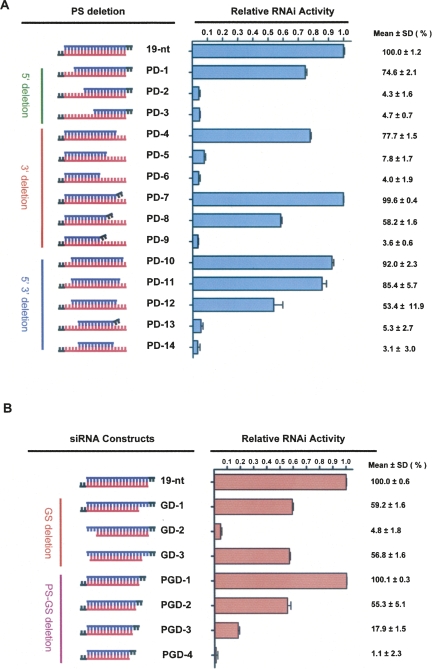
FIGURE 1.
FIGURE 1.
(A) siRNAs with passenger-strand (PS) deletions as triggers for RNAi. Each GFP siRNA construct shown and reporter plasmids were co-transfected into HeLa cells and RNAi activity was quantified 48 h post-transfection. Relative RNAi activity represents the percentage of GFP knockdown induced by 50 nM siRNA with passenger-strand deletions relative to the inhibition induced by 50 nM 19-nt wild-type siRNA (designated 100%). Each siRNA was tested for knockdown in duplicate in two independent experiments. (B) Effects of guide-strand and two-strand deletions on RNAi activity. The relative RNAi activity of each GFP siRNA construct shown was evaluated as described in (A).
FIGURE 2.
FIGURE 2.
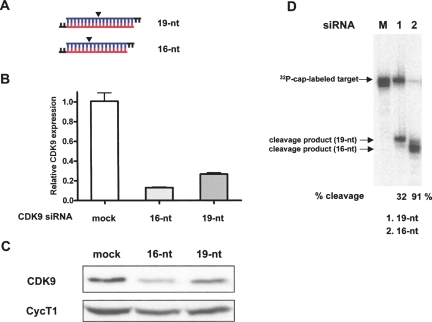
The 16-nt siRNA targeting CDK9 efficiently induces endogenous gene silencing in HeLa cells. (A) The wild-type and 16-nt CDK9 siRNAs used to program RISC are shown. Arrowheads mark target cleavage sites defined by the 5′-end of the guide strand. siRNA sequences are shown in Supplemental Figure 1. (B) The 16-nt CDK9 siRNA more efficiently knocks down CDK9 mRNA than 19-nt WT siRNA. HeLa cells were transfected with 50 nM CDK9 siRNA (19-nt or 16-nt), harvested 48 h post-transfection, and 1 μg total RNA was reverse-transcribed. CDK9 mRNA levels quantified by quantitative PCR and normalized to GAPDH mRNA are presented relative to mRNA levels in mock-transfected cells. Data represent three independent experiments. (C) The 16-nt CDK9 siRNA more efficiently decreases CDK9 protein expression than 19-nt WT siRNA. Immunoblot analysis of CDK9 knockdown by 19-nt and 16-nt siRNAs. HeLa cells were transfected and harvested as in (B), and 120 μg total protein was analyzed by immunoblot using anti-CDK9 and anti-CycT1 antibodies. (D) The 16-nt CDK9 siRNA more efficiently programs RISC to cleave target CDK9 mRNA than 19-nt WT siRNA. CDK9 siRISC was programmed by transfecting HeLa cells with 19-nt or 16-nt siRNA. Target cleavage reaction was performed at 37°C for 90 min. See Materials and Methods for details. The arrow designated “32P-cap-labeled target” points to full-length 32P-cap-labeled CDK9 target mRNA. The arrows designated “cleavage product (19-nt)” and “cleavage product (16-nt)” point to products of target mRNA cleavage by CDK9 siRISC programmed with 19-nt and 16-nt siRNA, respectively.
FIGURE 3.
FIGURE 3.
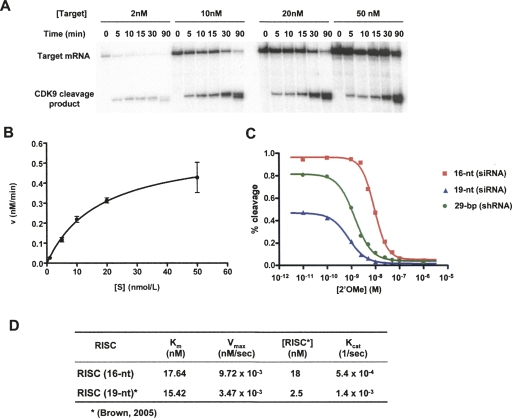
Kinetic analysis of CDK9 16-nt RISC. (A) CDK9 RISC cleavage of target mRNA depends on substrate concentration. Efficiency of target mRNA cleavage by CDK9 RISC programmed by 16-nt siRNA at various substrate concentrations. (B) CDK9 RISC cleavage of target mRNA shows Michaelis–Menten kinetics. Michaelis–Menten analysis of 16-nt RISC. The initial velocity of cleavage product formation was determined from the slope of a curve fit to the cleavage reactions at 0–30 min as shown in (A). (C) The 16-nt siRNA programs more RISC than 19-nt siRNA or 29-nt shRNA. Concentrations of active CDK9 RISC programmed by 16-nt RNA, 19-nt siRNA, or 29-nt shRNA were determined by 2′-O-Me inhibition in vitro cleavage assay. (D) Kinetic analysis of 16-nt CDK9 RISC. K m and V max were determined by Michaelis–Menten analysis as shown in (B).

References

    1. Brown K.M., Chu C.Y., Rana T.M. Target accessibility dictates the potency of human RISC. Nat. Struct. Mol. Biol. 2005;12:469–470. - PubMed
    1. Caplen N.J., Parrish S., Imani F., Fire A., Morgan R.A. Specific inhibition of gene expression by small double-stranded RNAs in invertebrate and vertebrate systems. Proc. Natl. Acad. Sci. 2001;98:9742–9747. - PMC - PubMed
    1. Chiu Y.L., Rana T.M. RNAi in human cells: Basic structural and functional features of small interfering RNA. Mol. Cell. 2002;10:549–561. - PubMed
    1. Chiu Y.L., Rana T.M. siRNA function in RNAi: A chemical modification analysis. RNA. 2003;9:1034–1048. - PMC - PubMed
    1. Chu C.Y., Rana T.M. Small RNAs: Regulators and guardians of the genome. J. Cell. Physiol. 2007;213:412–419. - PubMed

Publication types

MeSH terms

Substances