. 2008 Aug;179(4):2013-26.
doi: 10.1534/genetics.108.089037. Epub 2008 Jul 27.

The population genetics of using homing endonuclease genes in vector and pest management

Affiliations

The population genetics of using homing endonuclease genes in vector and pest management

Anne Deredec et al. Genetics. 2008 Aug.

Abstract

Homing endonuclease genes (HEGs) encode proteins that in the heterozygous state cause double-strand breaks in the homologous chromosome at the precise position opposite the HEG. If the double-strand break is repaired using the homologous chromosome, the HEG becomes homozygous, and this represents a powerful genetic drive mechanism that might be used as a tool in managing vector or pest populations. HEGs may be used to decrease population fitness to drive down population densities (possibly causing local extinction) or, in disease vectors, to knock out a gene required for pathogen transmission. The relative advantages of HEGs that target viability or fecundity, that are active in one sex or both, and whose target is expressed before or after homing are explored. The conditions under which escape mutants arise are also analyzed. A different strategy is to place HEGs on the Y chromosome that cause one or more breaks on the X chromosome and so disrupt sex ratio. This strategy can cause severe sex-ratio biases with efficiencies that depend on the details of sperm competition and zygote mortality. This strategy is probably less susceptible to escape mutants, especially when multiple X shredders are used.


Figures

F<sc>igure</sc> 1.—
Figure 1.—
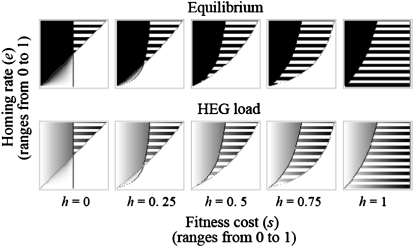
Equilibrium frequency and load of a HEG that is active (homes) after gene expression. Top row: equilibrium HEG frequency as a function of homing rate and fitness costs. The gene is fixed in the solid region and lost in the open region. Where an interior equilibrium is possible the darkness of the shading is proportional to the equilibrium frequency. In the striped region the gene is either fixed or lost depending on its initial frequency. Bottom row: load imposed by the HEG in the same regions of parameter space as in the top row. The darkness of the shading is proportional to the HEG load.
F<sc>igure</sc> 2.—
Figure 2.—
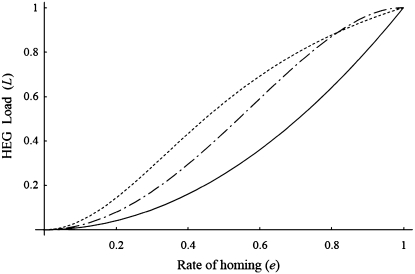
HEG load (L) as a function of homing frequency (e) when the target gene is essential and the wild type is fully dominant (s = 1, h = 0). We plot three cases: in the first two the effects of the HEG are experienced equally by both sexes, the homozygote either being lethal (solid line) or having no postmating fertility through either sperm or ova (dotted-and-dashed line). The third case is a female-specific HEG where effects on either viability or postmating fertility lead to the same load (dotted line).
F<sc>igure</sc> 3.—
Figure 3.—
The number of generations taken for a HEG to increase in frequency from 0.05 to 0.9 as a function of fitness costs (s), homing frequency (e), and dominance (h).
F<sc>igure</sc> 4.—
Figure 4.—
Equilibrium frequency and load of a HEG that is active (homes) before gene expression. Drawing conventions and parameters are the same as in Figure 1.
F<sc>igure</sc> 5.—
Figure 5.—
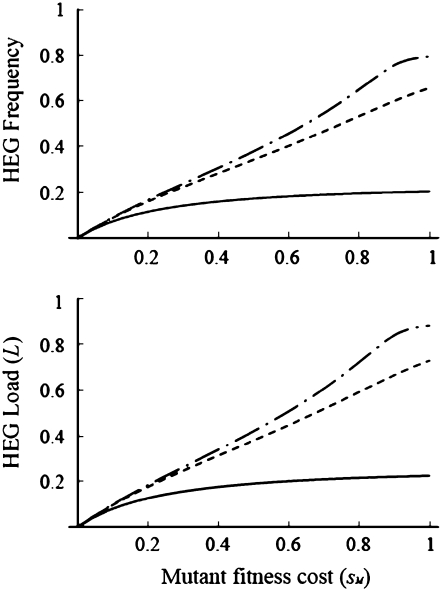
The equilibrium HEG frequency (top) and HEG load (bottom) when the repair of the cut chromosome can produce mutant alleles with intermediate fitness costs, 0 < sM < 1. A homing rate of e = 0.9 is assumed and the three lines represent different probabilities of misrepair: γ = 0.5 (solid line), 0.1 (dotted line), and 0.01 (dashed line).
F<sc>igure</sc> 6.—
Figure 6.—
The spread of an X-shredding HEG (solid lines) and its consequences for the population sex ratio (dashed lines). For each pair of lines the bottom (solid) curve represents the case of a single HEG recognition site on the X chromosome (k = 1) and the top (shaded) curve represents five recognition sites (k = 5). A cutting frequency of e = 0.8 is assumed. At equilibrium the HEG loads are 0.67 and 0.99 for k = 1 and 5, respectively.
F<sc>igure</sc> 7.—
Figure 7.—
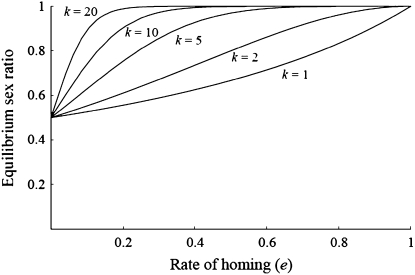
Equilibrium sex ratio in the presence of X-shredding HEGs as a function of the chromosome break frequency (e) and the number of HEGs or HEG recognition sites (k). In all cases the HEG-bearing Y chromosome goes to fixation at equilibrium.
F<sc>igure</sc> 8.—
Figure 8.—
The effect of multiple mating and sperm competition on the rate at which an X-shredder HEG spreads through the population. The precise assumptions made about the distribution of mating frequencies are described in the text and the average number of matings per female is m. We assumed a cutting frequency (e) of 0.9, a HEG with one recognition site (k = 1), and a HEG initial frequency of 0.01.
F<sc>igure</sc> 9.—
Figure 9.—
The effect of “pseudofertilization” on the rate at which an X-shredder HEG spreads through the population. It is assumed that a fraction z of sperm with cut X chromosomes fertilize ova that subsequently die. We assumed a cutting frequency (e) of 0.7, a HEG with two recognition sites (k = 2), and a HEG initial frequency of 0.01.
F<sc>igure</sc> 10.—
Figure 10.—
Examples of the spread of an X-shredder escape mutant. Three different assumptions about the fitness of the escape mutant are made (solid lines, sM = 0; dashed lines, sM = 0.5; dotted-and-dashed lines, sM = 1), and the sex ratio (shaded lines) and escape mutant frequency (among males, solid lines) are plotted. We assumed a cutting frequency (e) of 0.9, a HEG with a single recognition site (k = 1), that the rate at which escape mutants are generated (γ) is 0.01, and a HEG initial frequency of 0.01.

References

    1. Adelman, Z. N., N. Jasinskiene, S. Onal, J. Juhn, A. Ashikyan et al., 2007. Nanos gene control DNA mediates developmentally regulated transposition in the yellow fever mosquito Aedes aegypti. Proc. Natl. Acad. Sci. USA 104 9970–9975. - PMC - PubMed
    1. Alphey, L., C. B. Beard, P. Billingsley, M. Coetzee, A. Crisanti et al., 2002. Malaria control with genetically manipulated insect vectors. Science 298 119–121. - PubMed
    1. Arnould, S., C. Perez, J. P. Cabaniols, J. Smith, A. Gouble et al., 2007. Engineered I–Crel derivatives cleaving sequences from the human XPC gene can induce highly efficient gene correction in mammalian cells. J. Mol. Biol. 371 49–65. - PubMed
    1. Ashburner, M., S. Misra, J. Roote, S. E. Lewis, R. Blazej et al., 1999. An exploration of the sequence of a 2.9-Mb region of the genome of Drosophila melanogaster: the Adh region. Genetics 153 179–219. - PMC - PubMed
    1. Ashburner, M., K. G. Golic and R. S. Hawley, 2005. Drosophila: A Laboratory Handbook. Cold Spring Harbor Laboratory Press, Cold Spring Harbor, NY.

Publication types