. 2008 Nov;47(11):939-46.
doi: 10.1002/gcc.20596.

The noncoding RNA, miR-126, suppresses the growth of neoplastic cells by targeting phosphatidylinositol 3-kinase signaling and is frequently lost in colon cancers

Affiliations

The noncoding RNA, miR-126, suppresses the growth of neoplastic cells by targeting phosphatidylinositol 3-kinase signaling and is frequently lost in colon cancers

Chunguang Guo et al. Genes Chromosomes Cancer. 2008 Nov.

Abstract

MicroRNAs (miRNA/miR) are a class of small noncoding RNAs implicated in the pathogenesis of various malignancies. In the current study, using micro(RNA) arrays, we found a ubiquitous loss of miR-126 expression in colon cancer lines when compared to normal human colon epithelia. Reconstitution of miR-126 in colon cancer cells resulted in a significant growth reduction as evidenced in clonogenic assays. A search for miR-126 gene targets revealed p85beta, a regulatory subunit involved in stabilizing and propagating the phosphatidylinositol 3-kinase (PI3K) signal, as one of the potential substrates. Restoration of miR-126 in cancer cells induced a > or =3-fold reduction in p85beta protein levels, with no concomitant change in p85alpha, a gene that is functionally related to p85beta but not a supposed target of miR-126. Additionally, using reporter constructs, we show that the p85beta-3' untranslated region is directly targeted by miR-126. Furthermore, this miR-126 mediated reduction of p85beta was accompanied by a substantial reduction in phosphorylated AKT levels in the cancer cells, suggesting an impairment in PI3K signaling. Finally, in a panel of matched normal colon and primary colon tumors, each of the tumors demonstrated miR-126 down-regulation together with an increase in the p85beta protein level. Taken together, we propose that miR-126 regulates PI3K signaling partly by targeting p85beta, and that the loss of miR-126 may provide a selective growth advantage during colon carcinogenesis.


Figures

Figure 1
Figure 1. Loss of miR-126 in colon cancer cells
miR-126 expression levels in colon cancer cell lines were shown as fold changes relative to the normal colon epithelial crypts (NCC) pooled from 5 individuals. Note the marked reduction of miR-126 expression in 12 of 12 cancer lines. Amplification products of the qRT-PCR reaction from NCCs were cloned, sequenced and confirmed as miR-126 (data not shown). 5S-rRNA was used as a normalization control.
Figure 2
Figure 2. miR-126 suppresses the growth of colon cancer cells
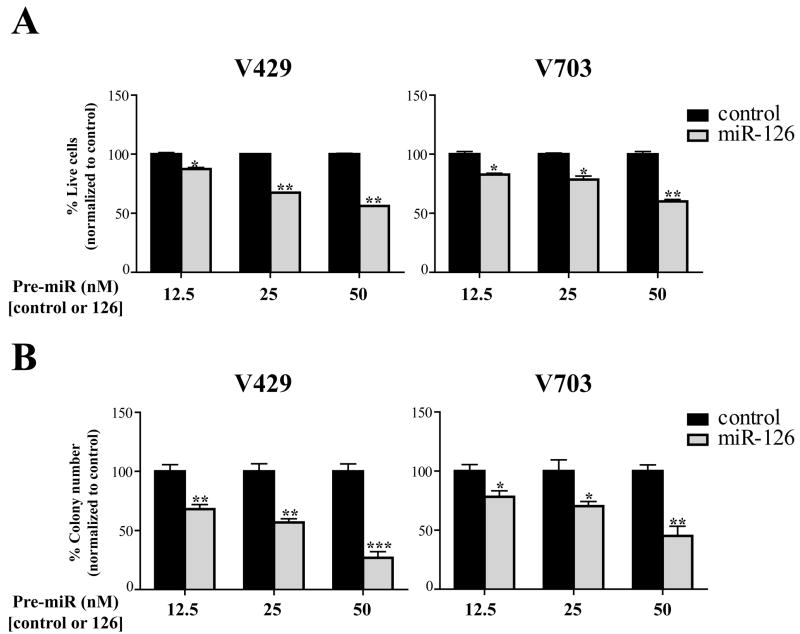
A) Quantification of cell growth in V429 and V703 cell lines transfected with a control or miR-126 precursor molecule at 3 different concentrations (Ambion). The bar graphs represent the percentage of live cells, normalized to the control group, at 72 hrs after control or miR-126 transfection. Data was obtained from 3 independent wells and each experiment repeated 3 times. Note the dose-dependent suppression of cell growth by miR-126 in both V429 and V703 cells. B) Quantification of colony numbers in cell lines. The bar graphs represent colony numbers expressed as a percentage of the colony counts observed in the control group for each concentration. The colony counts for control and miR-126 groups at different doses were obtained from 3 independent wells and each experiment was repeated 3 times. Note the dose-dependent reduction in the colony number following miR-126 reconstitution in both cell lines. Statistical analysis was performed using an unpaired t test and the error bars indicate standard error of the means. (*) represents significant differences (*p<0.05, **p<0.005, ***p<0.0005) between means of the control verses miR-126 treated groups for each concentration.
Figure 3
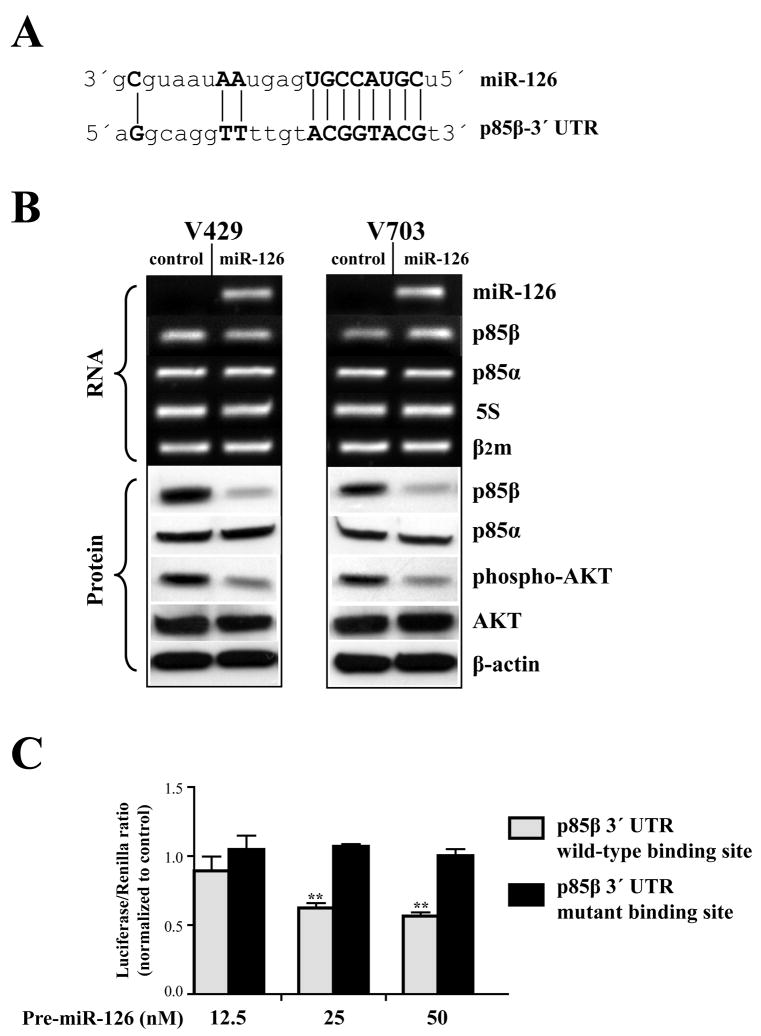
Figure 3. miR-126 represses PI3K signaling by targeting p85β
A) Sequence alignment of miR-126 with 3′ UTR of p85β (Griffiths-Jones et al., 2006). Note the complimentarity of miR-126 seed sequence to p85β 3′ UTR displayed as vertical lines. B) Rows 1–5 show the RNA levels analyzed by qRT-PCR and rows 6–10 display the protein levels determined by Western blots after miR-126 induction. Row 1 demonstrates the successful restoration of miR-126 in cell lines transfected with its precursor molecule (Ambion). Note the reduction in p85β (row 6) and phospho-AKT (row 8) proteins in miR-126 treated cells. β–actin, β2microglobulin (β2m) and 5S-rRNA were used as loading controls for protein, mRNA and miRNA respectively. All analyses were performed 48 hrs after miR-126 transfection. C) Dual luciferase assays of luciferase reporter constructs carrying a wild-type p85β 3′ UTR verses a 3′ UTR mutation in the potential miR-126 binding site. Note the dose-dependent reduction in the luciferase activity of wild-type p85β when compared to the mutant p85β following miR-126 induction. (**) indicates significant differences between the means of wild-type and mutant p85β 3′ UTR luciferase activities within each group (t-test, p<0.005). All analyses were performed in triplicates after 48 hr incubation and values expressed as the ratio of luciferase/renilla activities and normalized to the control miRNA precursor within the respective groups.
Figure 4
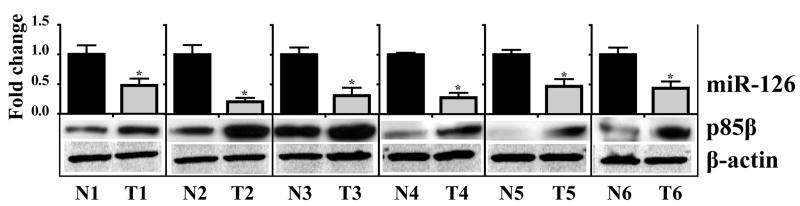
Figure 4. Inverse correlation between miR-126 and p85β in primary colon tumors
The upper panel shows the qRT-PCR quantification of miR-126 and lower panel shows the western blot analysis of p85β protein levels in matched colon normal (N) and primary colon tumor (T) pairs. miR-126 in tumors is expressed as fold change relative to their matched normals. Note the significant downregulation of miR-126 (≥2-fold, t-test p<0.05) and overexpression of p85β protein in each of the colon tumors. 5S-rRNA and β–actin protein were used as normalization controls for miR-126 and p85β protein, respectively.

References

    1. Bandres E, Cubedo E, Agirre X, Malumbres R, Zarate R, Ramirez N, Abajo A, Navarro A, Moreno I, Monzo M, Garcia-Foncillas J. Identification by Real-time PCR of 13 mature microRNAs differentially expressed in colorectal cancer and non-tumoral tissues. Molecular cancer. 2006;5:29. - PMC - PubMed
    1. Chen WD, Han ZJ, Skoletsky J, Olson J, Sah J, Myeroff L, Platzer P, Lu S, Dawson D, Willis J, Pretlow TP, Lutterbaugh J, Kasturi L, Willson JK, Rao JS, Shuber A, Markowitz SD. Detection in fecal DNA of colon cancer-specific methylation of the nonexpressed vimentin gene. Journal of the National Cancer Institute. 2005;97:1124–1132. - PubMed
    1. Cummins JM, He Y, Leary RJ, Pagliarini R, Diaz LA, Jr, Sjoblom T, Barad O, Bentwich Z, Szafranska AE, Labourier E, Raymond CK, Roberts BS, Juhl H, Kinzler KW, Vogelstein B, Velculescu VE. The colorectal microRNAome. Proceedings of the National Academy of Sciences of the United States of America. 2006;103:3687–3692. - PMC - PubMed
    1. Dwivedi Y, Rizavi HS, Teppen T, Zhang H, Mondal A, Roberts RC, Conley RR, Pandey GN. Lower phosphoinositide 3-kinase (PI 3-kinase) activity and differential expression levels of selective catalytic and regulatory PI 3-kinase subunit isoforms in prefrontal cortex and hippocampus of suicide subjects. Neuropsychopharmacology. 2007 in press. - PubMed
    1. Gartel AL, Kandel ES. miRNAs: Little known mediators of oncogenesis. Seminars in cancer biology. 2008;18:103–110. - PubMed

Publication types

MeSH terms