Review
. 2008 Oct;7(10):1780-94.
doi: 10.1074/mcp.R800002-MCP200. Epub 2008 Jul 29.

Proteomic contributions to personalized cancer care

Affiliations
Review

Proteomic contributions to personalized cancer care

John M Koomen et al. Mol Cell Proteomics. 2008 Oct.

Abstract

Cancer impacts each patient and family differently. Our current understanding of the disease is primarily limited to clinical hallmarks of cancer, but many specific molecular mechanisms remain elusive. Genetic markers can be used to determine predisposition to tumor development, but molecularly targeted treatment strategies that improve patient prognosis are not widely available for most cancers. Individualized care plans, also described as personalized medicine, still must be developed by understanding and implementing basic science research into clinical treatment. Proteomics holds great promise in contributing to the prevention and cure of cancer because it provides unique tools for discovery of biomarkers and therapeutic targets. As such, proteomics can help translate basic science discoveries into the clinical practice of personalized medicine. Here we describe how biological mass spectrometry and proteome analysis interact with other major patient care and research initiatives and present vignettes illustrating efforts in discovery of diagnostic biomarkers for ovarian cancer, development of treatment strategies in lung cancer, and monitoring prognosis and relapse in multiple myeloma patients.


Figures

F<sc>ig</sc>. 1.
Fig. 1.
A model for the development of personalized cancer care. Each patient will follow a similar journey through diagnosis, treatment, and ongoing monitoring (A). The current steps in the process (in bold) are shown with their respective improvements expected from ongoing research. Surviving patients, their families, and caregivers often enter screening programs. Patients who suffer relapse or recurrence will begin the process again. The standard of care may change between initial onset and relapse, providing additional tools for personalized medicine. The interface between physicians and research enables the continuous assessment and improvement of clinical practice (B). By understanding and evaluating challenges at each step in treatment, researchers can suggest or provide solutions, developing and implementing molecularly driven patient care. The Roman numerals indicate the vignettes used to illustrate the impact that proteomics research can have on clinical care.
F<sc>ig</sc>. 2.
Fig. 2.
Strategies for ovarian cancer (OvCa) diagnostic biomarker discovery and verification. Differential display techniques visualizing intact proteins are attractive because candidate biomarkers can be manually selected and statistically verified; examples include 2D gel (A), 2D LC (B), and single sample mass spectrometry profiling. However, greater numbers of candidate biomarkers can be identified by LC-MS/MS shotgun sequencing experiments. In addition to peptide catalogs, the spectral counts (C) and the average peak areas and standard deviations from extracted ion chromatograms (D) can be used to qualitatively and quantitatively compare cancer patients with controls as shown here for haptoglobin. Regardless of the targeting strategy, quantitative mass spectrometry can be used to narrow down the list of candidates for validation (E).
F<sc>ig</sc>. 3.
Fig. 3.
Development of treatment strategies using tyrosine kinase inhibitors. Selected TKIs identified in chemical screens enter early phase clinical trials that evaluate safety, tolerability, and pharmacokinetics. Parallel preclinical testing can use chemical proteomics approaches to discern putative binding partners. Identification of non-target partners may be correlated with adverse effects identified in human trials. Putative binding targets for TKIs can be examined for expression in the active (functional) and phosphorylated state using shotgun phosphoproteomics. Next the effect of TKI on the function of specific targets can be evaluated using quantitative strategies after purifying Tyr(P) (pY) peptides or specific proteins. Knowledge from early phase clinical trials and the achievable concentrations of the TKI in humans can be used to determine dose-response effects on target modulation. Effects on individual targets can be evaluated within the broader effects on signaling networks again using quantitative proteomics or in silico methods. Finally clinical assays can be developed that monitor pharmacodynamic markers in either tumor cells or in blood.
F<sc>ig</sc>. 4.
Fig. 4.
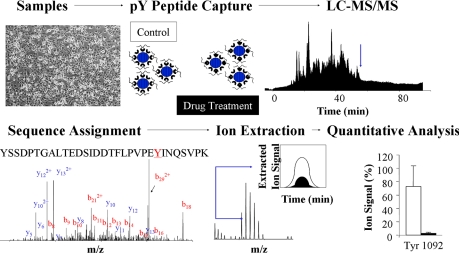
Phosphotyrosine proteomics detects modulation of signaling after TKI treatment. Samples are processed in parallel through lysis, protein denaturation, proteolysis, and phosphotyrosine (pY)-containing peptide capture. Each sample is analyzed with LC-MS/MS on a hybrid linear ion trap-Orbitrap mass spectrometer. After database searches assign sequences of interest with high confidence, average peak areas and standard deviations from extracted ion chromatograms are used to examine the changes in ion signal after TKI treatment.
F<sc>ig</sc>. 5.
Fig. 5.
Multiple myeloma diagnosis and prognosis with a quantitative mass spectrometry assay. Currently excessive antibody production is detected with serum protein electrophoresis (A). The antibodies are identified using immunofixation electrophoresis (B); here the monoclonal spike is an IgG with κ light chain. After LC-MS/MS, peptides, like ALPAPIEK from IgG, can be selected for quantitative mass spectrometry assays (C). A schematic diagram of selected reaction monitoring is shown (D); a single molecule can be detected by filtering the m/z values for peptide and specific fragments. Using the same serum sample shown in B, the quantity and type of antibody are determined in a mass spectrometry assay; high levels of ALPAPIEK from IgG (E) and DSTYSLSSTLTLSK (F) from κ light chain are confirmed using multiple reaction monitoring.

References

    1. Dalton, W. S., and Friend, S. H. ( 2006) Cancer biomarkers—an invitation to the table. Science 312 1165–1168 - PubMed
    1. American Cancer Society ( 2008) 2008 Estimated US Cancer Deaths, in Cancer Statistics 2008, American Cancer Society, Inc., Atlanta, GA
    1. Holschneider, C. H., and Berek, J. S. ( 2000) Ovarian cancer: epidemiology, biology, and prognostic factors. Semin. Surg. Oncol. 19 3–10 - PubMed
    1. Boente, M. P., Schilder, R., and Ozols, R. F. ( 1999) Gynecological cancers. Cancer Chemother. Biol. Response Modif. 18 418–434 - PubMed
    1. Baker, T. R., and Piver, M. S. ( 1994) Etiology, biology, and epidemiology of ovarian cancer. Semin. Surg. Oncol. 10 242–248 - PubMed

Publication types