Comparative Study
. 2008 Aug 5;105(31):10984-9.
doi: 10.1073/pnas.0712043105. Epub 2008 Jul 29.

Spontaneous local variations in ongoing neural activity bias perceptual decisions

Affiliations
Comparative Study

Spontaneous local variations in ongoing neural activity bias perceptual decisions

Guido Hesselmann et al. Proc Natl Acad Sci U S A. .

Abstract

Neural variability in responding to identical repeated stimuli has been related to trial-by-trial fluctuations in ongoing activity, yet the neural and perceptual consequences of these fluctuations remain poorly understood. Using functional neuroimaging, we recorded brain activity in subjects who reported perceptual decisions on an ambiguous figure, Rubin's vase-faces picture, which was briefly presented at variable intervals of > or = 20 s. Prestimulus activity in the fusiform face area, a cortical region preferentially responding to faces, was higher when subjects subsequently perceived faces instead of the vase. This finding suggests that endogenous variations in prestimulus neuronal activity biased subsequent perceptual inference. Furnishing evidence that evoked sensory responses, we then went on to show that the pre- and poststimulus activity interact in a nonlinear way and the ensuing perceptual decisions depend upon the prestimulus context in which they occur.


Conflict of interest statement

The authors declare no conflict of interest.

Figures
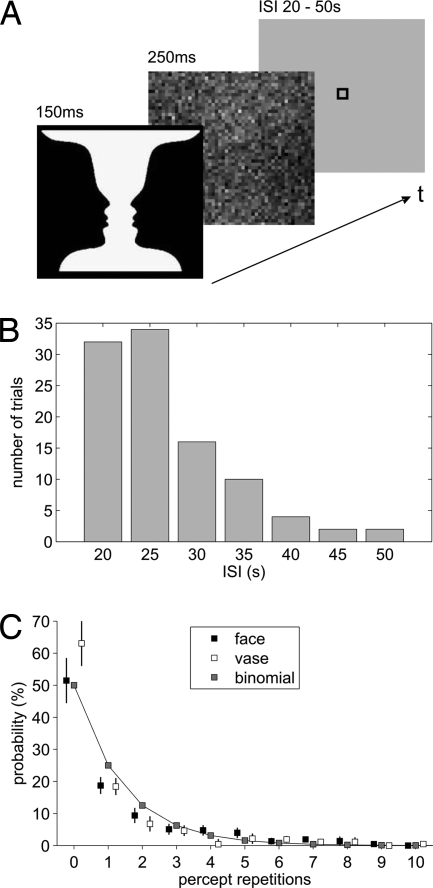
Fig. 1.
Fig. 1.
Experimental paradigm and analysis of percept repetitions. (A) During fMRI, subjects were repeatedly shown Rubin's ambiguous figure followed by a noise mask. In each trial, subjects reported whether they had perceived a vase or faces. (B) Distribution of ISIs across trials. (C) The incidence of repetitions for either percept averaged across all ISIs can very well be approximated by a binomial distribution (goodness-of-fit R2 = 0.97, for faces percepts, R2 = 0.93, for vase percepts).
Fig. 2.
Fig. 2.
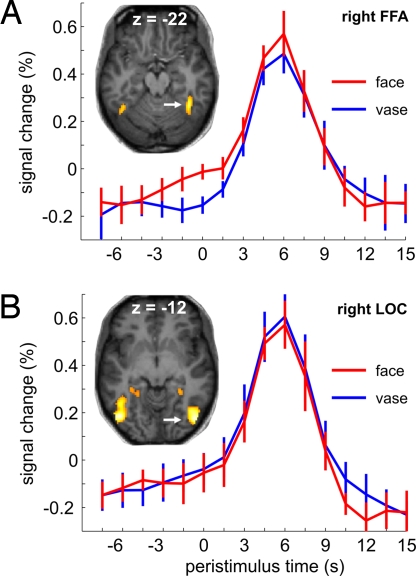
Peristimulus fMRI signal time courses from right FFA (A) and right LOC (B), averaged across subjects as a function of percept. Significant percept-dependent signal differences were found in the right FFA at time points −1.5 s (t11 = 2.88, P = 0.015), 0 s (t11 = 3.34, P = 0.007), and 6 s (t11 = 2.76, P = 0.019) (two-sided paired t tests). Error bars represent ± SEM. The images show, for a single representative subject, the two main regions of interest identified in the localizer experiment.
Fig. 3.
Fig. 3.
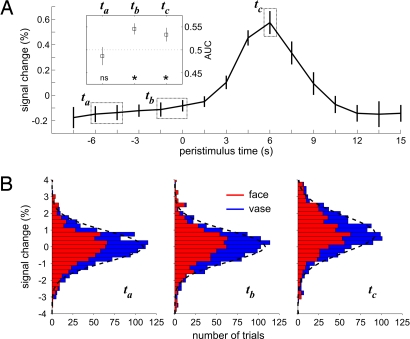
Time-dependent analysis of activity levels in right FFA. (A) BOLD signal time course averaged across subjects and percepts. The inserted plot shows average choice probabilities (expressed as AUC) for time points ta, tb, and tc. Asterisks mark choice probabilities significantly larger (P < 0.05, two-sided paired t test) than 0.5 in epochs tb (prestimulus baseline) and tc (peak response), indicating a relationship between higher activity levels and the perceptual decision for faces (individual data shown in Fig. S3). Note that there is no significant correlation between percept and signal at the earlier time point ta. (B) Stacked distributions of activity levels at time points ta, tb, and tc with the proportion of trials leading to faces and vase percepts indicated in red and blue, respectively. Distributions of FFA signal at ta and tb are very similar, but within this distribution face trials are reshuffled to higher signal intensities only at baseline time point tb as well as during the evoked response in tc. Fitted Gaussian distributions are indicated by dashed lines.

References

    1. Schiller PH, Finlay BL, Volman SF. Short-term response variability of monkey striate neurons. Brain Res. 1976;105:347–349. - PubMed
    1. Arieli A, Sterkin A, Grinvald A, Aertsen A. Dynamics of ongoing activity: Explanation of the large variability in evoked cortical responses. Science. 1996;273:1868–1871. - PubMed
    1. Fiser J, Chiu C, Weliky M. Small modulation of ongoing cortical dynamics by sensory input during natural vision. Nature. 2004;431:573–578. - PubMed
    1. Super H, van der Togt C, Spekreijse H, Lamme VA. Internal state of monkey primary visual cortex (V1) predicts figure-ground perception. J Neurosci. 2003;23:3407–3414. - PMC - PubMed
    1. Boly M, et al. Baseline brain activity fluctuations predict somatosensory perception in humans. Proc Natl Acad Sci USA. 2007;104:12187–12192. - PMC - PubMed

Publication types

LinkOut - more resources