. 2008 Jul 30;3(7):e2795.
doi: 10.1371/journal.pone.0002795.

Matrix development in self-assembly of articular cartilage

Affiliations

Matrix development in self-assembly of articular cartilage

Gidon Ofek et al. PLoS One. .

Abstract

Background: Articular cartilage is a highly functional tissue which covers the ends of long bones and serves to ensure proper joint movement. A tissue engineering approach that recapitulates the developmental characteristics of articular cartilage can be used to examine the maturation and degeneration of cartilage and produce fully functional neotissue replacements for diseased tissue.

Methodology/principal findings: This study examined the development of articular cartilage neotissue within a self-assembling process in two phases. In the first phase, articular cartilage constructs were examined at 1, 4, 7, 10, 14, 28, 42, and 56 days immunohistochemically, histologically, and through biochemical analysis for total collagen and glycosaminoglycan (GAG) content. Based on statistical changes in GAG and collagen levels, four time points from the first phase (7, 14, 28, and 56 days) were chosen to carry into the second phase, where the constructs were studied in terms of their mechanical characteristics, relative amounts of collagen types II and VI, and specific GAG types (chondroitin 4-sulfate, chondroitin 6-sulfate, dermatan sulfate, and hyaluronan). Collagen type VI was present in initial abundance and then localized to a pericellular distribution at 4 wks. N-cadherin activity also spiked at early stages of neotissue development, suggesting that self-assembly is mediated through a minimization of free energy. The percentage of collagen type II to total collagen significantly increased over time, while the proportion of collagen type VI to total collagen decreased between 1 and 2 wks. The chondroitin 6- to 4- sulfate ratio decreased steadily during construct maturation. In addition, the compressive properties reached a plateau and tensile characteristics peaked at 4 wks.

Conclusions/significance: The indices of cartilage formation examined in this study suggest that tissue maturation in self-assembled articular cartilage mirrors known developmental processes for native tissue. In terms of tissue engineering, it is suggested that exogenous stimulation may be necessary after 4 wks to further augment the functionality of developing constructs.


Conflict of interest statement

Competing Interests: The authors have declared that no competing interests exist.

Figures

Figure 1
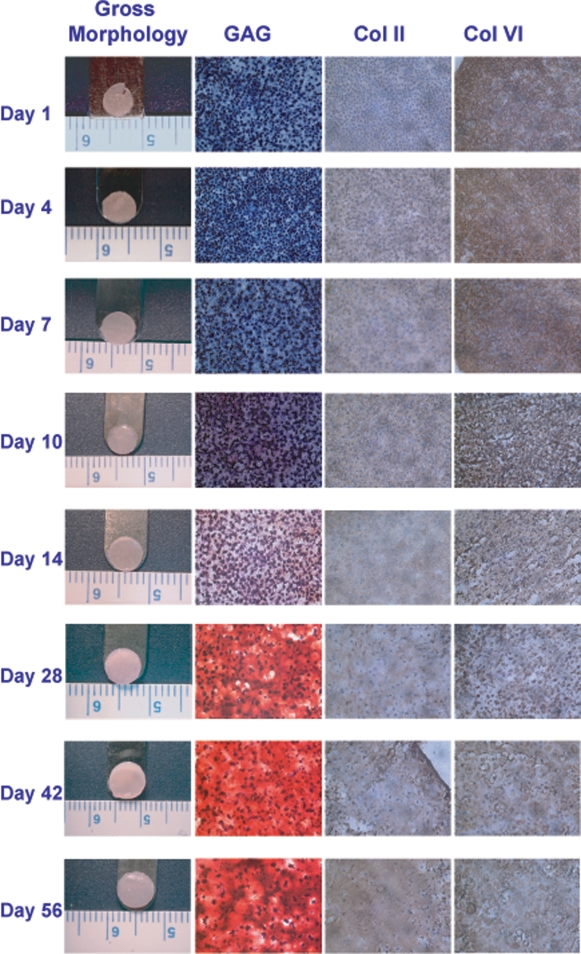
Figure 1. Gross morphology (column 1) and histological sections (columns 2–4) of self-assembled cartilage constructs.
Original magnification, 40X. GAGs were initially concentrated pericellularly, but were observed throughout the tissue by 4 wks. Also at 4 wks, collagen type VI localized around the cells, while collagen type II appeared evenly distributed in the constructs.
Figure 2
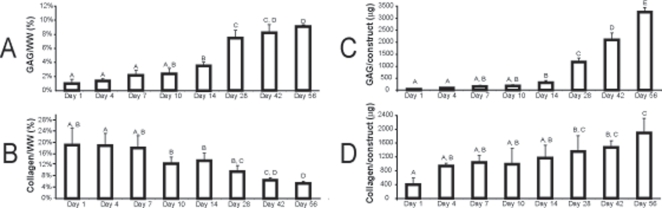
Figure 2. GAG and collagen content in constructs during development in Phase I.
Significant differences in GAG/WW can be observed between 7 and 14 days, 14 and 28 days, and 28 and 56 days (A). Significant differences can be observed in collagen/WW between 7 and 14 days, and 28 and 56 days (B). Increasing trends were observed for both total GAG per construct (C) and total collagen per construct (D). Data presented as mean±standard deviations.
Figure 3
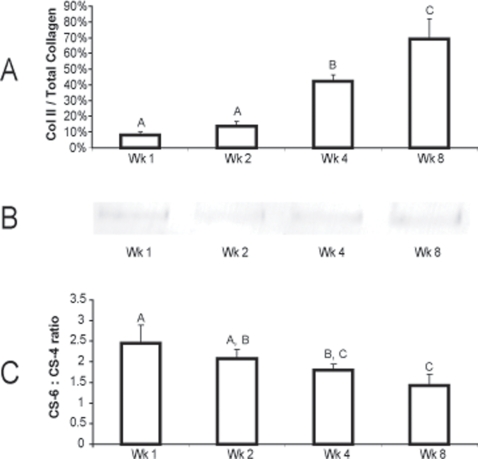
Figure 3. Three major biochemical changes can be observed in cartilage neotissue maturation with the self-assembling process, which mirror known developmental trends for articular cartilage.
(A) The percentage of collagen type II to total collagen increased consistently over time, from 8.1% at 1 wk to 69.1% at 8 wks, with statistically significant increases between 2, 4, and 8 wks. (B) In a western blot for collagen type VI, normalized to total collagen content, it is observed that at the proportion of collagen type VI to total collagen decreased by approximately 40% between 1 and 2 wks and then increased slightly at 8 wks. Relative collagen type VI levels were determined by the integrated optical density of each band. (C) The ratio of CS-6 to CS-4 decreased steadily during construct maturation, from 2.4 at 1 wk to 1.4 at 8 wks. Data presented as mean±standard deviations.
Figure 4
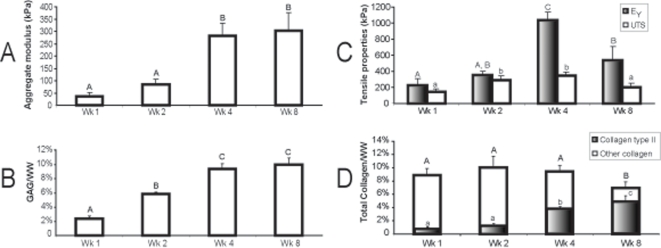
Figure 4. Biomechanical and biochemical properties of the constructs in Phase II.
Large and significant increases in the aggregate moduli (A) were observed between 2 and 4 wks, corresponding to increases in GAG/WW (B). The Young's modulus and ultimate tensile strength (C) increased during the first 4 wks, coinciding with increases in the percentage of collagen type II to total collagen. Both tensile mechanical properties then decreased significantly at 8 wks, concurrent with a similarly significant decrease in total collagen/WW (D). Data presented as mean±standard deviations.
Figure 5
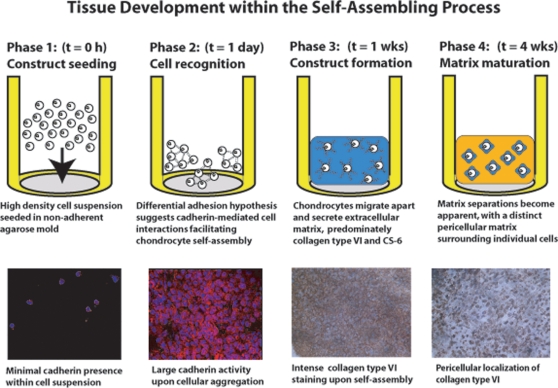
Figure 5. Tissue development within the self-assembling process can be described in four phases.
In the first phase, a high density cell suspension is seeded in an agarose mold. In the second phase, chondrocytes begin to recognize each other and coalesce through a minimization of the free energy in the system, as described by the differential adhesion hypothesis. In the third phase, tissue constructs begin to form as the cells migrate apart and secrete predominately collagen type VI and CS-6 to compose its extracellular matrix. In the fourth phase, extracellular matrix separations become apparent, as indicated by a PCM surrounding individual chondrocytes. The initially abundant collagen type VI decreases in proportion to total collagen and localizes around individual cells, as the percentage of collagen type II to total collagen increases. The mature tissue matrix consists predominately of collagen type II and a slightly greater percentage of CS-6 than CS-4.

References

    1. Hu JC, Athanasiou KA. Structure and Function of Articular Cartilage. Handbook of Histology Methods for Bone and Cartilage 2003
    1. Arthritis. Disease Center: Osteoarthritis. 2007 www.arthritis.org.
    1. Hu JC, Athanasiou KA. A self-assembling process in articular cartilage tissue engineering. Tissue Eng. 2006;12:969–79. - PubMed
    1. Elder BD, Athanasiou KA. Effects of confinement on the mechanical properties of self-assembled articular cartilage constructs in the direction orthogonal to the confinement surface. J Orthop Res. 2008;26:238–46. - PMC - PubMed
    1. Hu JC, Athanasiou KA. The effects of intermittent hydrostatic pressure on self-assembled articular cartilage constructs. Tissue Eng. 2006;12:1337–44. - PubMed

Publication types