Review
. 2009 Sep;92(2):215-24.
doi: 10.1016/j.nlm.2008.07.001. Epub 2008 Aug 19.

Habituation to repeated stress: get used to it

Affiliations
Review

Habituation to repeated stress: get used to it

Nicola Grissom et al. Neurobiol Learn Mem. 2009 Sep.

Abstract

Habituation, as described in the landmark paper by Thompson et al. [Thompson, R. F., & Spencer, W. A. (1966). Habituation: A model phenomenon for the study of neuronal substrates of behavior. Psychological Review, 73(1), 16-43], is a form of simple, nonassociative learning in which the magnitude of the response to a specific stimulus decreases with repeated exposure to that stimulus. A variety of neuronal and behavioral responses have been shown to be subject to habituation based on the criteria presented in that paper. It has been known for several decades that the magnitude of hypothalamic-pituitary-adrenal (HPA) activation occurring in response to a stressor declines with repeated exposure to that same stressor. For some time this decline has been referred to as "habituation" in the stress neurobiology literature. However, how this usage compares to the definition proposed by Thompson and Spencer has not been systematically addressed. For this special issue, we review the stress neurobiology literature and examine the support available for considering declines in HPA response to repeated stress to be response habituation in the sense defined by Thompson and Spencer. We conclude that habituation of HPA activity meets many, but not all, important criteria for response habituation, supporting the use of this term within the context of repeated stress. However, we also propose that response habituation can, at best, only partially explain the phenomenon of HPA habituation, which also involves well-known negative feedback mechanisms, activation of broad stress-related neural circuitry and potentially more complex associative learning mechanisms.


Figures
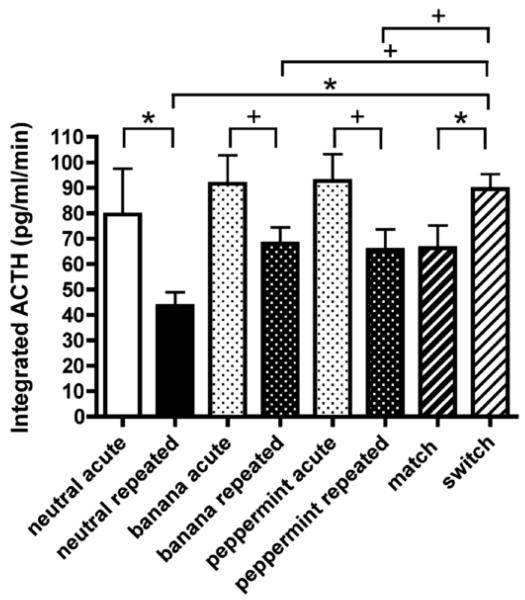
Figure 1
Figure 1
Habituation of HPA responses to repeated restraint is disrupted by exposure to an unfamiliar odor during restraint. Eight groups of animals were either unstressed or repeatedly restrained for 30min per day for 7 days prior to a test 30 minute restraint on day 8. Repeatedly restrained animals which were not exposed to a specific odor during prior restraint (other than the neutral odor of the housing room; “neutral repeated” group) exhibited significantly habituated integrated ACTH as compared to acutely restrained animals which were not exposed to a specific odor (“neutral acute” group), as expected. Repeatedly restrained animals exposed to only one of either banana odor (“banana repeated” group) or peppermint odor (“peppermint repeated” group) during all 8 days of prior restraint exposures exhibited significantly habituated HPA activity to the 8th restraint as compared to acutely restrained animals exposed to banana (“banana acute” group) or peppermint (“peppermint acute” group). Critically, repeatedly restrained animals exposed on day 8 to restraint with the same odor as the previous seven days (“match” group) had significantly lower HPA activity than repeatedly restrained animals exposed to the alternate odor during restraint on day 8 (“switch” group). This finding demonstrates the apparent context specificity of habituated HPA responses (see Criteria 1 and 7). * indicates p ≤ 0.05; + indicates p ≤ 0.09. Data are expressed as mean ± SEM. From Grissom et al., 2007, with permission.
Figure 2
Figure 2
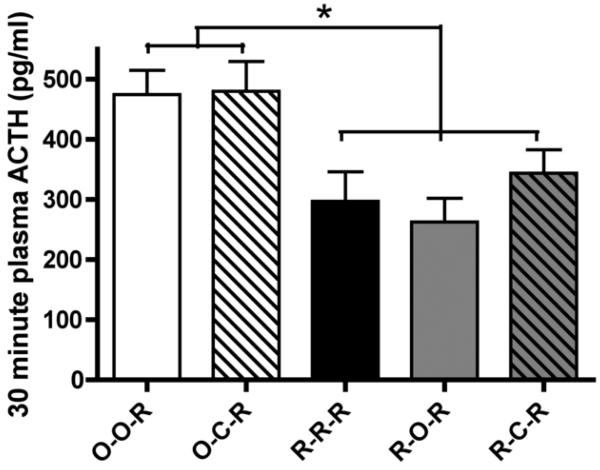
Five groups of adult male rats were treated as follows. Two groups were acutely restrained on day 8; one of these groups received no treatment prior to restraint on day 8 (O-O-R) and one group was only exposed to 4°C cold for 2 hours on day 7 followed by acute restraint on day 8 (O-C-R). Three other groups of rats were repeatedly restrained. One group received daily restraint on days 1-8 (R-R-R). One group tested the effect of missing one day of restraint on day 7 on the maintenance of habituated HPA responses on day 8 (R-O-R). The last group tested the effect of a novel, dishabituating stressor (novel cold stress) on day 7 on habituation to restraint on day 8 (R-C-R). Overall, the two groups receiving acute restraint displayed similar levels of HPA activity in response to restraint. Importantly, the three groups that received repeated restraint demonstrated significantly habituated ACTH levels at the end of 30 minute restraint on day 8, regardless of treatment on day 7. Therefore, withholding restraint for one day did not result in spontaneous recovery of the habituated HPA response (see Criterion 2) and exposure to novel, presumably dishabituating cold stress did not alter the habituated response to familiar restraint (see Criterion 8). * indicates significantly different at p ≤ 0.05. Data are expressed as mean + SEM.
Figure 3
Figure 3
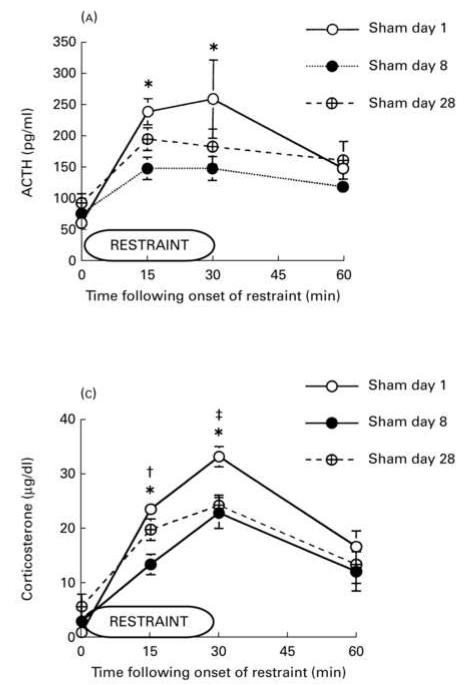
Habituation of HPA activity to repeated restraint does not fully recover after three weeks without restraint. As part of a larger experiment investigating the role of the paraventricular thalamus on the production of habituated responses to HPA activity, the maintenance of habituation in sham-lesioned animals was tested three weeks after the last restraint exposure. Animals were sampled during days 1 and 8 of 8 daily restraints, then were undisturbed from day 9 until day 27. On day 28, all rats were once again restrained and sampled. Overall, animals demonstrated significant habituation by day 8 of restraint as compared to day 1. When animals were re-restrained on day 28, ACTH concentrations during restraint on day 28 were either significantly lower than day 1 responses nor significantly higher than day 8 responses, indicating neither significant habituation nor significant recovery. Corticosterone concentrations during restraint on day 28 were significantly different from day 8 values at 15 minutes and significantly different than day 1 values at 30 minutes. Overall, these results do not demonstrate clear spontaneous recovery of a previously habituated HPA response (Criterion 2). * p ≤ 0.05; day 1 significantly different from day 8. ‡ p ≤ 0.05; day 1 significantly different from day 28. † p ≤ 0.05; day 8 significantly different from day 28. Data are expressed as mean ± SEM. Adapted with permission from Bhatnagar et al., 2002.
Figure 4
Figure 4
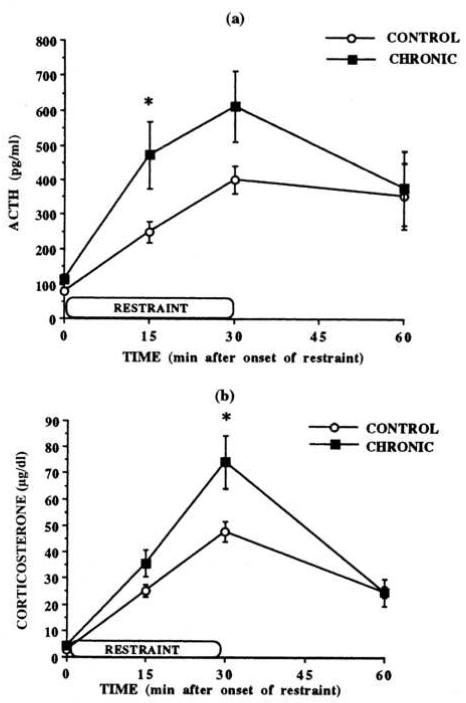
HPA responses are facilitated by exposure to a novel stressor after repeated prior stress. HPA responses have been previously shown to habituate to repeated cold stress (see Criterion 1). When acute restraint is adminstered on day 8 after 7 daily exposures to 4°C environment for 4 hours (CHRONIC), marked elevations in HPA activity are seen above the level seen in naïve animals (CONTROL) exposed to acute restraint. Therefore, HPA responses are dishabituated or facilitated to novel stress in habituated animals (see Criterion 8). * indicates significantly different at p ≤ 0.05. Data are expressed as mean ± SEM. From Bhatnagar and Dallman, 1998, with permission.
Figure 5
Figure 5
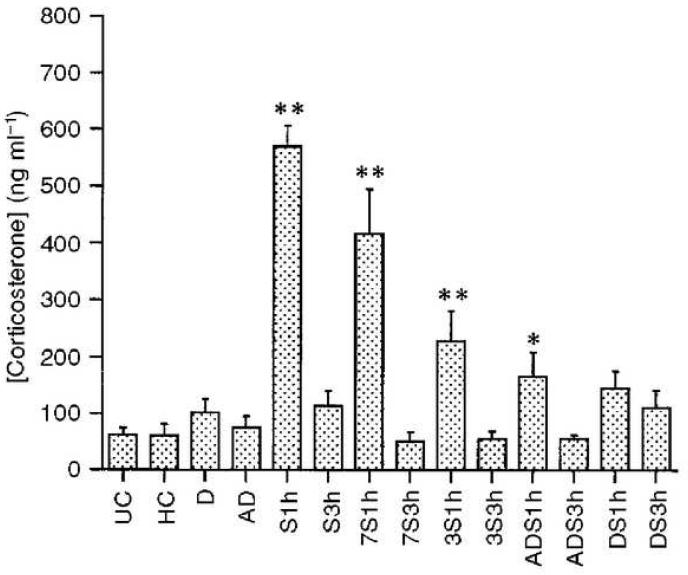
HPA responses become more habituated with increasing numbers of stress exposures within a given period of time (Criterion 4). HPA responses were examined in a total of 14 groups of rats. Four groups were sampled under unstressed, basal conditions on day 15 after 14 prior days of either no treatment (UC, unhandled control), daily handling (HC), alternate day restraint (AD), or daily restraint (D). These groups, displayed on the far left, did not show any significant difference from the UC group, which was used as the primary control group. The remaining ten groups were restrained on day 15 or 16 and sampled either at the end of 1 hour restraint (1h groups) or 2 hours after the end of one hour restraint (3h groups) at which time responses for all groups had all returned to baseline (as indicated by no significant differences seen between any 3h group and UC). The largest significant elevations in corticosterone concentrations over UC animals were seen in naïve animals acutely restrained on day 15 (S1h). The next largest elevations were seen in animals exposed to restraint once every 7 days prior to restraint on day 15 (7S1h). The next largest elevations were seen in animals restrained once every three days prior to restraint on day 16 (3S1h). A slight, but significant elevation in corticosterone concentrations was seen in animals restrained every other day prior to restraint on day 15 (ADS1h) and no significant elevation in corticosterone over baseline was seen in animals restrained daily (DS1h). Thus, the most frequent presentation of restraint, daily restraint, produced the strongest habituation and habituation was weakened with less frequent stress exposure. This pattern of results supports Criterion 4, which states that habituation should be enhanced by stimulating more rapidly over a given period of time. ** p ≤ 0.01, as compared to UC; * p ≤ 0.05 as compared to UC. Data are expressed as mean + SEM. From Ma and Lightman, 1998, with permission.

References

    1. Akana SF, Hanson ES, Horsley CJ, Strack AM, Bhatnagar S, Bradbury MJ, Milligan ED, Dallman MF. Clamped corticosterone (B) reveals the effect of endogenous B on both facilitated responsivity to acute restraint and metabolic responses to chronic stress. Stress (Amsterdam, Netherlands) 1996;1(1):33–49. - PubMed
    1. Akana SF, Shinsako J, Dallman MF. Relationships among adrenal weight, corticosterone, and stimulated adrenocorticotropin levels in rats. Endocrinology. 1983;113(6):2226–2231. - PubMed
    1. Armario A. The hypothalamic-pituitary-adrenal axis: What can it tell us about stressors? CNS & Neurological Disorders Drug Targets. 2006;5(5):485–501. - PubMed
    1. Armario A, Castellanos JM, Balasch J. Adaptation of anterior pituitary hormones to chronic noise stress in male rats. Behavioral and Neural Biology. 1984;41(1):71–76. - PubMed
    1. Armario A, Hidalgo J, Giralt M. Evidence that the pituitary-adrenal axis does not cross-adapt to stressors: Comparison to other physiological variables. Neuroendocrinology. 1988;47(3):263–267. - PubMed

MeSH terms