. 2008 Sep;15(9):1436-49.
doi: 10.1128/CVI.00123-08. Epub 2008 Jul 30.

Gender-dependent HLA-DR-restricted epitopes identified from herpes simplex virus type 1 glycoprotein D

Affiliations

Gender-dependent HLA-DR-restricted epitopes identified from herpes simplex virus type 1 glycoprotein D

Xiuli Zhang et al. Clin Vaccine Immunol. 2008 Sep.

Abstract

In recent clinical trials, a herpes simplex virus (HSV) recombinant glycoprotein D (gD) vaccine was more efficacious in woman than in men. Here we report six HLA-DR-restricted T-cell gD epitope peptides that bind to multiple HLA-DR (DR1, DR4, DR7, DR13, DR15, and DRB5) molecules that represent a large proportion of the human population. Four of these peptides recalled naturally primed CD4(+) T cells in up to 45% of the 46 HSV-seropositive, asymptomatic individuals studied. For the gD(49-82), gD(77-104), and gD(121-152) peptides, the CD4(+) T-cell responses detected in HSV-seropositive, asymptomatic women were higher and more frequent than the responses detected in men. Immunization of susceptible DRB1*0101 transgenic mice with a mixture of three newly identified, gender-dependent, immunodominant epitope peptides (gD(49-82), gD(77-104), and gD(121-152)) induced a gender- and CD4(+) T-cell-dependent immunity against ocular HSV type 1 challenge. These results revealed a gender-dependent T-cell response to a discrete set of gD epitopes and suggest that while a T-cell epitope-based HSV vaccine that targets a large percentage of the human population may be feasible with a limited number of immunodominant promiscuous HLA-DR-restricted epitopes, gender should be taken into account during evaluations of such vaccines.


Figures

FIG. 1.
FIG. 1.
Illustration of HSV-1 gD showing the relative positions of T-cell epitope peptides used in this study. HSV-1 (strain 17) gD regions carrying potential human class II-restricted T-cell epitopes predicted by the TEPITOPE computer-assisted algorithm based on known HLA-peptide-TCR interactions are shown. The amino acid sequence, in single-letter code, and the peptide positions based on the full-length sequence of gD are shown. The black box represents the transmembrane domain.
FIG. 2.
FIG. 2.
CD4+ T-cell proliferative response to HSV-1 gD-derived epitopes. (A) Fresh peripheral blood-derived CD4+ T cells were isolated and stimulated in vitro with 12 individual gD peptides in a 6-day proliferation assay as described in Materials and Methods. The Tp-cell responses of Caucasian (white) and non-Caucasian (nonwhite) ethnic groups against each peptide, assessed by a [3H]thymidine incorporation assay, were compared. Proliferative responses were expressed as Δcpm values (counts per minute of cells incubated with peptide − counts per minute of cells without peptide). The mean of each group is shown as a solid horizontal line. An analysis of T-cell responses in 22 seronegative individuals is shown. A positive T-cell proliferative response was defined on the basis of the responses of HSV-seronegative control individuals, with a Δcpm value of ≥1,000 and an SI (counts per minute of cells incubated with peptide/counts per minute of cells without peptide) of ≥2. The values at the bottom of each data set (i.e., 30/35) are the mean number of responders/total number of individuals tested. The value at the top of each data set (i.e., 11.5) is the mean SI of each of the two groups, i.e., white or nonwhite. The P values compare the Tp-cell responses between white and nonwhite groups by one-way ANOVA. An asterisk in parentheses indicates a peptide that induced higher T-cell proliferation compared with HSV-seronegative control individuals (i.e., significantly higher SI and Δcpm value). (B) Analysis of HLA-DR restriction and functional frequencies of HSV-1 gD peptide-specific CD4+ T cells. Blocking of PBMC proliferation in response to the gD1-29 and gD49-82 peptides by specific anti-HLA-DR MAb.
FIG. 3.
FIG. 3.
Gender differences in Tp-cell responses to HSV-1 gD epitope peptides detected in healthy, asymptomatic, HSV-seropositive individuals. (A and D) Peptide-specific Tp-cell responses in HSV-1- and/or HSV-2-seropositive, asymptomatic, healthy individuals were examined as described in the legend to Fig. 2. The P values in panel A indicate statistically significant differences in Tp-cell responses between men and women (P < 0.05, ANOVA test). Gender dependence of IFN-γ-producing CD4+ T cells specific to 12 gD peptides (B) and to an irrelevant CD4+ T-cell epitope peptide from OVA (OVA323-339) (C) was detected by ELISPOT in HSV-seropositive, asymptomatic individuals. PBMC derived from HSV-1/HSV-2-seropositive, asymptomatic men and women were stimulated with 12 gD peptides for 5 days, and IFN-γ ELISPOT assays were performed as described in Materials and Methods.
FIG. 4.
FIG. 4.
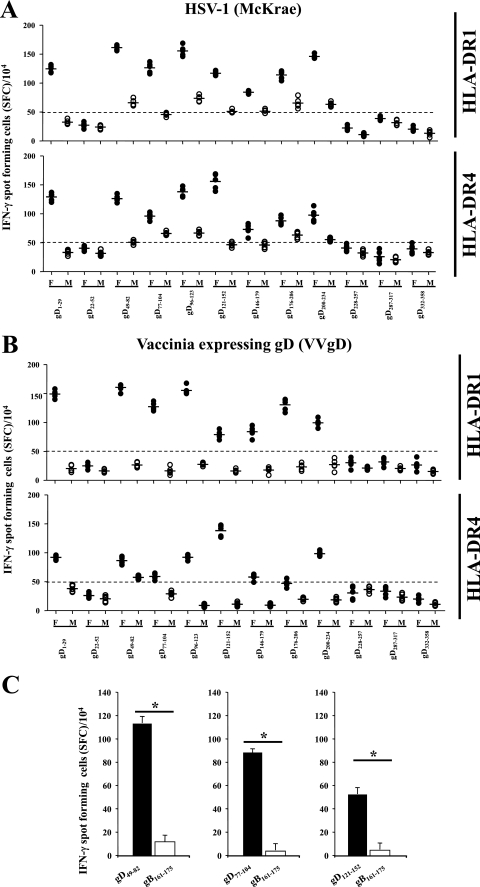
Gender difference in gD epitope-specific CD4+ T-cell responses detected in HLA-DR1 B1*0101 and HLA-DR4 B1*0401 Tg mice. Age-matched HLA-DR1 B1*0101 (HLA-DR1) and HLA-DR4 B1*0401 (HLA-DR4) Tg mice were infected ocularly with HSV-1 (McKrae) (A) or immunized intraperitoneally with VVgD (B). Spleens were harvest on day 14 postinfection and stimulated with each of the 12 individual peptides for 5 days, and peptide-specific IFN-γ-producing CD4+ T cells were detected as described in Materials and Methods. (C) CD4+ T-cell lines specific to gender-dependent gD49-82, gD77-104, and gD121-152 were established from HSV-1-infected HLA Tg mice and restimulated in vitro with either the corresponding specific gD peptide or a heterologous HLA-DR-restricted T-cell epitope from HSV-1 gB (i.e., gB161-175). The numbers of SFC producing IFN-γ are shown for each peptide as mean values ± standard deviations from two independent experiments. The P values are for comparisons of the IFN-γ-producing CD4+ T-cell responses of age-matched females and males by one-way ANOVA.

References

    1. BenMohamed, L., Y. Belkaid, E. Loing, K. Brahimi, H. Gras-Masse, and P. Druilhe. 2002. Systemic immune responses induced by mucosal administration of lipopeptides without adjuvant. Eur. J. Immunol. 32:2274-2281. - PubMed
    1. BenMohamed, L., G. Bertrand, C. D. McNamara, H. Gras-Masse, J. Hammer, S. L. Wechsler, and A. B. Nesburn. 2003. Identification of novel immunodominant CD4+ Th1-type T-cell peptide epitopes from herpes simplex virus glycoprotein D that confer protective immunity. J. Virol. 77:9463-9473. - PMC - PubMed
    1. BenMohamed, L., H. Gras-Masse, A. Tartar, P. Daubersies, K. Brahimi, M. Bossus, A. Thomas, and P. Druilhe. 1997. Lipopeptide immunization without adjuvant induces potent and long-lasting B, T helper, and cytotoxic T lymphocyte responses against a malaria liver stage antigen in mice and chimpanzees. Eur. J. Immunol. 27:1242-1253. - PubMed
    1. BenMohamed, L., R. Krishnan, C. Auge, J. F. Primus, and D. J. Diamond. 2002. Intranasal administration of a synthetic lipopeptide without adjuvant induces systemic immune responses. Immunology 106:113-121. - PMC - PubMed
    1. BenMohamed, L., R. Krishnan, J. Longmate, C. Auge, L. Low, J. Primus, and D. J. Diamond. 2000. Induction of CTL response by a minimal epitope vaccine in HLA A*0201/DR1 transgenic mice: dependence on HLA class II restricted TH response. Hum. Immunol. 61:764-779. - PubMed

Publication types

Substances