


Death receptor 5 mediated-apoptosis contributes to cholestatic liver disease
- PMID: 18667695
- PMCID: PMC2504811
- DOI: 10.1073/pnas.0802702105
Death receptor 5 mediated-apoptosis contributes to cholestatic liver disease
Abstract
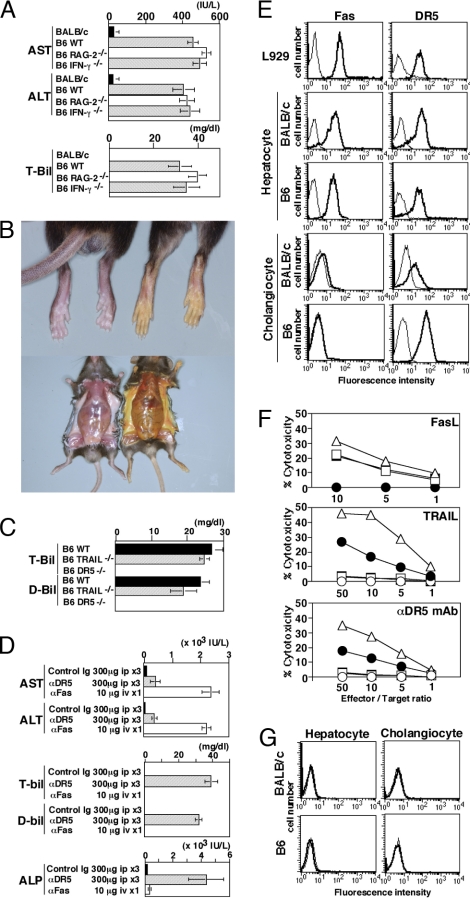
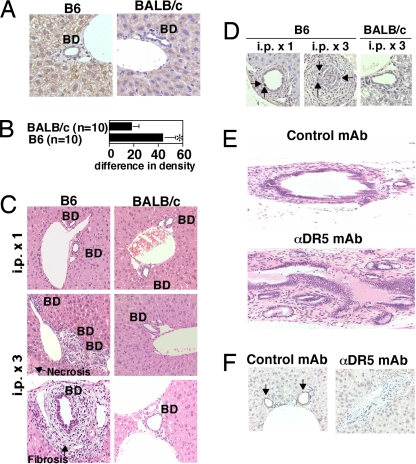
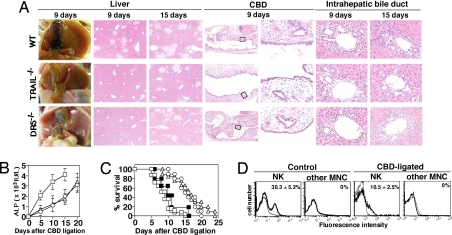
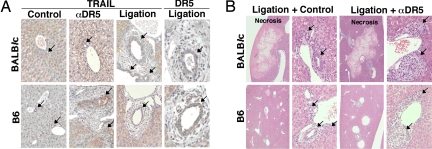
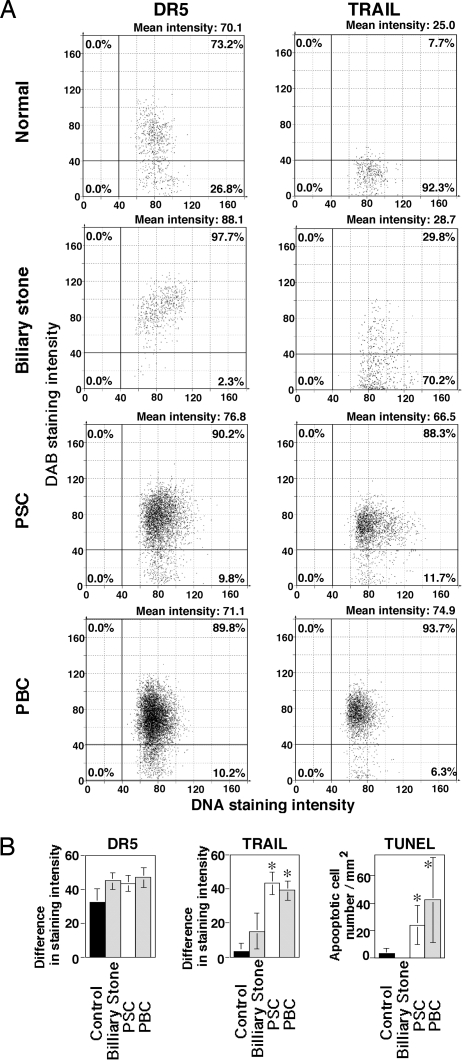
Chronic cholestasis often results in premature death from liver failure with fibrosis; however, the molecular mechanisms contributing to biliary cirrhosis are not demonstrated. In this article, we show that the death signal mediated by TNF-related apoptosis-inducing ligand (TRAIL) receptor 2/death receptor 5 (DR5) may be a key regulator of cholestatic liver injury. Agonistic anti-DR5 monoclonal antibody treatment triggered cholangiocyte apoptosis, and subsequently induced cholangitis and cholestatic liver injury in a mouse strain-specific manner. TRAIL- or DR5-deficient mice were relatively resistant to common bile duct ligation-induced cholestasis, and common bile duct ligation augmented DR5 expression on cholangiocytes, sensitizing mice to DR5-mediated cholangitis. Notably, anti-DR5 monoclonal antibody-induced cholangitis exhibited the typical histological appearance, reminiscent of human primary sclerosing cholangitis. Human cholangiocytes constitutively expressed DR5, and TRAIL expression and apoptosis were significantly elevated in cholangiocytes of human primary sclerosing cholangitis and primary biliary cirrhosis patients. Thus, TRAIL/DR5-mediated apoptosis may substantially contribute to chronic cholestatic disease, particularly primary sclerosing cholangitis.
Conflict of interest statement
The authors declare no conflict of interest.
Figures
References
-
- Aggarwal BB, Shishodia S, Ashikawa K, Bharti AC. The role of TNF and its family members in inflammation and cancer: lessons from gene deletion. Current Drug Targets. 2002;1:327–341. - PubMed
-
- Locksley RM, Killeen N, Lenardo MJ. The TNF and TNF receptor superfamilies: integrating mammalian biology. Cell. 2001;104:487–501. - PubMed
-
- Ashkenazi A. Targeting death and decoy receptors of the tumour-necrosis factor superfamily. Nat Rev Cancer. 2002;2:420–430. - PubMed
-
- Janssen EM, et al. CD4+ T-cell help controls CD8+ T-cell memory via TRAIL-mediated activation-induced cell death. Nature. 2005;434:88–93. - PubMed
-
- Hamilton SE, Wolkers MC, Schoenberger SP, Jameson SC. The generation of protective memory-like CD8+ T cells during homeostatic proliferation requires CD4+ T cells. Nat Immunol. 2006;7:475–481. - PubMed
Publication types
MeSH terms
Substances
LinkOut - more resources
Full Text Sources
Other Literature Sources
Molecular Biology Databases
