


Cumulative cultural evolution in the laboratory: an experimental approach to the origins of structure in human language
- PMID: 18667697
- PMCID: PMC2504810
- DOI: 10.1073/pnas.0707835105
Cumulative cultural evolution in the laboratory: an experimental approach to the origins of structure in human language
Erratum in
-
Correction to Supporting Information for Kirby et al., Cumulative cultural evolution in the laboratory: An experimental approach to the origins of structure in human language.Proc Natl Acad Sci U S A. 2017 Mar 21;114(12):E2544. doi: 10.1073/pnas.1702129114. Epub 2017 Feb 27. Proc Natl Acad Sci U S A. 2017. PMID: 28242685 Free PMC article. No abstract available.
Abstract
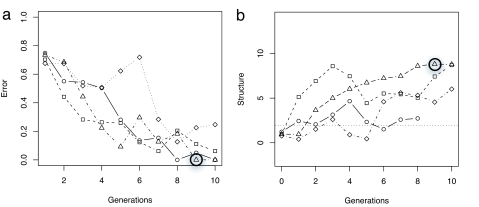
We introduce an experimental paradigm for studying the cumulative cultural evolution of language. In doing so we provide the first experimental validation for the idea that cultural transmission can lead to the appearance of design without a designer. Our experiments involve the iterated learning of artificial languages by human participants. We show that languages transmitted culturally evolve in such a way as to maximize their own transmissibility: over time, the languages in our experiments become easier to learn and increasingly structured. Furthermore, this structure emerges purely as a consequence of the transmission of language over generations, without any intentional design on the part of individual language learners. Previous computational and mathematical models suggest that iterated learning provides an explanation for the structure of human language and link particular aspects of linguistic structure with particular constraints acting on language during its transmission. The experimental work presented here shows that the predictions of these models, and models of cultural evolution more generally, can be tested in the laboratory.
Conflict of interest statement
The authors declare no conflict of interest.
Figures



References
-
- Maynard Smith J, Szathmary E. The Major Transitions in Evolution. Oxford, UK: Oxford Univ Press; 1997.
-
- Deacon TW. The Symbolic Species: The Co-evolution of Language and the Brain. New York: WW Norton; 1997.
-
- Christiansen MH, Chater N. Language as shaped by the brain. Behav Brain Sci. 2008 in press. - PubMed
-
- Kirby S. Function, Selection and Innateness: The Emergence of Language Universals. Oxford UK: Oxford Univ Press; 1999.
-
- Hurford JR. Social transmission favours linguistic generalization. In: Knight C, Studdert-Kennedy M, Hurford JR, editors. The Evolutionary Emergence of Language: Social Function and the Origins of Linguistic Form. Cambridge, UK: Cambridge Univ Press; 2000. pp. 324–352.
Publication types
MeSH terms
LinkOut - more resources
Full Text Sources
