


Evaluation of the effect of anti-tumor necrosis factor agent use on rheumatoid arthritis work disability: the jury is still out
- PMID: 18668597
- PMCID: PMC3653626
- DOI: 10.1002/art.23923
Evaluation of the effect of anti-tumor necrosis factor agent use on rheumatoid arthritis work disability: the jury is still out
Abstract
Objective: To examine the role of anti-tumor necrosis factor (anti-TNF) agents in predicting work disability in subjects with rheumatoid arthritis (RA).
Methods: We studied 953 subjects with rheumatologist-diagnosed RA from a US cohort using a nested, matched, case-control approach. Subjects provided data on medication usage and employment every 6 months for 18 months, were employed at baseline, and were age <65 years at last followup. Cases were subjects who were not employed at followup (n = 231) and were matched approximately 3:1 by time of entry into the cohort to 722 controls who were employed at followup. Risk of any employment loss, or loss attributed to RA, at followup as predicted by use of an anti-TNF agent at baseline was computed using conditional logistic regression. Stratification on possible confounding factors and recursive partitioning analyses were also conducted.
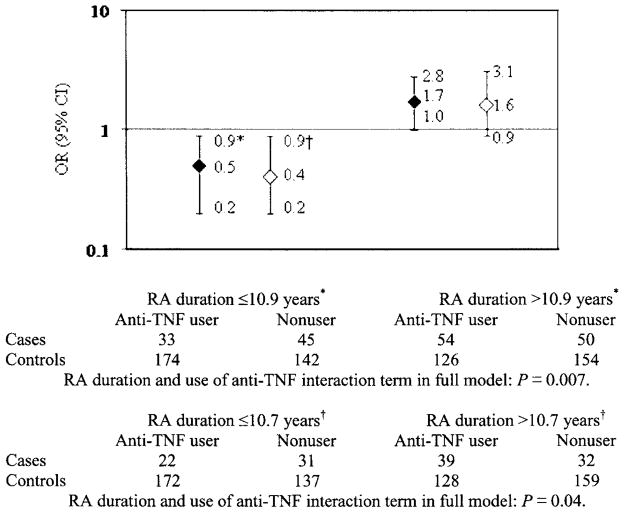
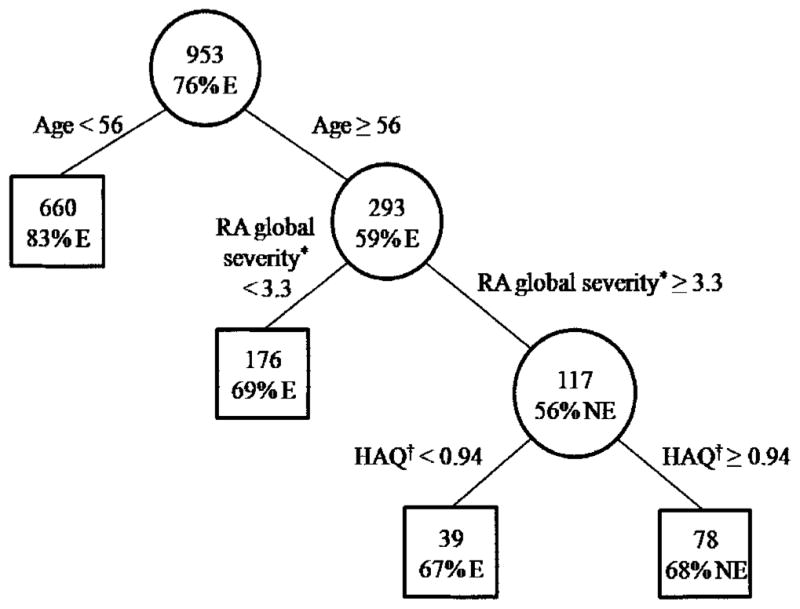
Results: Subjects' mean age was 51 years, 82% were female, 92% were white, and 72% had more than a high school education. Nearly half (48%) used an anti-TNF agent at baseline; characteristics of anti-TNF agent users were similar to nonusers. In the main analyses, anti-TNF use did not protect against any or RA-attributed employment loss (odds ratio [95% confidence interval] 1.1 [0.7-1.6] versus 0.9 [0.5-1.5]). However, a protective effect was found for users with disease duration <11 years (odds ratio [95% confidence interval] 0.5 [0.2-0.9]). In recursive partitioning analyses, age, RA global severity, and functional limitation played a much greater role in determining employment loss than anti-TNF agent use.
Conclusion: Anti-TNF agent use did not protect against work disability in the main analyses. In stratified analyses, their use was protective among subjects with shorter RA duration, whereas in nonparametric analyses, age and disease factors were the prominent predictors of work disability.
Figures
References
-
- Yelin E. The costs of rheumatoid arthritis: absolute, incremental, and marginal estimates. J Rheumatol Suppl. 1996;44:47–51. - PubMed
-
- Pugner KM, Scott DI, Holmes JW, Hieke K. The costs of rheumatoid arthritis: an international long-term view. Semin Arthritis Rheum. 2000;29:305–20. - PubMed
-
- Merkesdal S, Ruof J, Schoffski O, Bernitt K, Zeidler H, Mau W. Indirect medical costs in early rheumatoid arthritis: composition of and changes in indirect costs within the first three years of disease. Arthritis Rheum. 2001;44:528–34. - PubMed
-
- Hallert E, Husberg M, Skogh T. Costs and course of disease and function in early rheumatoid arthritis: a 3-year follow-up (the Swedish TIRA project) Rheumatology (Oxford) 2006;45:325–31. - PubMed
-
- Jacobsson LT, Lindroth Y, Marsal L, Juran E, Bergstrom U, Kobelt G. Rheumatoid arthritis: what does it cost and what factors are driving those costs? Results of a survey in a community-derived population in Malmö. Sweden Scand J Rheumatol. 2007;36:179– 83. - PubMed
Publication types
MeSH terms
Substances
Grants and funding
LinkOut - more resources
Full Text Sources
Medical
