. 2008 Oct 1;586(19):4643-8.
doi: 10.1113/jphysiol.2008.155002. Epub 2008 Jul 31.

Within-step modulation of leg muscle activity by afferent feedback in human walking

Affiliations

Within-step modulation of leg muscle activity by afferent feedback in human walking

Richard af Klint et al. J Physiol. .

Abstract

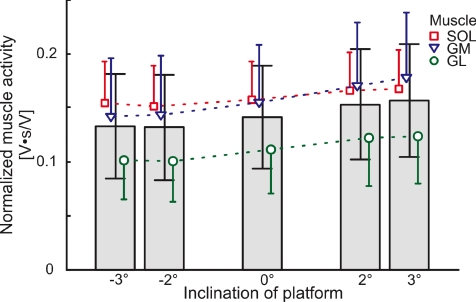
To maintain smooth and efficient gait the motor system must adjust for changes in the ground on a step-to-step basis. In the present study we investigated the role of sensory feedback as 19 able-bodied human subjects walked over a platform that mimicked an uneven supporting surface. Triceps surae muscle activation was assessed during stance as the platform was set to different inclinations (+/-3 deg, +/-2 deg and 0 deg rotation in a parasagittal plane about the ankle). Normalized triceps surae muscle activity was significantly increased when the platform was inclined (2 deg: 0.153 +/- 0.051; 3 deg: 0.156 +/- 0.053) and significantly decreased when the platform was declined (-3 deg: 0.133 +/- 0.048; -2 deg: 0.132 +/- 0.049) compared with level walking (0.141 +/- 0.048) for the able-bodied subjects. A similar experiment was performed with a subject who lacked proprioception and touch sensation from the neck down. In contrast with healthy subjects, no muscle activation changes were observed in the deafferented subject. Our results demonstrate that the ability to compensate for small irregularities in the ground surface relies on automatic within-step sensory feedback regulation rather than conscious predictive control.


Figures
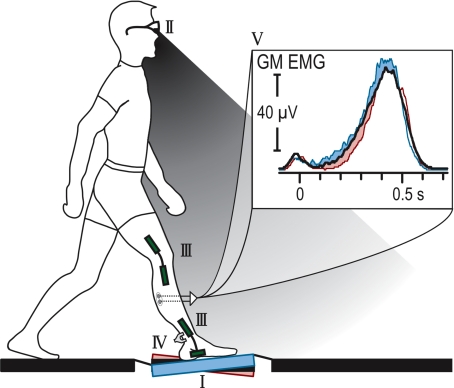
Figure 1
Figure 1. Experimental set-up
Subjects stepped on an inclined surface (I) in the middle of a 10 m walk-way. Knowledge of the platform's inclination was prevented by occluding part of the subject's view (grey area) with taped glasses (II). Ankle and knee rotation were recorded using goniometers (III) and Achilles' tendon force was estimated by an external buckle transducer (IV). Ensemble averaged (n > 20) electromyographic recordings from gastrocnemius medialis (GM) of a representative subject is presented for 0 deg (black), +3 deg and −3 deg (increase and decrease, respectively, in the EMG) degree inclination (V), showing modulation in muscle activity induced by the inclination of the platform.
Figure 2
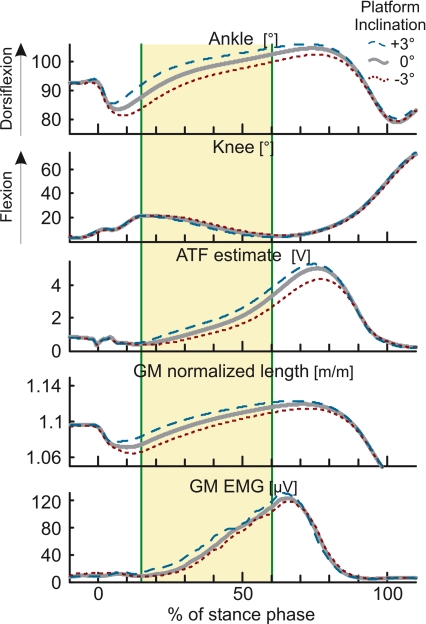
Figure 2. Analysis of the effect of stepping on an inclined surface
Grand mean ensemble averages of 18 able-bodied subjects' ankle dorsiflexion, knee flexion, Achilles' tendon force (ATF) estimate, normalized gastrocnemius medialis (GM) muscle–tendon length and GM muscle activity are presented for level, +3 deg and −3 deg inclination of the platform (thick, dashed, and dotted, respectively). The analysis window for the kinematics, force and EMG recordings is represented by the shaded areas (15–60% of stance). Stepping on the inclined surface shifts the ankle rotation at foot touch down. This has an effect on the muscle–tendon length throughout the step, illustrated here for GM. ATF estimates and muscle activity also vary concomitantly with the inclination of the platform.
Figure 3
Figure 3. EMG modulations with respect to the inclination of the platform in able bodied subjects
The bars represent the overall normalized EMG for all muscles. The individual muscle modulation is indicated for soleus (SOL, □), gastrocnemius medialis (GM, ∇) and gastrocnemius lateralis (GL, ◯). The normalized EMG is increased while walking over a positively inclined surface and decreased for negative inclinations. Error bars represent the standard deviation of the normalized muscle activation.
Figure 4
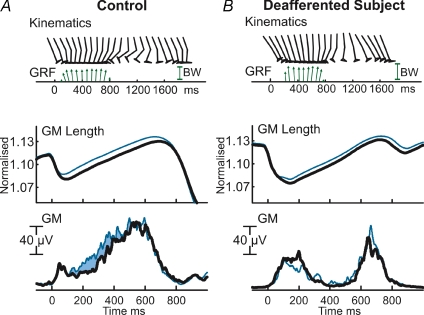
Figure 4. Kinematics and ground reaction forces
Kinematics and ground reaction forces (GRF; subjects' body weight (BW) is shown for comparison) of a typical step, and ensemble averaged plots of gastrocnemius medialis (GM) normalized muscle–tendon length and GM muscle activity in the age-matched control (A) and the deafferented subject IW (B) for 0 deg and +3 deg inclination (thick and thin line, respectively; 0 deg: n= 14, +3 deg: n= 16). The age-matched control shows a concomitant increase in EMG while stepping on a positively inclined surface (filled area). This increase is absent in the deafferented subject.

Comment in

References

    1. Berger W, Quintern J, Dietz V. Pathophysiology of gait in children with cerebral palsy. Electroencephalogr Clin Neurophysiol. 1982;53:538–548. - PubMed
    1. Cole JD, Sedgwick EM. The perceptions of force and of movement in a man without large myelinated sensory afferents below the neck. J Physiol. 1992;449:503–515. - PMC - PubMed
    1. Day BL, Cole JD. Vestibular-evoked postural responses in the absence of somatosensory information. Brain. 2002;125:2081–2088. - PubMed
    1. Dietz V, Quintern J, Berger W. Corrective reactions to stumbling in man: functional significance of spinal and transcortical reflexes. Neurosci Lett. 1984;44:131–135. - PubMed
    1. Donelan JM, Pearson KG. Contribution of sensory feedback to ongoing ankle extensor activity during the stance phase of walking. Can J Physiol Pharmacol. 2004;82:589–598. - PubMed

LinkOut - more resources