Open access publishing, article downloads, and citations: randomised controlled trial
- PMID: 18669565
- PMCID: PMC2492576
- DOI: 10.1136/bmj.a568
Open access publishing, article downloads, and citations: randomised controlled trial
Abstract
Objective: To measure the effect of free access to the scientific literature on article downloads and citations.
Design: Randomised controlled trial.
Setting: 11 journals published by the American Physiological Society.
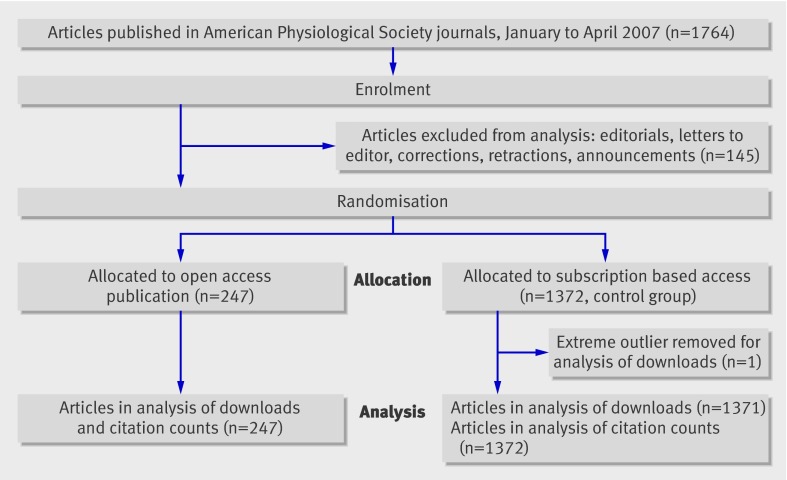
Participants: 1619 research articles and reviews.
Main outcome measures: Article readership (measured as downloads of full text, PDFs, and abstracts) and number of unique visitors (internet protocol addresses). Citations to articles were gathered from the Institute for Scientific Information after one year.
Interventions: Random assignment on online publication of articles published in 11 scientific journals to open access (treatment) or subscription access (control).
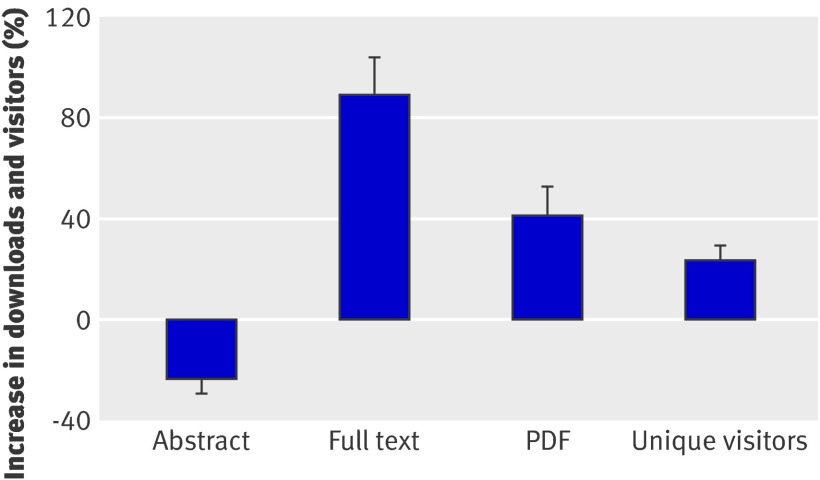
Results: Articles assigned to open access were associated with 89% more full text downloads (95% confidence interval 76% to 103%), 42% more PDF downloads (32% to 52%), and 23% more unique visitors (16% to 30%), but 24% fewer abstract downloads (-29% to -19%) than subscription access articles in the first six months after publication. Open access articles were no more likely to be cited than subscription access articles in the first year after publication. Fifty nine per cent of open access articles (146 of 247) were cited nine to 12 months after publication compared with 63% (859 of 1372) of subscription access articles. Logistic and negative binomial regression analysis of article citation counts confirmed no citation advantage for open access articles.
Conclusions: Open access publishing may reach more readers than subscription access publishing. No evidence was found of a citation advantage for open access articles in the first year after publication. The citation advantage from open access reported widely in the literature may be an artefact of other causes.
Conflict of interest statement
Competing interests: None declared.
Figures
Comment in
-
Open access to research.BMJ. 2008 Jul 31;337:a1051. doi: 10.1136/bmj.a1051. BMJ. 2008. PMID: 18669562 No abstract available.
References
-
- Hagstrom WO. The scientific community. New York: Basic Books, 1965.
-
- Kaplan N. The norms of citation behavior: prolegomena to the footnote. Am Document 1965;16:179-84.
-
- Garfield E. Citation indexes for science. Science 1955;122:108-11. - PubMed
-
- Crane D. Invisible colleges; diffusion of knowledge in scientific communities. Chicago: University of Chicago Press, 1972.
-
- Cronin B. The citation process: the role and significance of citations in scientific communication. London: Taylor Graham, 1984.
Publication types
MeSH terms
LinkOut - more resources
Full Text Sources