Review
. 2008 Dec;22(12):2583-95.
doi: 10.1210/me.2008-0209. Epub 2008 Jul 31.

How peptide hormone vesicles are transported to the secretion site for exocytosis

Affiliations
Review

How peptide hormone vesicles are transported to the secretion site for exocytosis

Joshua J Park et al. Mol Endocrinol. 2008 Dec.

Abstract

Post-Golgi transport of peptide hormone-containing vesicles from the site of genesis at the trans-Golgi network to the release site at the plasma membrane is essential for activity-dependent hormone secretion to mediate various endocrinological functions. It is known that these vesicles are transported on microtubules to the proximity of the release site, and they are then loaded onto an actin/myosin system for distal transport through the actin cortex to just below the plasma membrane. The vesicles are then tethered to the plasma membrane, and a subpopulation of them are docked and primed to become the readily releasable pool. Cytoplasmic tails of vesicular transmembrane proteins, as well as many cytosolic proteins including adaptor proteins, motor proteins, and guanosine triphosphatases, are involved in vesicle budding, the anchoring of the vesicles, and the facilitation of movement along the transport systems. In addition, a set of cytosolic proteins is also necessary for tethering/docking of the vesicles to the plasma membrane. Many of these proteins have been identified from different types of (neuro)endocrine cells. Here, we summarize the proteins known to be involved in the mechanisms of sorting various cargo proteins into regulated secretory pathway hormone-containing vesicles, movement of these vesicles along microtubules and actin filaments, and their eventual tethering/docking to the plasma membrane for hormone secretion.


Figures
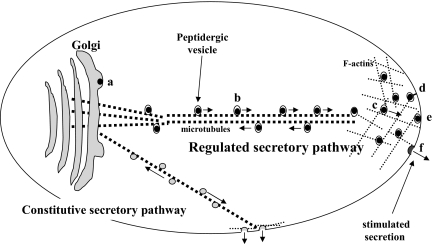
Figure 1
Figure 1
Steps for post-Golgi RSP Vesicle Transport to the Release Site Multiple steps are involved in transporting hormone-containing vesicles from the site of biogenesis at the TGN to the release site in the regulated secretory pathway: a, vesicle budding; b, microtubule-based transport; c, actin-based transport; d, vesicle tethering; e, docking; and f, fusion with the plasma membrane. These steps share some commonality with the trafficking of constitutive secretory vesicles, but there are differences as well (see Table 1).
Figure 2
Figure 2
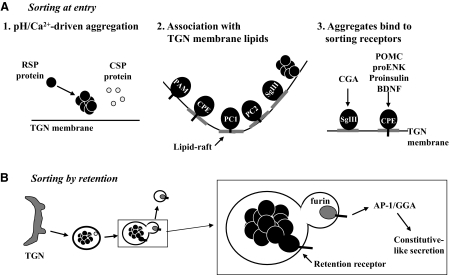
RSP Protein-Sorting Mechanisms A, Sorting at entry (at the TGN): 1) Low pH and high Ca2+ concentration-drive RSP protein aggregation which excludes CSP proteins; 3) Protein aggregates associate with the TGN membrane, through direct interaction with lipids, some specifically at lipid-rafts, or 2) by protein-protein interaction with protein sorting receptors: e.g. CPE is a proposed RSP-sorting receptor for POMC, proenkephalin (proENK), proinsulin, and BDNF, whereas SgIII is a proposed sorting receptor for chromogranin A (CgA). The TGN membrane then buds to form the vesicle bringing along the aggregated protein cargo. B, Sorting by retention: in this model, RSP proteins along with some CSP proteins enter the immature secretory vesicle formed at the TGN. During maturation of the secretory vesicle, the RSP proteins are retained in the maturing vesicle by binding to a retention receptor, e.g. in pancreatic β-cells immature vesicles, membrane CPE binds and retains insulin (34) whereas CSP proteins (e.g. furin) are removed from the vesicle by an AP-1/GGA/clathrin-mediated budding mechanism to yield constitutive-like vesicles for secretion.
Figure 3
Figure 3
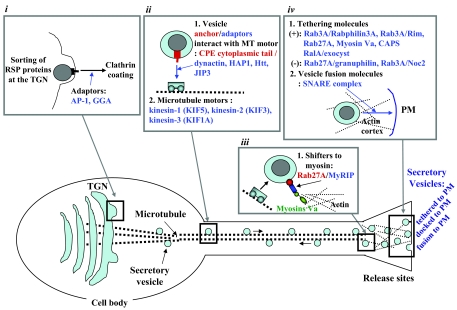
Hormone Vesicle Transport in the Regulated Secretory Pathway of (Neuro)Endocrine Cells Molecules mediating different steps of vesicle transport to the RSP are shown in this model. Peptide hormones and neuropeptides are sorted and packaged into immature clathrin-coated vesicles at the TGN. The adaptors that might be involved in clathrin coating of budding RSP vesicles at the TGN are outlined in box i. The immature vesicles are then anchored to the microtubule (MT)-based transport system via linkers such as the cytoplasmic tail of vesicular transmembrane CPE and adaptors such as dynactin, which recruits various kinesin motor proteins (box ii) to effect movement to the proximity of the release site. The vesicles are then shifted from the microtubule-based system to the myosin transport system that moves these vesicles through the actin cortex to the proximity of the plasma membrane, forming a reserve vesicle pool. The recruitment of the vesicles to the myosin-based transport system is facilitated by rabGTPases and their effector molecules, outlined in box iii. A population of vesicles from the reserve pool are then moved and tethered to the plasma membrane via tethering molecules (box iv). In addition to positive tethering molecules, there are negative ones as well as indicated. A subpopulation of the tethered vesicles are then immobilized on the plasma membrane by SNARE complex (docking) and primed to become the readily releasable pool. Upon stimulation, the docked and primed vesicles are exocytosed, releasing the vesicle contents into the extracellular space. PM, Plasma membrane; MT, microtubule; HAP1, Huntington-associated protein 1; Htt, Huntington; KIF, kinesin-like family; MyRIP, myosin VIIa- and Rab-interacting protein.

References

    1. Egan MF, Kojima M, Callicott JH, Goldberg TE, Kolachana BS, Bertolino A, Zaitsev E, Gold B, Goldman D, Dean M, Lu B, Weinberger DR 2003 The BDNF val66met polymorphism affects activity-dependent secretion of BDNF and human memory and hippocampal function. Cell 112:257–269 - PubMed
    1. Guillemin R, Vargo T, Rossier J, Minick S, Ling N, Rivier C, Vale W, Bloom F 1977 β-Endorphin and adrenocorticotropin are selected concomitantly by the pituitary gland. Science 197:1367–1369 - PubMed
    1. Schwartz MW, Woods SC, Porte Jr D, Seeley RJ, Baskin DG 2000 Central nervous system control of food intake. Nature 404:661–671 - PubMed
    1. Thoenen H 2000 Neurotrophins and activity-dependent plasticity. Prog Brain Res 128:183–191 - PubMed
    1. Kelly RB 1985 Pathways of protein secretion in eukaryotes. Science 230:25–32 - PubMed

Publication types

Substances