


Lack of an adverse effect of Giardia intestinalis infection on the health of Peruvian children
- PMID: 18669932
- PMCID: PMC2727197
- DOI: 10.1093/aje/kwn177
Lack of an adverse effect of Giardia intestinalis infection on the health of Peruvian children
Abstract
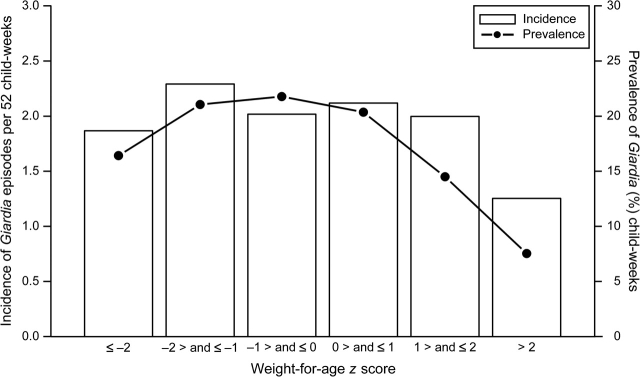
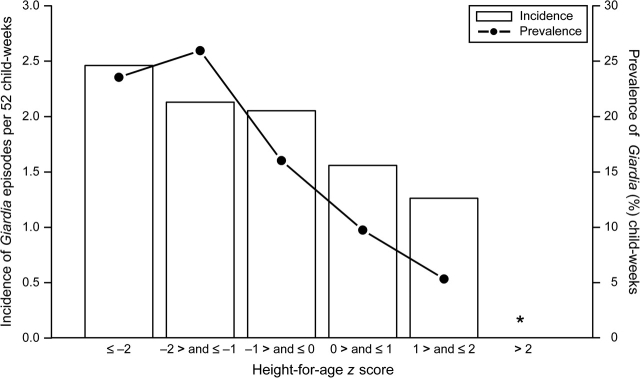
Giardia intestinalis is a common gastrointestinal protozoan worldwide, but its effects on childhood growth in developing countries are not clearly understood. The authors aimed to describe its effects on child growth. They followed 220 Peruvian children daily for diarrhea, weekly for stool samples, and monthly for anthropometry. The authors modeled the effect of nutritional status on the risk of Giardia infection and the risk of diarrhea attributable to Giardia using negative binomial regression. They modeled the effects of Giardia infection on growth using linear regression, with 85% of children becoming infected with Giardia and 87% of these becoming reinfected. In multivariable analysis, the risk of Giardia infection did not vary with weight for age (relative risk = 1.00, 95% confidence interval: 0.89, 1.12) or height for age (relative risk = 0.92, 95% confidence interval: 0.82, 1.04). Giardiasis did not affect growth at 1 or 2 months following the first infection at any age interval. The longitudinal prevalence of Giardia between 6 and 24 months of age was not associated with height gain in that interval (p = 0.981). Giardia was not associated with an increased risk of diarrhea at any age interval. Study results question the importance of Giardia as a childhood pathogen in developing countries where giardiasis is hyperendemic.
Figures
References
-
- Fraser D, Dagan R, Naggan L, et al. Natural history of Giardia lamblia and Cryptosporidium infections in a cohort of Israeli Bedouin infants: a study of a population in transition. Am J Trop Med Hyg. 1997;57:544–9. - PubMed
-
- Ali S, Hill D. Giardia intestinalis. Curr Opin Infect Dis. 2003;16:453–60. - PubMed
-
- Moreira-Lima AA. Tropical diarrhea: new developments in traveller's diarrhea. Curr Opin Infect Dis. 2001;14:547–52. - PubMed
-
- Thompson RC, Reynoldson JA, Mendis AH. Giardia and giardiasis. Adv Parasitol. 1993;32:71–160. - PubMed
-
- Black RE, Brown KH, Becker S. Effects of diarrhea associated with specific enteropathogens on the growth of children in rural Bangladesh. Pediatrics. 1984;73:799–805. - PubMed
Publication types
MeSH terms
Grants and funding
LinkOut - more resources
Full Text Sources
Medical
