


Review
doi: 10.1186/gb-2008-9-7-226.
New clues to organ size control in plants
Affiliations
- PMID: 18671834
- PMCID: PMC2530862
- DOI: 10.1186/gb-2008-9-7-226
Item in Clipboard
Review
New clues to organ size control in plants
Genome Biol.
2008.
Abstract
Plant growth has unparalleled importance for human civilization, yet we are only starting to gain an understanding of its mechanisms. The growth rate and final size of plant organs is determined by both genetic constraints and environmental factors. Regulatory inputs act at two control points: on proliferation; and on the transition between proliferation and differentiation. Cell-autonomous and short-range growth signals act within meristematic domains, whereas diffusible signals from differentiated parts to proliferating cells provide measures of geometry and size and channel environmental inputs.
Figures

Mechanisms for organ size control. (a) Organ formation, exemplified here by leaf development, consists of two stages. The first phase is underpinned by cell proliferation, characterized by intense macromolecular/cytoplasmic synthesis and rapid cell division. The second phase is characterized by cell expansion and differentiation. Differentiation takes place along a basipetal gradient (that is, from leaf tip to leaf base), as indicated here by the gradient in cell size and cell greening. The red arrow summarizes the proliferative inputs, and the black arrow the arrest of proliferation and initiation of differentiation. (b, c) The two principal mechanisms for controlling organ size. Enlargement of organs can be produced by either (b) increasing proliferation signals or (c) delaying the transition between proliferation and differentiation. In both cases the number of cells available for organ formation at the end of the proliferative phase is increased, but the underlying mechanisms are different.
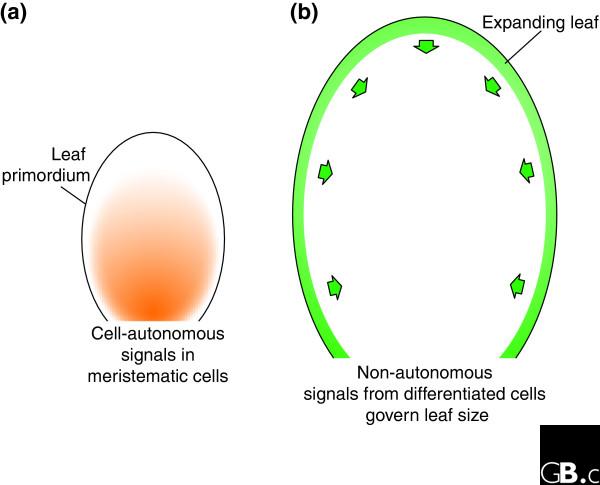
Distinct localization of growth- and size-regulatory mechanisms. (a) Cell-autonomous signals act (positively or negatively) on the proliferating cell pool in the meristems or young tissues. (b) Non-cell-autonomous signals, exemplified by KLUH and its expression domain in differentiated margin cells, act at a distance to determine the proliferation potential of meristematic cells or to restrict the transition between proliferation and differentiation. Organ expansion beyond a critical area would result in the KLUH signal reaching a critical low value, insufficient to maintain proliferation and thus allowing differentiation to take place. Signals from mature organs or from environmental inputs also act non-cell-autonomously.
References
-
- Busov VB, Brunner AM, Strauss SH. Genes for control of plant stature and form. New Phytol. 2008;177:589–607. - PubMed
-
- Anastasiou E, Lenhard M. Growing up to one's standard. Curr Opin Plant Biol. 2007;10:63–69. - PubMed
-
- Fleming AJ. The integration of cell proliferation and growth in leaf morphogenesis. J Plant Res. 2006;119:31–36. - PubMed
-
- Tsukaya H. Mechanism of leaf-shape determination. Annu Rev Plant Biol. 2006;57:477–496. - PubMed
-
- Reddy GV, Heisler MG, Ehrhardt DW, Meyerowitz EM. Real-time lineage analysis reveals oriented cell divisions associated with morphogenesis at the shoot apex of Arabidopsis thaliana. Development. 2004;131:4225–4237. - PubMed
Publication types
MeSH terms
Substances
Grants and funding
LinkOut - more resources
Full Text Sources
Other Literature Sources
