


Effects of prenatal ethanol exposure on regulation of basal hypothalamic-pituitary-adrenal activity and hippocampal 5-HT1A receptor mRNA levels in female rats across the estrous cycle
- PMID: 18672336
- PMCID: PMC5518675
- DOI: 10.1016/j.psyneuen.2008.05.001
Effects of prenatal ethanol exposure on regulation of basal hypothalamic-pituitary-adrenal activity and hippocampal 5-HT1A receptor mRNA levels in female rats across the estrous cycle
Abstract
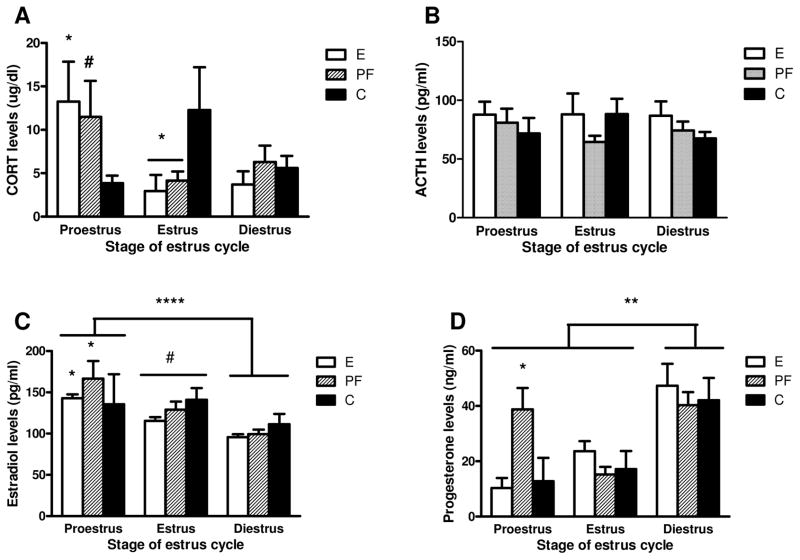
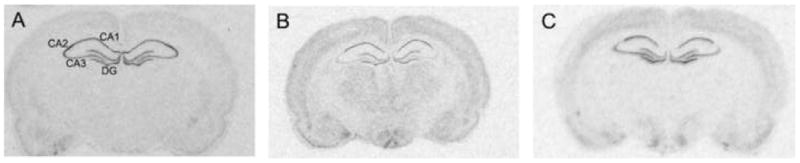
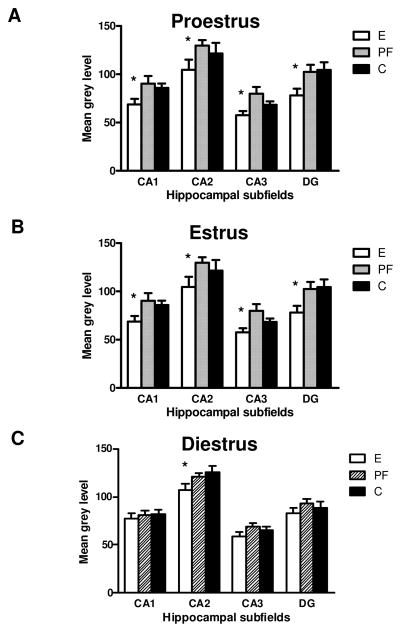
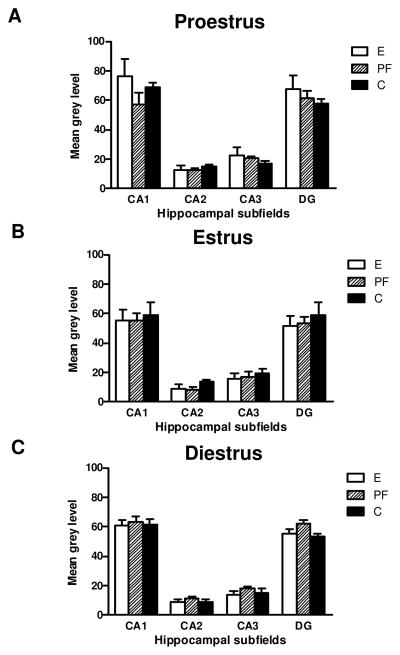
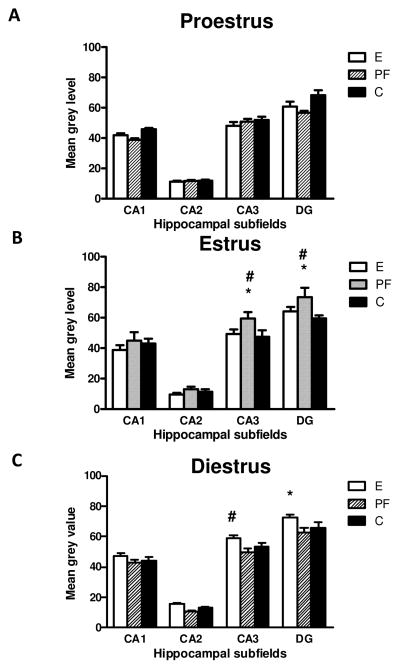
Prenatal ethanol exposure, like other early adverse experiences, is known to alter hypothalamic-pituitary-adrenal (HPA) activity in adulthood. The present study examined the modulatory effects of the gonadal hormones on basal HPA regulation and serotonin Type 1A receptor (5-HT(1A)) mRNA levels in adult female rats prenatally exposed to ethanol (E) compared to that in females from pair-fed (PF) and ad libitum-fed control (C) conditions. We demonstrate, for the first time, long-lasting consequences of prenatal ethanol exposure for basal corticosterone (CORT) regulation and basal levels of hippocampal mineralocorticoid (MR), glucocorticoid (GR) and serotonin Type 1A (5-HT(1A)) receptor mRNA, as a function of estrous cycle stage: (1) basal CORT levels were higher in E compared to C females in proestrus but lower in E and PF compared to C females in estrus; (2) there were no differences among groups in basal levels of adrenocorticotropin (ACTH), estradiol or progesterone; (3) hippocampal MR mRNA levels were decreased in E compared to PF and C females across the estrus cycle, with the greatest effects in proestrus, whereas E (but not PF or C) females had higher hippocampal GR mRNA levels in proestrus than in estrous and diestrus; (4) 5-HT(1A) mRNA levels were increased in E compared to PF and C females in diestrus. That alterations were revealed as a function of estrous cycle stage suggests a role for the ovarian steroids in mediating the adverse effects of ethanol. Furthermore, it appears that ethanol-induced nutritional effects may play a role in mediating at least some of the effects observed. The resetting of HPA activity by early environmental events could be one mechanism linking early life experiences with long-term health consequences. Thus, changes in basal CORT levels, a shift in the MR/GR balance and alterations in 5-HT(1A) receptor mRNA could have important clinical implications for understanding the secondary disabilities, such as an increased incidence of depression, in children with FASD.
Figures
References
-
- Andrews MH, Matthews SG. Programming of the hypothalamo-pituitary-adrenal axis: serotonergic involvement. Stress. 2004;7:15. - PubMed
-
- Atkinson HC, Waddell BJ. Circadian variation in basal plasma corticosterone and adrenocorticotropin in the rat: sexual dimorphism and changes across the estrous cycle. Endocrinology. 1997;138:3842. - PubMed
-
- Bakker JM, van Bel F, Heijnen CJ. Neonatal glucocorticoids and the developing brain: short-term treatment with life-long consequences? Trends Neurosci. 2001;24:649. - PubMed
-
- Burgess L, Handa R. Estrogen-induced alterations in the regulation of mineralocorticoid and glucocorticoid receptor messenger RNA experssion in female rat anterior pituitary and brain. Mol Cell Neurosci. 1993;4:191. - PubMed
-
- Burgess LH, Handa RJ. Chronic estrogen-induced alterations in adrenocorticotropin and corticosterone secretion, and glucocorticoid receptor-mediated functions in female rats. Endocrinology. 1992;131:1261. - PubMed
Publication types
MeSH terms
Substances
Grants and funding
LinkOut - more resources
Full Text Sources
