. 2008 Aug 1:5:69.
doi: 10.1186/1742-4690-5-69.

New and old complex recombinant HIV-1 strains among patients with primary infection in 1996-2006 in France: the French ANRS CO06 primo cohort study

Affiliations

New and old complex recombinant HIV-1 strains among patients with primary infection in 1996-2006 in France: the French ANRS CO06 primo cohort study

Pierre Frange et al. Retrovirology. .

Abstract

Background: Prevalence of HIV-1 non-B subtypes has increased overtime in patients diagnosed at the time of primary infection (PHI) in France. Our objective was to characterize in detail non-B strains which could not be genetically classified into the known subtypes/Circulating Recombinant Forms (CRFs).

Methods: Among 744 patients enrolled in the ANRS PRIMO Cohort since 1996, 176 (23.7%) were infected with HIV-1 non-B strains. The subtype/CRF could not be identified in RT for 15 (2%). The V3-V5 env region was sequenced and 3 strains (04FR-KZS, 06FR-CRN, 04FR-AUK) were full-length sequenced. Phylogenetic and bootscan analyses were used to characterize the mosaic structures.

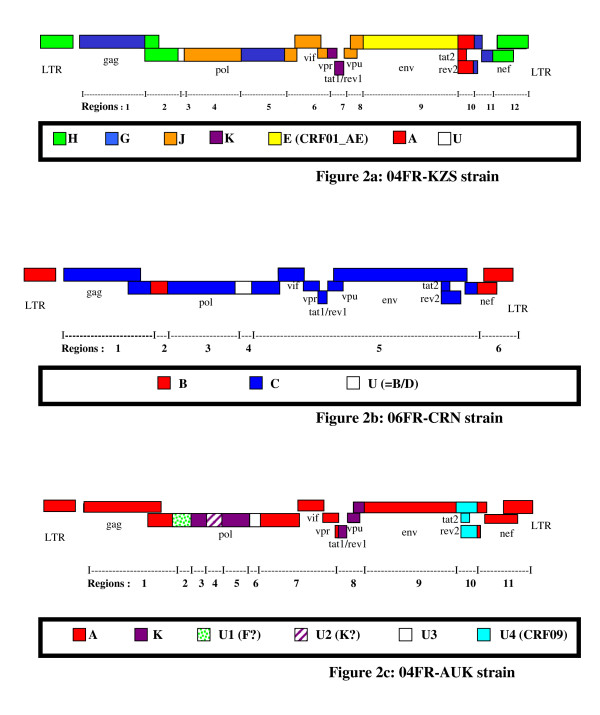
Results: Among V3-V5 sequences, 6 were divergent A, 2 distantly related to E or D, 2 C, 1 B and 2 remained unclassified. 04FR-KZS, isolated in a Congolese woman infected in France, clustered with 2 previously described viruses from the Democratic Republic of Congo. They represent CRF27_cpx involving A/E/G/H/J/K/U subtypes. 06FR-CRN, isolated in a homosexual Caucasian patient, was a B/C/U recombinant involving a Brazilian C strain. 04FR-AUK, isolated in a Congolese patient infected in France, was a A/K/CRF09/U recombinant clustering from gag to vif with HIV-1 MAL. Others PHI were further observed in 2006-2007 with 1 KZS and 5 CRN-like viruses, suggesting their spread in France.

Conclusion: This study illustrates the increasing HIV-1 diversity in France associating new (06FR-CRN) and old (CRF27_cpx and "MAL-like" 04FR-AUK) strains, which are rare in their region of origin but may have a possible founder effect in France. Our results strengthen the French guidelines recommending viro-epidemiological surveillance of HIV-1 diversity.


Figures
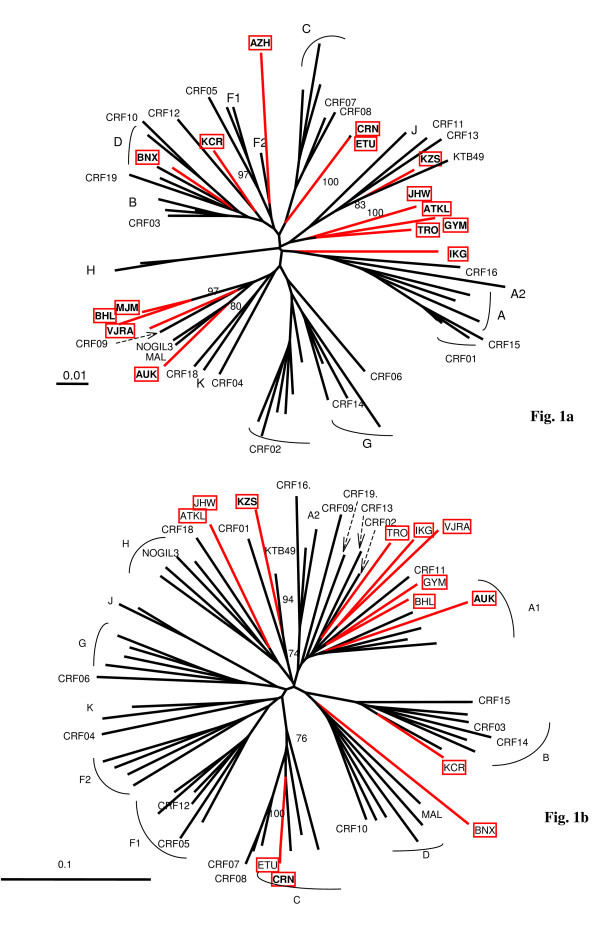
Figure 1
Figure 1
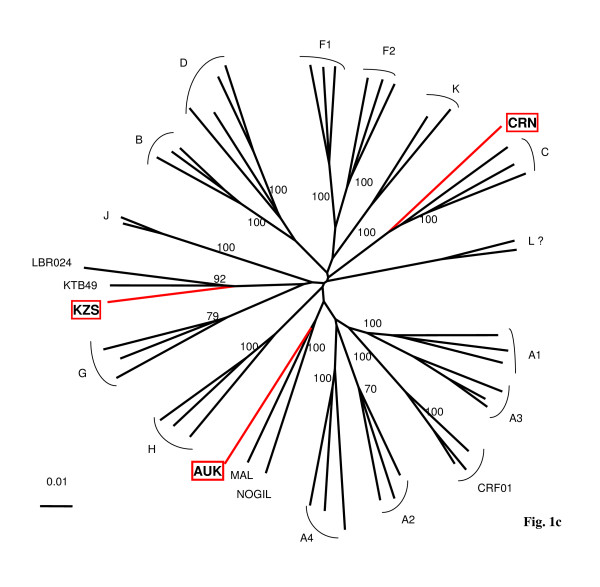
Phylogenetic tree analysis of the 15 "undetermined" viruses isolated in patients enrolled at the time of primary infection. In the phylogenetic trees, based on the RT nucleotide sequence of the 15 “undetermined” strains (a) and the corresponding V3-V5 env region for 13 of them (b), the reference sequences were as follows: 3 references for all pure subtypes, 1 reference for 18 previously described CRF (CRF01-16 and CRF18-19), and unique recombinant MAL [23], NOGIL [24] and 97CD-KTB49 [18] strains. Trees based on unambiguously aligned nucleotides were generated by the neighbour-joining method, and the reliability of each clustering was assessed by bootstrapping with one hundred replicates implemented by Clustal W. The Simplot v3.5.1 performed bootscanning on NJ trees along the genome alignment by moving a 400 base pairs window along the genome alignment with 20 base pairs increment and one hundred replicates for each phylogeny. Only bootstrap values above 70 at each of the internal branches defining a subtype are shown.
Figure 2
Figure 2
Phylogenetic tree analysis of the 3 full-length sequenced strains (04FR-KZS, 06FR-CRN, 04FR-AUK).The sequences were aligned with HIV-1 subtype and subsubtype references, as well as CRF01_AE, MAL, NOGIL, 97CD-KTB49 and 02CD-LBR024 [19] sequences.
Figure 3
Figure 3
Schematic representation of the subtype pattern of the 04FR-KZS (a), 06FR-CRN (b) and 04FR-AUK (c) strains. U = unclassified region.
Figure 4
Figure 4
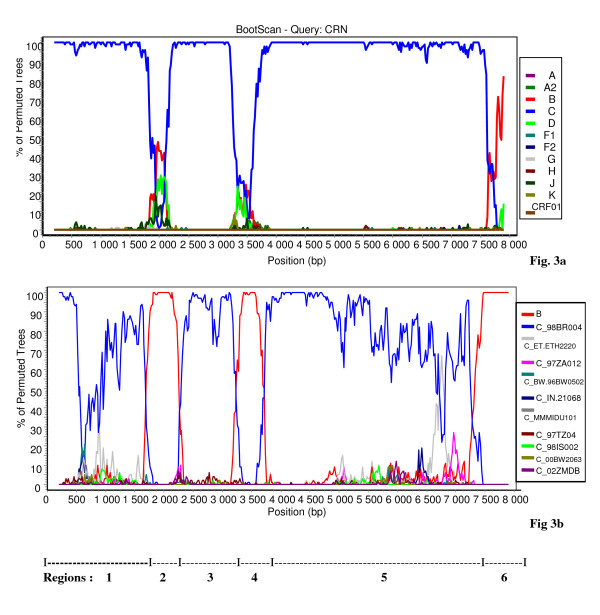
Analysis of the recombinant structure of 06FR-CRN strain. Bootscan plots (a) showing the complex mosaic structure of the 06FR-CRN strain (9684bp). The full-length sequence was aligned with HIV-1 subtype and subsubtype reference sequences (gaps were stripped from the 8116 unambigously aligned base pairs). (b) Bootscan plots with B and C references performed to better characterize the geographic origin of the 06FR-CRN strain.
Figure 5
Figure 5
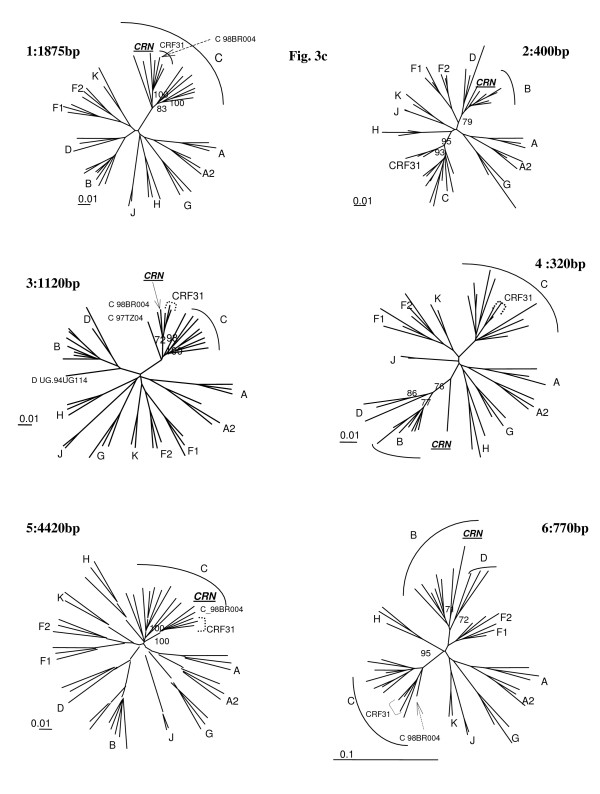
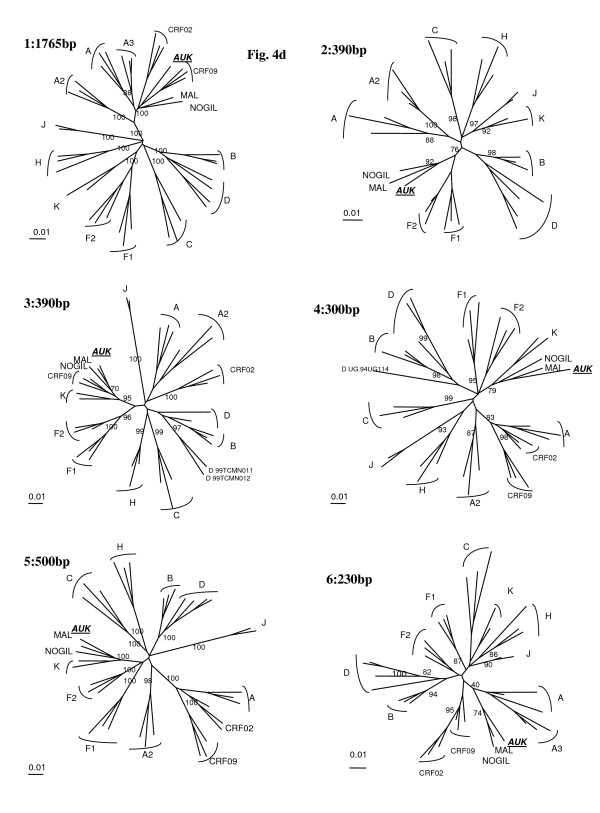
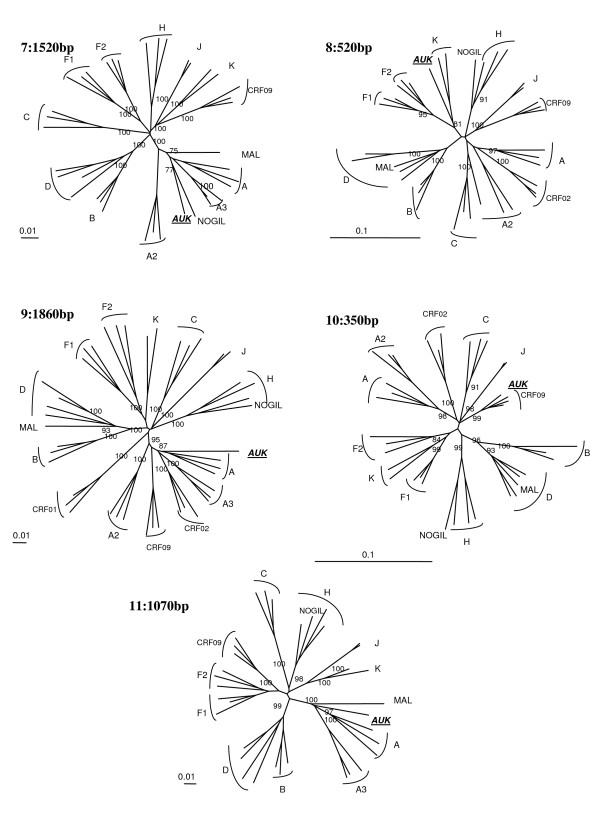
Phylogenetic tree analysis of each of the 6 recombinant regions of 06FR-CRN strain defined in Fig. 6b and represented in schema 2b.
Figure 6
Figure 6
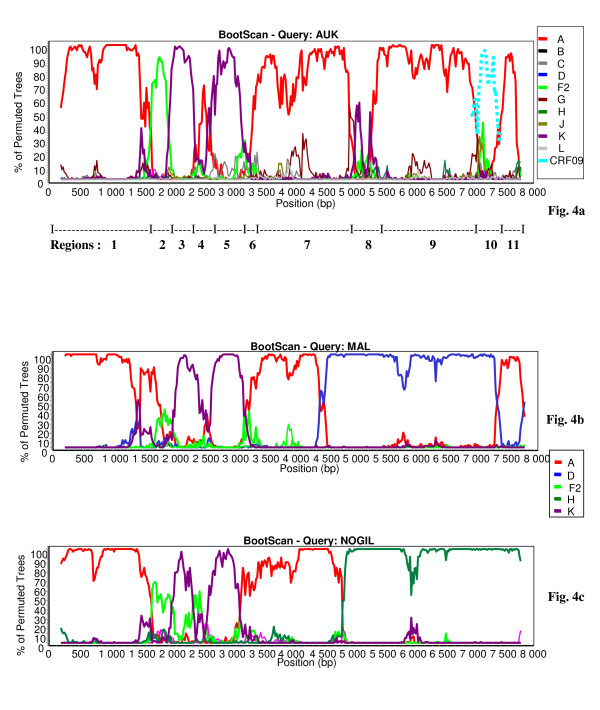
Analysis of the recombinant structure of 04FR-AUK strain. Bootscan plots (a) showing the complex mosaic structure of the AUK strain (9680bp). The full-length sequence was aligned with HIV-1 subtype and subsubtype reference sequences (gaps were stripped from the 8051 unambigously aligned base pairs). The same analysis was then performed in the undetermined region 10 by adding CRF09_cpx reference sequences (in doted lines). Bootscan plots showing the mosaic structure of the previously reported MAL [23] (b) and NOGIL [24] (c) strains.
Figure 7
Figure 7
Part 1
Figure 8
Figure 8
Part 2

References

    1. Burke DS. Recombination in HIV: an important viral evolutionary strategy. Emerg Infect Dis. 1997;3:253–259. - PMC - PubMed
    1. Charpentier C, Nora T, Tenaillon O, Clavel F, Hance AJ. Extensive recombination among human immunodeficiency virus type 1 quasispecies makes an important contribution to viral diversity in individual patients. J Virol. 2006;80:2472–2482. doi: 10.1128/JVI.80.5.2472-2482.2006. - DOI - PMC - PubMed
    1. Simon F, Mauclere P, Roques P, Loussert-Ajaka I, Muller-Trutwin MC, Saragosti S, Georges-Courbot MC, Barre-Sinoussi F, Brun-Vezinet F. Identification of a new human immunodeficiency virus type 1 distinct from group M and group O. Nat Med. 1998;4:1032–1037. doi: 10.1038/2017. - DOI - PubMed
    1. Toni T, Adje-Toure C, Vidal N, Minga A, Huet C, Borger MY, Recordon-Pinson P, Masquelier B, Nolan M, Nkengasong J, Fleury HJ, Delaporte E, Peeters M. Presence of CRF09_cpx and complex CRF02_AG/CRF09_cpx recombinant HIV type 1 strains in Cote d'Ivoire, West Africa. AIDS Res Hum Retroviruses. 2005;21:667–672. doi: 10.1089/aid.2005.21.667. - DOI - PubMed
    1. Powell RL, Zhao J, Konings FA, Tang S, Nanfack A, Burda S, Urbanski MM, Saa DR, Hewlett I, Nyambi PN. Identification of a novel circulating recombinant form (CRF) 36_cpx in Cameroon that combines two CRFs (01_AE and 02_AG) with ancestral lineages of subtypes A and G. AIDS Res Hum Retroviruses. 2007;23:1008–1019. doi: 10.1089/aid.2006.0289. - DOI - PubMed

Publication types

Substances

Associated data