Review
. 2008 Jul-Aug;15(4):576-86.
doi: 10.1016/j.nuclcard.2008.05.005.

Molecular imaging of cardiovascular disease using ultrasound

Affiliations
Review

Molecular imaging of cardiovascular disease using ultrasound

Flordeliza S Villanueva. J Nucl Cardiol. 2008 Jul-Aug.

Abstract

Molecular imaging using probes that specifically home to function- or disease-specific targets is a promising tool for both basic research investigations as well as clinical diagnostics. Ultrasound-based molecular imaging utilizes acoustically active particles (contrast agents) bearing targeting ligands that specifically bind to a molecule of interest. In the presence of an ultrasound field, the bound particles are detectable as a persistent contrast effect during ultrasound imaging. Different types of targeted contrast agents have been reported, most of which share in common the presence of a gas encapsulated by a shell of varying chemical formulation. These agents, or "microbubbles," are typically 2 to 4 mum in diameter, and have a natural resonance frequency that corresponds to the frequencies used in diagnostic echocardiography. This attribute makes it possible to induce microbubble resonance and non-linear oscillation at diagnostic ultrasound frequencies, leading to acoustic emissions from the microbubbles that can be detected as specific signals during two dimensional ultrasound imaging. Targeting ligands that have been attached to microbubbles include monoclonal antibodies, peptides, and the naturally occurring ligands for the receptor of interest, such as vascular endothelial growth factor. Because the contrast agents stay within the intravascular space, they are ideally suited for detection of endothelial epitopes, such as leukocyte adhesion molecules or angiogenesis receptors. Ultrasound molecular imaging with targeted contrast agents has been used to detect inflammation association with ischemia/reperfusion (ischemic memory), cardiac transplant rejection, early atherosclerosis, and angiogenesis. Application to tumor angiogenesis has also been reported using peptides that specifically bind to angiogenic tumor endothelium. Translation of ultrasound molecular imaging to the clinical arena will require optimization of contrast agent design to maximize specific binding, and customization of imaging systems to sensitively detect the binding events.


Figures
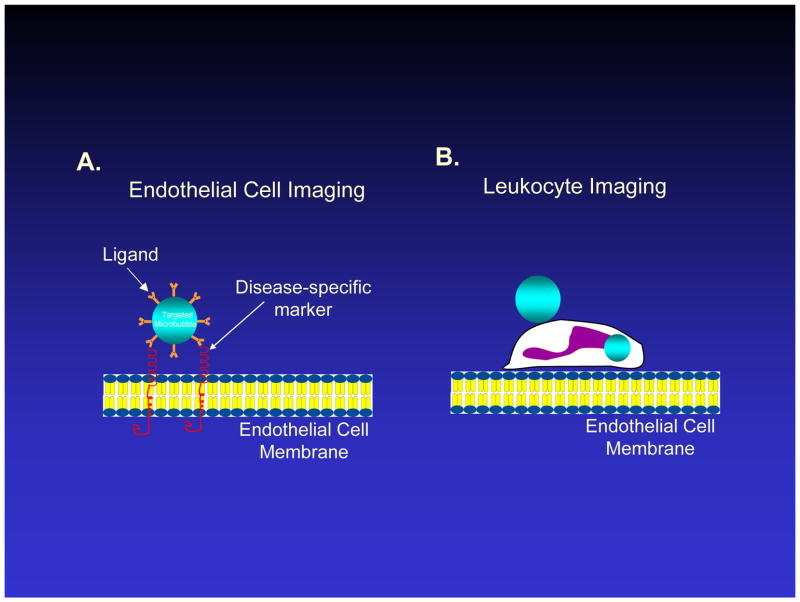
Figure 1
Figure 1
Schematic diagram of vascular endothelial lining and approaches for ultrasound molecular imaging in which ultrasound contrast agents, or microbubbles, adhere to endothelium. A. Microbubbles with a targeting ligand on their surface can bind specifically to a molecule overexpressed by endothelium in cardiovascular disease, such as a leukocyte adhesion molecule. B. Activated leukocytes may bind or phagocytose microbubbles, which remain acoustically active for a brief period of time, allowing ultrasound detection of leukocytes which have adhered to inflammatory endothelium. Figure not drawn to scale.
Figure 2
Figure 2
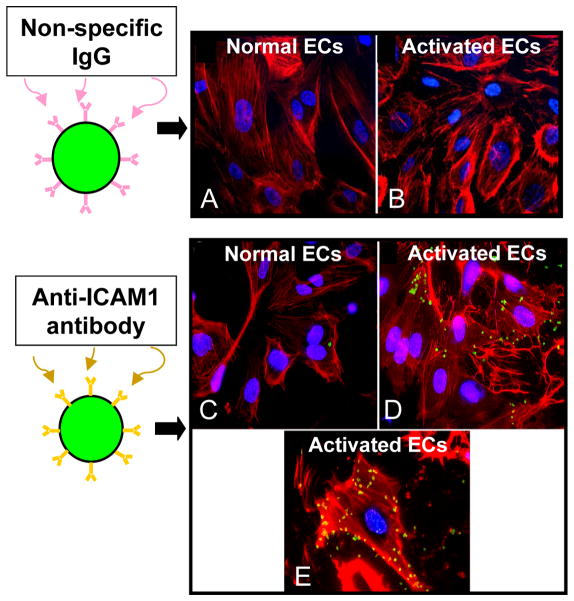
In vitro studies demonstrating proof of the concept that microbubbles can adhere to a biological surface via a specific targeting ligand. Fluorescent microbubbles (green) were conjugated to either non-specific IgG (control) or to antibody directed against intercellular adhesion molecule 1 (ICAM1) and allowed dwell with cultured human coronary artery endothelial cells (ECs, F-actin labeled with rhodamine, red). Control microbubbles did not adhere to cells at baseline (A) or after endothelial activation to overexpress ICAM1 (B). Anti-ICAM1 microbubbles adhered minimally to non-activated cells due to constitutive expression of ICAM1 (C), and adhered abundantly to activated endothelial cells (D). Panel E is a higher power image of a single activated cell to which multiple ICAM1-targeted microbubbles have adhered. Reprinted with permission from Ref
Figure 3
Figure 3
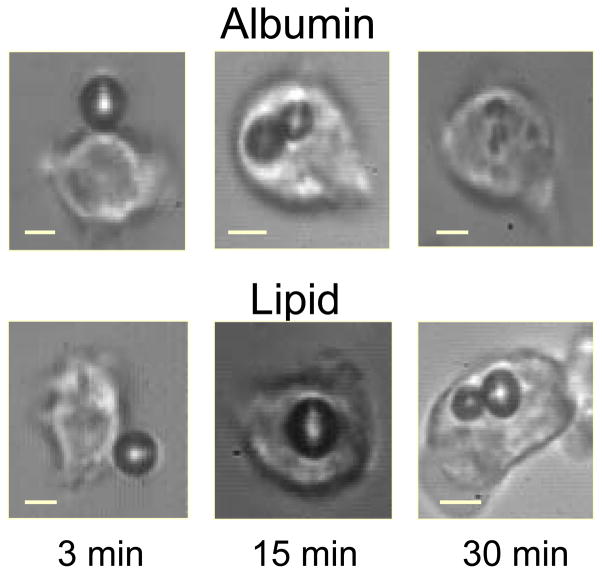
Photomicrographs demonstrating adhesion of microbubbles made of albumin or lipid shells to activated leukocytes 3 minutes after exposure, and the time course of subsequent phagocytosis. Reprinted with permission from Ref .
Figure 4
Figure 4
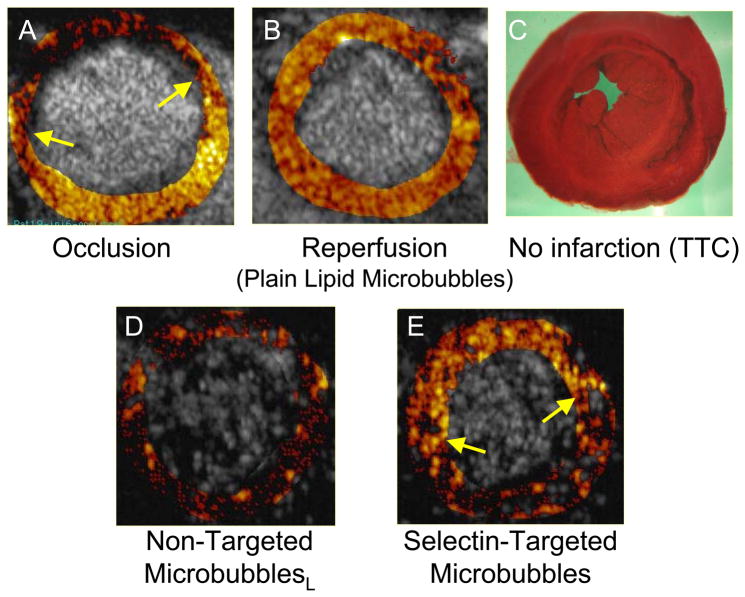
Ischemic memory imaging of myocardium using microbubbles targeted to bind to P-selectin in a rat model of 15 minute coronary occlusion/reperfusion. Short axis ultrasound images of left ventricular myocardium at mid-papillary muscle level are background subtracted, color-coded frames in which shades of red, progressing to orange, yellow, and white, indicate increasing contrast change. A. During coronary occlusion, there is a contrast defect corresponding to the risk area (region between arrows). B. After release of the coronary occlusion, myocardial contrast echo perfusion imaging with non-targeted lipid bubbles confirms reperfusion to the anterior wall. C. Post-mortem staining with triphenyl tetrazolium chloride (TTC) shows no infarction. D. During reperfusion, imaging after intravenous injection of non-targeted lipid bubbles bearing sialyl Lewisc as the control ligand, shows no evidence of persistent myocardial contrast enhancement. E. During reperfusion, imaging after intravenous injection of microbubbles targeted to P-selectin via sialyl Lewisx demonstrates persistent contrast enhancement in the area that was previously ischemic. Reprinted with permission from Ref .
Figure 5
Figure 5
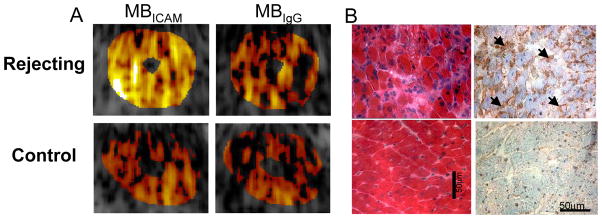
Detection of acute heart transplant rejection using ultrasound imaging of ICAM1 in rats with abdominal heterotopic heart transplantation. A. Each animal was separately administered microbubbles with anti-ICAM1 antibody (MBICAM, left panels) or isotope control non-specific IgG (MBCTL, right panels) on their surface. In the rejecting allografts (upper panels), MBICAM caused persistent contrast enhancement not seen after injection of MBCTL. In the non-rejecting isograft hearts (lower panels), there was no significant persistence of myocardial contrast enhancement after injection of either microbubble species. B. Histology of myocardium showing inflammatory infiltrate and ICAM1 (brown) on hematoxylin and eosin and immunohistochemical staining, respectively, in rejecting allograft (upper panels); this was not seen in control isograft myocardium (lower panels). Reprinted with permission from Ref .
Figure 6
Figure 6
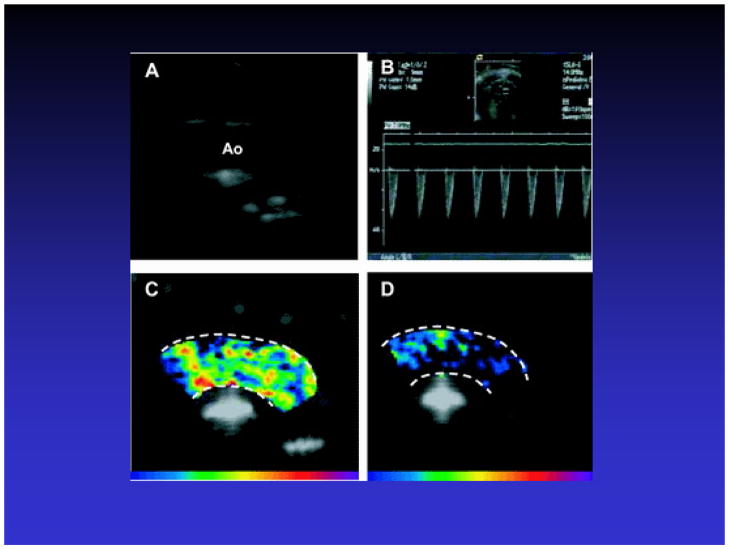
Ultrasound molecular imaging of early atherosclerosis in Apo E-deficient mice fed a high cholesterol diet. A. Two dimensional imaging of the aortic arch. B. Spectral Doppler imaging of the aortic arch. C. Ultrasound imaging 10 minutes after injection of microbubbles targeted to vascular cell adhesion molecule-1 (VCAM1) via an antibody directed against VCAM-1 demonstrates persistent contrast enhancement of the arch. D. Persistent contrast enhancement of the arch is not seen after injection of control microbubbles conjugated to an isotype control antibody. Reprinted with permission from Ref .
Figure 7
Figure 7
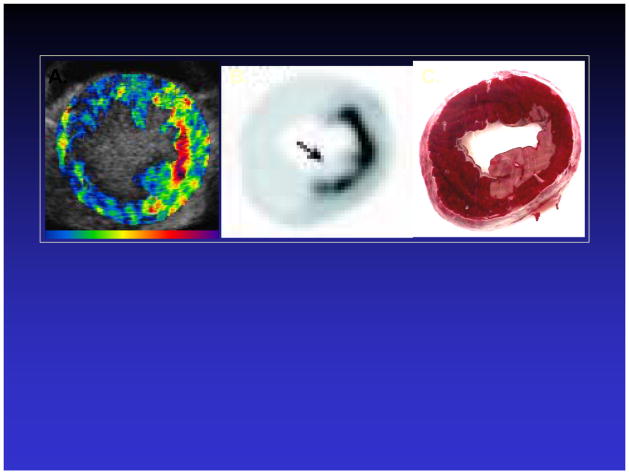
Inflammatory imaging of post-ischemic/infarcted canine myocardium using activated leukocytes, which have ingested microbubbles, as the molecular probe. A. During reperfusion, there is persistent contrast enhancement in the post-ischemic area. B. The region of enhancement in (A) spatially corresponds to areas of leukocyte activation as shown on autoradiography of isotope-labeled leukocytes (B). C. TTC- stained myocardial section demonstrating area of resulting infarction. Reprinted with permission from Ref .
Figure 8
Figure 8
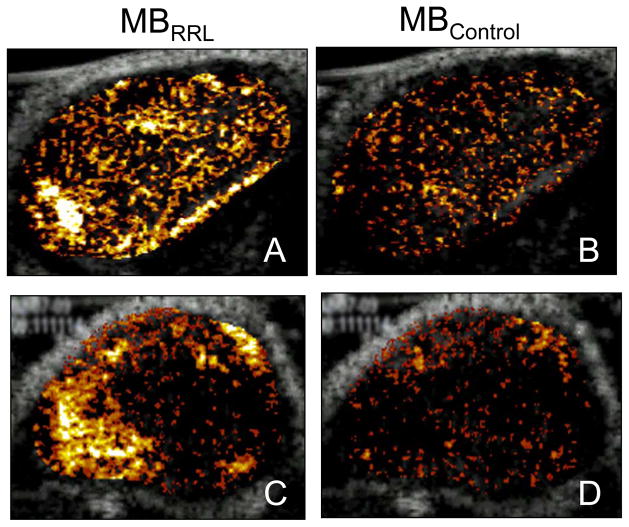
Ultrasound imaging of angiogenesis using a microbubble conjugated to the tripeptide sequence RRL (MBRRL). Control microbubble (MBCTL) has the sequence GGG on its surface. Nude mice bearing sarcoma (Clone C) (Panels A and B) or human prostate tumors (PC3) (Panels C and D) were imaged after injection of either MBRRL or MBCTL. There is persistent contrast enhancement of the tumors after injection of MBRRL (Panels A, C), which is not seen after injection of MBCTL (Panels B, D). Reprinted with permission from Ref .

References

    1. Skyba DM, Camarano G, Goodman NC, Price RJ, Skalak TC, Kaul S. Hemodynamic characteristics, myocardial kinetics and microvascular rheology of FS-069, a second generation echocardiographic contrast agent capable of producing myocardial opacification from a venous injection. J Am Coll Cardiol. 1996;28:1292–1300. - PubMed
    1. Huang S, Hamilton AJ, Nagaraj A, Tiukinhoy SD, Klegerman ME, McPherson DD, et al. Improving ultrasound reflectivity and stability of echogenic liposomal dispersions for use as targeted ultrasound contrast agents. J Pharmacol Sci. 2001;90(12):1917–26. - PubMed
    1. Demos SM, Alkan-Onyuksel H, Kane BJ, Ramani K, Nagaraj A, Greene R, et al. In vivo targeting of acoustically reflective liposomes for intravascular and transvascular ultrasonic enhancement. J Am Coll Cardiol. 1999;33:867–75. - PubMed
    1. Lanza GM, Abendschein DR, Hall CS, Marsh JN, Scott MJ, Scherrer DE, et al. Molecular imaging of stretch-induced tissue factor expression in carotid arteries with intravascular ultrasound. Invest Radiol. 2000;35:227–34. - PubMed
    1. Straub JA, Chickering DE, Hartman TG, Gloff CA, Bernstein H. AI-700 pharmacokinetics, tissue distribution and exhaled elimination kinetics in rats. International Journal of Pharmaceutics. 2007;328:35–41. - PubMed

Publication types